
A Hastings Farms landscape install starts with a piece of paperwork most homeowners don't expect: a Design Review Application to Trestle Management Group before a single yard of granite gets delivered. Hastings Farms doesn't post a single downloadable landscape spec sheet the way some newer Queen Creek master-plans do. It's a community that was built out in phases by two different builders, Cresleigh Homes and Lennar, over roughly two decades, and it sits alongside two separately-named, separately-governed neighbors, Hastings Farms Estates and Preserve at Hastings Farms. Before you draw a plan, the first real question is which HOA and which guideline document actually applies to your specific address.
We've run into this directly. A turf-and-paver layout that would clear review without a second look in Eastmark or Encanterra came back from a Hastings Farms submittal asking for a plot plan we hadn't prepared, because the reviewer needed to confirm which phase of the community the lot sat in before applying the right standard. Hastings Farms was established as an HOA in January 2006 and has grown out from there, which means the guidelines that governed an original 2013-era lot aren't automatically the same ones a 2021-era Creekside lot near Ellsworth Road and Chandler Heights Road falls under. This post covers what actually governs a Hastings Farms landscape install, what it costs, and how we handle the review process on every project we run in the community.
Hastings Farms landscape install projects need Design Review sign-off first
Every exterior landscape or hardscape change at Hastings Farms, turf swaps included, goes through the association's Design Review Committee before work starts. Trestle Management Group, the community's management company, runs this process the same way it does across its other managed HOAs: a homeowner (or their contractor) submits a Design Review Application describing the change, and the board or committee reviews it before work can begin. Trestle's own guidance is direct about the downside of skipping this step — proceeding without prior written approval can mean being required to remove or correct the work, on top of possible fines.
In practice, that changes how a project needs to be planned:
- Confirm which specific HOA covers your lot first. "Hastings Farms," "Hastings Farms Estates," and "Preserve at Hastings Farms" are related but distinct associations in the same immediate area, and a rule that applies to one doesn't automatically apply to the others.
- Because the community was built in phases by two different builders across roughly two decades, don't assume a neighbor's approved plan on an older section reflects the current standard on a newer one, or vice versa.
- A complete first submittal (plot plan, material notes, color selections) moves faster than a partial one that has to go back into the review queue.
We confirm the exact HOA and current guideline set with Trestle Management before we draw up any plan, so the plot plan and material notes we submit match what's actually being reviewed for that lot.
Why Hastings Farms' build-out history matters for a landscape install
Hastings Farms isn't a single-builder, single-phase subdivision. Cresleigh Homes and Lennar both built sections here, including Cresleigh's Creekside series near the corner of Ellsworth Road and Chandler Heights Road, with homes going up across a build window that runs from the early 2000s into the 2020s. That kind of multi-phase, multi-builder growth is common in Queen Creek, but it means the community's amenities (parks, playgrounds, walking paths, and a community pool, per the HOA's own listed features) and its lot sizes vary more than a single-phase community would. Some parcels here run 12,000–14,000+ sq ft, noticeably larger than the 6,000–8,000 sq ft lots common in newer Queen Creek master-plans, which directly changes how much turf, hardscape, and irrigation a full install actually needs.
The practical takeaway: a design that reads as generously scaled on a Creekside-series lot might look sparse on one of the community's larger original parcels, and vice versa. We measure the actual lot before pricing rather than quoting off a neighborhood average.
Turf and ground cover rules that hold up under review
Without a single published Hastings Farms spec sheet to cite line by line, the baseline that holds across every East Valley HOA we've submitted to under Trestle Management's process looks like this:
- Ground cover: decomposed granite in a blended, neighborhood-consistent tone is the default expectation for anything visible from the street or a common area. Rear yards not visible from those sightlines typically get more flexibility.
- Artificial turf: professional-grade synthetic turf with a clean hardscape or granite border reads as an intentional design choice to a review committee, where a turf patch dropped straight into gravel usually doesn't. Arizona's HB2131 (2022) guarantees your right to install artificial turf even where an HOA prefers natural grass, capped at 70% of total lot coverage across front, side, and rear yards combined — the Design Review Committee can still set standards for grade, color, and installation quality.
- Front-yard visibility: anything visible from the street or a shared walking path typically draws more scrutiny on color and edging than a fully enclosed rear yard, which is consistent with how most East Valley HOAs weight review.
Confirming which HOA actually governs your lot
This is the step that trips up more Hastings Farms homeowners than any specific landscape rule. Real estate listings and even some resident forums use "Hastings Farms" loosely to describe a broader pocket of Queen Creek that actually contains at least three separate associations: the original Hastings Farms HOA, Hastings Farms Estates, and Preserve at Hastings Farms. Each can carry its own management contact, its own fee schedule, and potentially different design standards, even though the communities sit next to each other and share a name.
Before finalizing any landscape plan, we verify with Trestle Management (or the relevant management company, if a different one covers a specific sub-association) exactly which HOA the lot in question falls under and pull that association's current design review requirements. Skipping this step and assuming one set of rules covers the whole area is the single most common reason a submittal gets sent back for correction.
Real cost of a Hastings Farms landscape install
Because lot sizes here run wider than a lot of newer Queen Creek communities, cost ranges track closer to our broader Queen Creek backyard cost guide than to a tight-lot community's numbers. Here's what we typically see, all-in with labor, base prep, and materials:
- Turf-only refresh (existing hardscape, replacing dead grass or aging turf): $5,000–$12,000 depending on square footage.
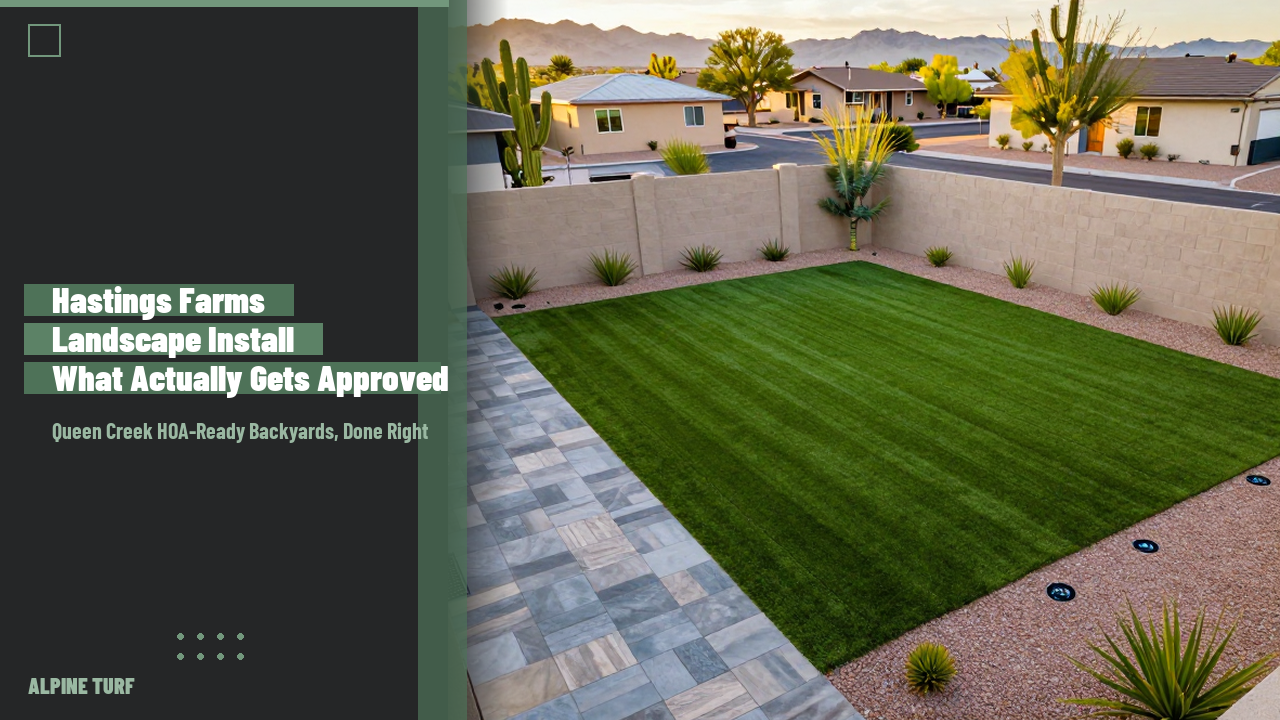
- Turf + paver patio + basic plant package: $12,000–$25,000, the most common scope on standard Hastings Farms lots.
- Full build-out (turf, extended pavers, ramada or pergola, irrigation, lighting): $25,000–$38,000, more common on the community's larger original-phase parcels.
- New-build dirt-to-done backyard (Creekside-series lots closing with a bare dirt yard): $18,000–$35,000 depending on scope, since these lots typically start with zero existing landscaping.
One Hastings Farms-specific line item: budget an extra $250–$500 if you want us to handle confirming the correct HOA, pulling current design review requirements, and preparing the submittal packet rather than doing that legwork yourself.
New-build lots: going from dirt to a finished backyard
If you closed on a newer section of Hastings Farms, particularly a Creekside-series lot, chances are your backyard is still builder-grade dirt. That's a different project than a remodel: there's no existing turf or hardscape to work around, but there's also no established grade, no irrigation stub-outs beyond what the builder ran to the front yard, and often a slab or block wall that hasn't been landscaped against yet. We plan irrigation sleeves, lighting conduit, and drainage direction into the base layout on these lots before any turf or pavers go down, since running conduit under finished hardscape later costs more than doing it once during initial install.
New-construction submittals also tend to move faster through Design Review than a remodel, since the association is reviewing a first landscape plan against baseline standards rather than evaluating a change to something already established.
Drainage, clay soil, and monsoon prep in Queen Creek
Queen Creek sits on the same heavy clay and caliche mix that causes standing water across the East Valley after a monsoon cell, and lot grading at Hastings Farms can't redirect water toward a neighbor or a common area — a standard expectation across every HOA we work in, but worth stating plainly since it's the most common reason a backyard floods a season after installation. The Town of Queen Creek's planning department tracks state legislation affecting HOA design review, which is worth a glance if a submittal ever stalls over a rule you can't find written down.
What actually works: a compacted crushed-granite base under turf and pavers instead of sand, which settles and creates low spots within a year or two; a slight positive grade away from the home; and drainage swales that move water to a catch basin or the street rather than letting it pool against a block wall. For a deeper look at how clay soil behaves under East Valley installs, see our clay soil yard problems guide for Queen Creek and our caliche soil landscaping breakdown.
Getting your Hastings Farms submittal approved the first time
A submittal that clears on the first pass starts with confirming the correct HOA for the lot, then includes a plot plan with dimensions for everything you're adding, material notes for turf and hardscape, and color selections for anything visible from the street or a common area. If a ramada, pergola, or built-in feature is part of the scope, dimension the setbacks directly on the drawing rather than describing them in a cover letter, and don't assume a neighbor's approved plan on a different phase of the community sets the standard for yours.
We handle the full submittal packet as part of every Hastings Farms landscape install: confirming which specific HOA governs the address, pulling the current design review requirements from Trestle Management, drawing the plot plan, and matching materials to what's recently cleared review in that section of the community. Homeowners who submit on their own most often lose time simply figuring out which association and which document actually apply, which is the one step we remove entirely.
Frequently asked questions
Does Hastings Farms allow artificial turf in the backyard?
Yes, with Design Review Committee approval on grade, color, and installation quality. Arizona's HB2131 (2022) prevents any HOA that allows natural grass from banning artificial turf outright, up to 70% of total lot coverage. Trestle Management's review process can still set standards for how it looks and how it's installed, which is why we submit material notes with every turf project here.
Is Hastings Farms the same HOA as Hastings Farms Estates or Preserve at Hastings Farms?
No. These are related but separate associations covering the same general area of Queen Creek. Confirm which specific HOA governs your address before assuming a rule, fee, or approval process applies. We verify this with Trestle Management (or the relevant management company) before drawing up any landscape plan.
How do I submit a landscape plan for Design Review at Hastings Farms?
Homeowners (or their contractor) submit a Design Review Application to Trestle Management Group describing the planned change, along with a plot plan and material notes. Trestle's process applies across its managed communities, and proceeding without prior written approval can mean being required to remove or correct the work, plus possible fines.
How much does a Hastings Farms landscape install cost?
Most standard Hastings Farms lots land between $12,000 and $25,000 for turf, a paver patio, and a basic plant package. A turf-only refresh starts around $5,000. New-build dirt-to-done backyards on Creekside-series lots typically run $18,000 to $35,000, and full build-outs on the community's larger original-phase parcels can run $25,000 to $38,000.
Why do lot sizes vary so much within Hastings Farms?
The community was built out in phases by two different builders, Cresleigh Homes and Lennar, across roughly two decades. Original-phase lots can run 12,000 to 14,000+ sq ft, while newer Creekside-series lots run smaller. That difference changes both the design and the cost of a full landscape install.
My backyard is still dirt from new construction. Where do I start?
Start with irrigation sleeves, lighting conduit, and grading before any turf or pavers go down, since running conduit under finished hardscape later costs more than planning it into the initial layout. New-construction landscape submittals also tend to move through Design Review faster than a remodel, since there's no existing landscaping to evaluate a change against.
Keep reading.
Ready to ditch the grass?
We install premium artificial turf across the East Valley: Gilbert, Chandler, Mesa, Queen Creek, San Tan Valley. Free on-site measure and quote, no obligation.
Book your free quote