
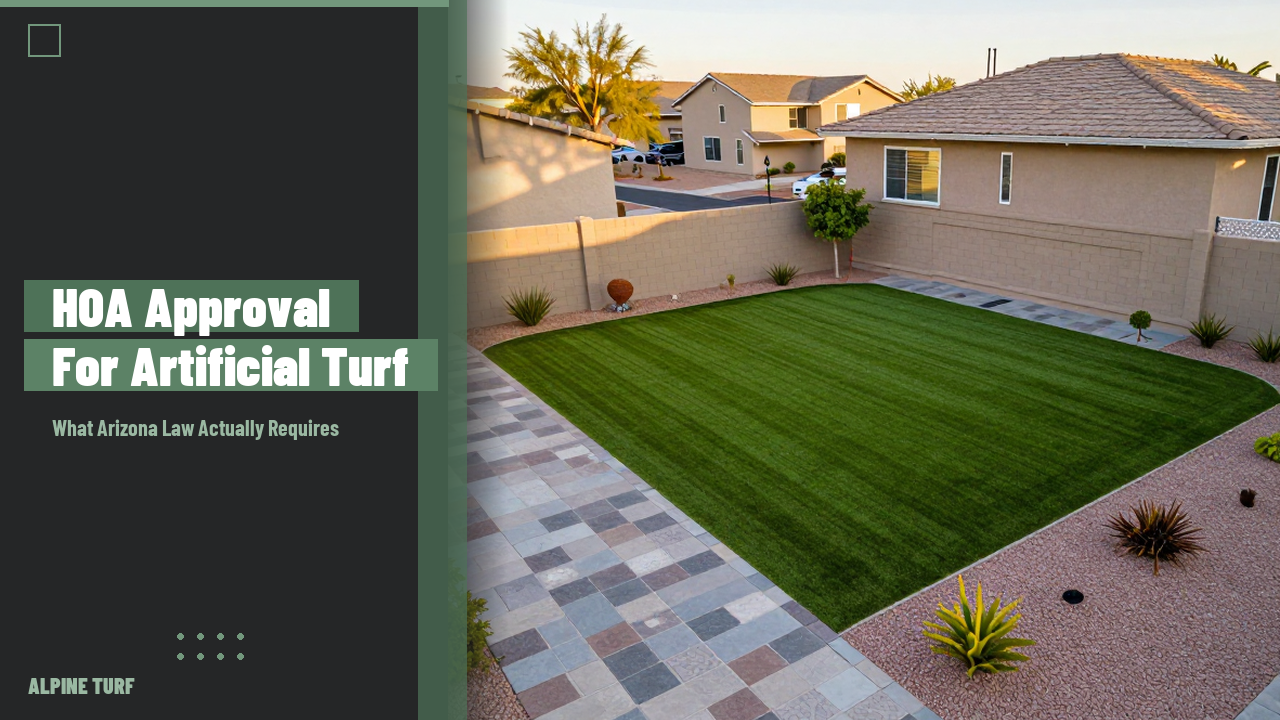
Every HOA-cluster post we write starts with the same phone call: a homeowner in Power Ranch or Ocotillo or Seville who already picked a turf product, already got a quote, and just found out their architectural review committee wants a submission package before a single roll of turf gets cut. Some of them assume the HOA can simply say no. A few assume the opposite, that Arizona law means turf gets a rubber stamp no matter what. Neither is right, and getting it wrong costs real time on a project that otherwise takes two days to install.
Here is what the law actually changed in 2022, what your HOA is still allowed to require, what a submission package that gets approved on the first pass looks like, and where East Valley communities differ enough that you cannot assume your neighbor's approval means yours is automatic.
HOA Approval for Artificial Turf Arizona: A.R.S. §33-1819
Governor Ducey signed House Bill 2131 into law on March 30, 2022, and it took effect September 24, 2022, adding a new section, A.R.S. §33-1819, to the statutes that govern Arizona planned communities. The core rule is narrow but important: in any planned community where an owner is currently allowed to have natural grass on their lot, the association cannot prohibit that owner from installing or using artificial turf instead.
Three limits matter as much as the rule itself. First, it only applies to planned communities governed under Title 33, Chapter 16 of Arizona law, which covers the vast majority of East Valley HOA-governed subdivisions, but the statute explicitly does not apply to condominiums, which are governed under a separate chapter. Second, it protects turf on a member's own lot, not common areas the association itself maintains or irrigates; an HOA can still landscape its own entryways, medians, and clubhouse grounds however it wants. Third, and this trips people up constantly, the law only kicks in where natural grass is already permitted. If your community's governing documents ban natural turf grass entirely in front yards (increasingly common in newer xeriscape-mandated communities like parts of Eastmark or Cadence at Gateway), the association is not required to allow artificial turf there either, because the underlying right to grass never existed in the first place.
The other piece of HB2131 that rarely gets mentioned: Arizona law requires a court to award attorney fees to whichever side wins a dispute brought under this statute. That cuts both ways. An HOA that denies a clearly compliant turf application in bad faith is exposed to a homeowner's legal fees if it loses. But a homeowner who ignores a legitimate appearance requirement and sues anyway can end up paying the HOA's fees instead. It is not a blank check for either side, which is exactly why the submission process below matters more than the statute itself.
What your HOA can still require
HB2131 explicitly preserves an association's right to adopt "reasonable rules and regulations regarding the installation and appearance of artificial turf." In practice, across every East Valley community we have submitted applications to, that authority shows up in four recurring places:
- Coverage limits. Most HOAs cap artificial turf at whatever percentage of the landscapable area natural grass was already limited to, commonly somewhere between 25% and 50% of the front yard depending on the community's design guidelines.
- Product and quality standards. Face weight, pile height, color blend (a flat, single-shade green reads as artificial from the street; a multi-tone blend with tan thatch does not), UV stabilization, and infill type are all fair game for an HOA to specify.
- Installation standards. A visible seam, an unedged border, or turf that does not meet grade at the sidewalk is a legitimate rejection reason in almost every ARC packet we have seen, because it is functionally the same as any other landscaping install standard the HOA already enforces.
- Ongoing maintenance. An association can require turf be kept clean, brushed, and free of matting or fading, and can require removal or replacement if it falls into visible disrepair. This is not a workaround to the anti-ban rule; it is a maintenance standard, the same category of rule that already applies to a poorly kept natural lawn.
What an HOA cannot do is deny an application outright because the board simply prefers real grass, or apply a rule to artificial turf that it does not apply equally to natural grass in the same location. If your neighbor's natural lawn is allowed to cover 100% of the front yard but the HOA tries to cap your turf at 20%, that mismatch is worth raising directly with the management company before you accept the lower number.
Building an ARC-ready submission package
Almost every rejection or delay we have walked a homeowner through traces back to an incomplete packet, not a denied concept. Architectural review committees move fast on applications that answer their questions before they ask, and slow on ones that force a back-and-forth. A submission that clears on the first pass typically includes:
- Product specification sheet. Manufacturer name, face weight (ounces per square yard), pile height, backing type, and infill material. If the HOA's guidelines specify minimums, as Ocotillo's do down to the ounce, your spec sheet needs to show the product clears every listed threshold, not just come close.
- Site plan with dimensions. A drawn or measured plan showing exactly where turf will be installed, its square footage, and what percentage of the total landscapable area that represents. This is the single most common missing item; verbal estimates ("about half the front yard") get bounced back for an actual number.
- Physical or photo sample. Many committees want to see the actual blade color and texture in hand, not a stock photo from a manufacturer's website. A physical swatch clipped to the application avoids a scheduling delay while the committee requests one separately.
- Installer information and warranty. Some East Valley HOAs (Ocotillo again is explicit about this) require the installer be a licensed Arizona contractor and that a manufacturer warranty of a minimum length, often eight years, accompany the application. Even where it is not required, including it removes a reason for the committee to ask a follow-up question.
What this looks like across East Valley HOAs
The single biggest mistake we see is a homeowner assuming their community's rules mirror a neighboring one because both communities are in Gilbert or Chandler. They rarely do, and the way each HOA publishes (or does not publish) its rules varies just as much.
Power Ranch in Gilbert publishes its full Design Guidelines as a public PDF at mypowerranch.com, no login required. Las Sendas in Mesa does the same through its own "Modify My Home" portal, spelling out a front-yard turf cap of 25% of the landscape area and a required 4-inch masonry or concrete header (rock, railroad ties, and plastic edging are all explicitly rejected as turf borders). Ocotillo in Chandler goes further still, publishing exact turf specs down to minimum face weight, infill poundage per square foot, and warranty length. If you live in one of these three, the published guideline is your starting checklist, and there is no excuse for submitting an incomplete package.
Other communities do not work this way at all. Seville in Gilbert keeps no public design guidelines document; residents have to request the current ARC packet directly from the management office. Some Sun Lakes sub-associations in Chandler publish detailed artificial turf specification sheets, while others in the same 55-plus community have no public document at all, which means "Sun Lakes allows this" is not a safe assumption without knowing which of the three separate HOAs actually governs your specific lot. The honest answer, and the one we give every homeowner regardless of which community they are in, is that we pull the current guidelines directly from the management office as part of every quote rather than relying on what a search result or a neighbor's memory says the rule used to be. Guidelines get amended, and a PDF dated two years ago is not proof of what the ARC will approve today.
Common rejection reasons and how to avoid them
Beyond an incomplete packet, a handful of specific issues account for most of the turf applications that come back for revision across the communities we work in:
- Coverage that exceeds the stated cap, usually because the homeowner measured the whole yard instead of just the landscapable area as the HOA defines it (planter beds, walkways, and driveway aprons are typically excluded from the calculation).
- A border material the HOA has specifically prohibited, most commonly loose rock, wood edging, or plastic landscape edging where a masonry or concrete header is required.
- A single-tone, uniformly bright green product that reads as artificial from the street. Committees that have seen enough applications can usually tell at a glance, and a multi-tone blend with a tan or brown thatch layer clears review far more consistently.
- No stated maintenance plan in communities that require one as a condition of approval, even though maintenance is genuinely simple (a quarterly brush and rinse is standard).
- Missing installer licensing information in the handful of HOAs, Ocotillo among them, that require a licensed AZ contractor on the application.
None of these are arbitrary. Every one of them maps to a documented standard we have seen an association actually enforce, which is why we build every quote around the specific HOA's current published rules or, where none exist publicly, around a direct call to the management office before the proposal goes out.
If your HOA denies or ignores your application
A denial based on a legitimate, evenly applied rule (coverage percentage, border material, product quality) is enforceable and worth fixing rather than fighting. A denial based on nothing more than board preference for natural grass, on the other hand, runs directly into A.R.S. §33-1819. Before escalating, put the request in writing if it was not already, reference the statute by section number, and ask the board in writing to identify which specific, previously published rule your application fails to meet. Associations that cannot point to one are on thin ground, and a written record matters if the dispute ever reaches Arizona's HOA dispute process through the Department of Real Estate or, in rarer cases, small claims court, where the statute's fee-shifting provision applies.
Most disputes never get that far. In our experience, the vast majority resolve once the homeowner resubmits with the specific documentation the ARC actually asked for, which is the entire reason we treat the submission package, not the legal argument, as the thing worth getting right the first time.
Frequently asked questions
Can an Arizona HOA legally ban artificial turf?
No, not outright, as long as the community currently allows natural grass on that lot. A.R.S. §33-1819, created by HB2131 and effective September 24, 2022, bars planned-community HOAs from prohibiting artificial turf where natural grass is permitted. The law does not apply to condominiums, and it does not require an association to allow turf in areas where natural grass was already prohibited, such as many mandatory-xeriscape front yards in newer East Valley communities.
What can my HOA still require for artificial turf approval?
Reasonable rules on quality, appearance, installation, location, and the percentage of the lot that can be covered, typically matched to whatever limit natural grass already carries. Associations can also require removal if the turf falls into disrepair or creates a documented maintenance or safety issue. What they cannot do is deny an application simply because the board prefers natural grass.
Does every East Valley HOA publish its turf guidelines online?
No. Some, like Power Ranch, Las Sendas, and Ocotillo, publish detailed public design guideline PDFs. Others, including Seville in Gilbert, only provide the current ARC packet through the management office on request. Some larger communities are actually split across multiple separate HOAs with different rules, so never assume your rules match a neighboring or similarly named community without confirming directly.
What should I include in an HOA turf submission package?
A product specification sheet with face weight, pile height, and infill type; a dimensioned site plan showing exact coverage and the percentage of the landscapable area affected; a physical or photo sample of the actual product; and, if your HOA requires it, proof of a licensed Arizona installer and manufacturer warranty length. Packages missing any of these are the most common reason for a delayed approval.
What happens if my HOA denies a compliant turf application?
Request in writing that the board identify the specific, previously published rule the application fails to meet. If the denial is not grounded in a legitimate, evenly applied standard, it may run afoul of A.R.S. §33-1819, and Arizona law requires courts to award attorney fees to the prevailing party in a dispute under this statute. This is general information, not legal advice; homeowners in an active dispute should consult an attorney familiar with Arizona planned-community law.
Does the artificial turf HOA law apply to condominiums?
No. A.R.S. §33-1819 applies specifically to planned communities under Title 33, Chapter 16 of Arizona law. Condominium associations are governed under a separate chapter and are not covered by this statute's turf protections.
Keep reading.
Ready to ditch the grass?
We install premium artificial turf across the East Valley: Gilbert, Chandler, Mesa, Queen Creek, San Tan Valley. Free on-site measure and quote, no obligation.
Book your free quote