
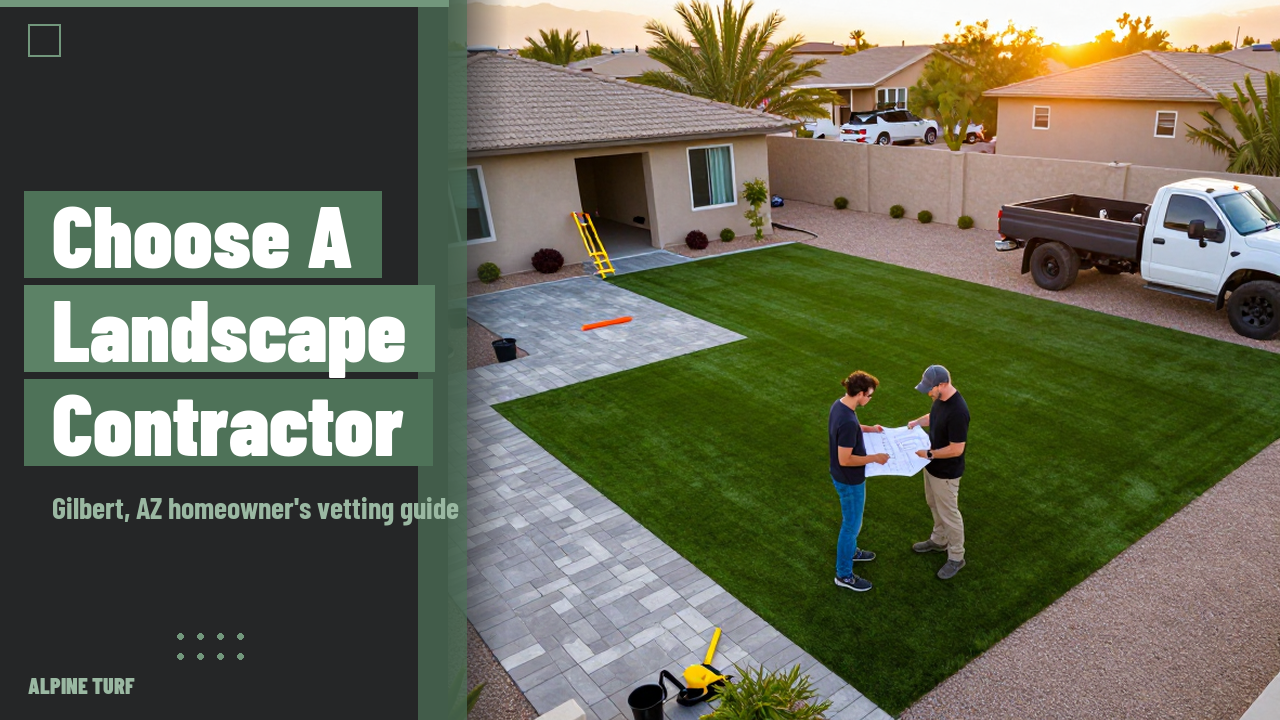
Gilbert's backyard remodel market runs hot for a reason. Communities like Power Ranch, Seville, Cooley Station, Val Vista Lakes, Adora Trails, and the neighborhoods inside Morrison Ranch put homeowners on newer lots with real square footage to work with, and after a decade or more in the house, plenty of those yards are overdue for a paver patio, a turf conversion, or a full outdoor living rebuild. That demand also draws crews who are not equipped to meet it: subcontracted labor working under someone else's license, door-to-door solicitors canvassing neighborhoods right after a monsoon knocks down a block wall, and handshake deals with no scope of work in writing.
Most of the damage from a bad hire in Gilbert does not show up as shoddy pavers. It shows up as an HOA violation notice six months later, a permit that was never pulled catching up with you at resale, or a deposit that walked off with a contractor who was never actually licensed to take the job. This guide walks through the exact steps we tell Gilbert homeowners to run before they sign anything, in the order that actually protects you.
Why the wrong contractor costs more than the estimate
A backyard remodel in Gilbert is not a small purchase. Full family builds commonly run $30,000 to $55,000, and custom outdoor living projects with kitchens, ramadas, and multiple hardscape zones regularly clear $70,000. At that price, the difference between a properly licensed, insured contractor and an unlicensed crew working out of a pickup truck is not a matter of polish. It is the difference between a project with legal recourse if something goes wrong and one with none.
The most common failure pattern we see homeowners walk into is not outright fraud, it is scope creep from an underqualified crew: a contractor who is genuinely skilled at laying pavers but has never run irrigation sleeves under a driveway, has no relationship with Gilbert's permitting office, and does not know that the Town requires a site plan for a solid-roof ramada. The work looks fine until the first monsoon exposes a drainage problem, or the HOA architectural committee flags a project that was never submitted for approval in the first place. Fixing that after the fact costs more than doing it right the first time, and by then the contractor who caused the problem is often unreachable.
Step 1: Verify the AZ ROC license before anything else
Every contractor bidding on hardscape, paver, or irrigation work in Gilbert needs an active license from the Arizona Registrar of Contractors. For landscape and hardscape work specifically, the relevant classification is CR-21, Hardscaping and Irrigation Systems, which covers both the commercial C-21 and residential R-21 scopes of work under a single dual license. Some contractors instead hold the standalone C-21 or R-21 version. All three require a minimum of 4 years of hands-on or managerial field experience and passing both the Statutes and Rules exam and a trade-specific exam before the state issues the license.
None of that shows up on a business card. The only way to actually confirm it is to look the license up yourself at roc.az.gov, where you can search by license number or company name and see the classification, whether it is active, and whether there is a history of complaints or disciplinary action. ROC's own guidance for homeowners is direct on this point: call the Registrar of Contractors to confirm a license rather than taking a salesperson's word for it, and if you are negotiating with someone other than the license holder, call the number on the ROC record to confirm they are an authorized representative of that licensed company. A surprising number of Gilbert leads get sold by one company and subcontracted to a second crew that has nothing to do with the license quoted on the estimate.
This step also protects you financially in a way most homeowners do not realize until they need it. Licensed residential contractors in Arizona are backed by the state's Residential Contractors' Recovery Fund, which exists specifically to reimburse homeowners when a licensed contractor fails to honor a judgment against them. Hire someone unlicensed and that protection does not exist. There is no fund standing behind a handshake deal.
Step 2: Confirm insurance, not just a license number
A license number tells you a contractor is legally qualified to do the work. It does not tell you what happens if a worker gets hurt on your property or if a piece of equipment damages your block wall or your neighbor's fence. Before any crew starts on your Gilbert property, ask for a current certificate of insurance showing general liability coverage, and ask specifically whether the crew doing the physical labor is covered by workers' compensation, either through the contractor directly or through a properly insured subcontractor.
This matters more on hardscape and outdoor living projects than most homeowners expect, because the work often involves trenching for irrigation and electrical, operating small excavation equipment, and working with saws to cut pavers and travertine. An uninsured worker injured on your property during that kind of work can, in some circumstances, become a liability the homeowner has to sort out directly. Asking to see the certificate before the contract is signed, not after the crew shows up, is the only way to confirm this before it becomes your problem.
Step 3: Find a landscape contractor in Gilbert who already knows the town
Licensing and insurance get you a legally qualified contractor. They do not tell you whether that contractor actually understands how projects move through Gilbert specifically, which is where a lot of otherwise-competent installers from outside the East Valley slow projects down or run into avoidable HOA rejections.
A contractor with real Gilbert experience should be able to speak specifically to your neighborhood's architectural committee process without you prompting them. Power Ranch, Seville, Cooley Station, Val Vista Lakes, Adora Trails, and the various Morrison Ranch communities each run their own HOA design review with their own plant palettes, hardscape material restrictions, and turf square footage limits, and submission packages that work for one community do not automatically satisfy another. Ask a candidate contractor directly: how many projects have you completed in this specific neighborhood, and do you have a design submission you can show me that this HOA already approved? A contractor who has actually worked in your community should be able to answer both questions immediately, not promise to "figure it out."
The same local-knowledge test applies to permitting. Gilbert's Development Services department requires a permit and site plan for any ramada or pergola with a solid, permanent roof, and for retaining walls that exceed 4 feet measured from the bottom of the footing to the top of the wall, not from grade. Gas line work for an outdoor kitchen or fire feature is also a listed permit type on the Town's own miscellaneous permit application. A contractor bidding a project with any of these elements should already know this and should be pulling the permit as part of the scope, not treating it as a surprise you discover later. If you are comparing a straightforward turf-and-paver-patio quote against one that includes a full ramada and outdoor kitchen, see our Gilbert backyard cost breakdown for how those tiers typically scale, and our travertine pavers cost and heat guide if hardscape material choice is part of your decision.
Step 4: Get a real written contract, not a one-page estimate
Arizona law requires that any residential construction contract over $1,000 include specific information in writing: the contractor's license number, a description of the work, the total contract price, and the dollar amount of any deposit. A one-page estimate scrawled on letterhead with a total price and nothing else does not meet that bar, and it leaves you with almost nothing to point to if a dispute comes up later. A contract worth signing should spell out:
- An itemized scope of work: exact square footage of turf and hardscape, specific paver or travertine product names (not just "pavers"), plant counts and species, irrigation zones, and any structures
- A payment schedule tied to project milestones, not a single lump sum
- Named brands and grades for turf, infill, and hardscape materials, so you know exactly what is being installed
- A written change order process for anything added or altered mid-project
- Warranty terms in writing, both on materials and on labor
- A realistic start date and completion window
On the deposit specifically: Arizona law limits what a licensed residential contractor can collect upfront to one-third of the total contract price or $1,000, whichever amount is smaller. That means on a $30,000 backyard remodel, a compliant deposit tops out at $1,000, not $10,000. Contractors can build in additional early payments tied to specific milestones like material delivery or the start of hardscape work, but a large lump sum requested before any work begins is a documented legal red flag, not just an aggressive but acceptable business practice.
Step 5: Six questions to ask before you sign
Beyond license, insurance, and contract terms, the way a contractor answers a short set of direct questions tells you almost everything else you need to know:
- Will your own crew do the work, or is this subcontracted? Either can be fine, but you need to know who is actually on your property and whether they are covered under the same insurance and license you verified.
- Who is my point of contact once the deposit is paid? A named project manager with a direct phone number is a good sign. "Someone from the office will call you" is not.
- Will you handle the HOA submission, or is that on me? On a project in a Gilbert HOA community, this should be part of the scope, not an assumption either side makes silently.
- Who pulls the permit if my project needs one? For anything involving a solid-roof structure, a tall retaining wall, or gas line work, this needs a clear, named answer before the contract is signed.
- What is the realistic timeline from signed contract to walk-through, including material lead times? Vague answers here often mean the contractor is juggling more projects than their crew can actually handle.
- What happens if something under the surface, like an unexpected irrigation line or a caliche layer, changes the scope mid-project? The answer should point back to the written change-order process in the contract, not a shrug.
Red flags that should end the conversation
Some warning signs are worth ending a conversation over immediately, before you invest more time getting a full quote:
- Door-to-door solicitation after a storm. Reputable Gilbert installers do not need to canvas neighborhoods after monsoon damage looking for panicked homeowners.
- Cash-only payment or a request to pay a supply house directly "to save on tax." This routes around the paper trail a written contract is supposed to create.
- No fixed business address, or a business address that turns out to be a UPS box. A licensed contractor with real overhead has a real location.
- Pressure to sign the same day with a discount that expires at midnight. Real contractors do not need artificial urgency to close a five-figure sale.
- A deposit request above the legal one-third or $1,000 cap. This alone is enough to walk away.
- No references, or references who cannot be reached. Ask for at least two completed Gilbert-area projects you can call directly, not just look at photos of.
What working with Alpine Turf looks like
We run every Gilbert project the way this guide describes, because it is also how we would want a contractor to treat our own backyard. That means a licensed AZ ROC contractor on the paperwork, current general liability and workers' compensation coverage on file before a crew sets foot on your property, and a written, itemized contract with named materials and a milestone-based payment schedule, never a lump-sum deposit above what state law allows.
- A free on-site design consult with a project manager who measures your specific lot, not a phone estimate
- HOA submission handled as part of the scope for Power Ranch, Seville, Cooley Station, Val Vista Lakes, Adora Trails, and every other Gilbert community we work in
- Permit coordination with Gilbert Development Services whenever a ramada, tall retaining wall, or gas line is part of the design
- One project manager and one crew from grading through final irrigation programming, not a chain of subcontractors you have to coordinate yourself
- A written warranty on both materials and labor before we ask for a dime
If you are earlier in the process and still comparing what a full remodel actually costs, our Gilbert backyard cost guide breaks down real 2026 pricing tiers, and if a grass-to-turf conversion is part of your plan, the Gilbert grass removal incentive guide covers what the Town and SRP currently pay toward that portion of the project.
Frequently asked questions
How do I verify a landscape contractor's license in Gilbert, AZ?
Look the contractor up directly at roc.az.gov using their license number or company name, which shows the classification (CR-21, C-21, or R-21 for hardscape and irrigation work), whether the license is active, and any complaint or disciplinary history. The Arizona Registrar of Contractors also recommends calling the number listed on the license record to confirm that the salesperson quoting your project is an authorized representative of the licensed company, not a separate unlicensed crew working under someone else's name.
How much can a landscape contractor legally ask for as a deposit in Arizona?
Arizona law caps the advance deposit a licensed residential contractor can collect before work begins at one-third of the total contract price or $1,000, whichever amount is smaller. On a $30,000 Gilbert backyard remodel, that means a legal deposit tops out at $1,000. Additional payments tied to specific milestones, like material delivery or the start of hardscape installation, are normal; a large lump sum requested upfront is not.
Does a Gilbert landscape contractor need a permit for a pergola or outdoor kitchen?
Yes, in most cases. The Town of Gilbert requires a permit and site plan for any ramada or pergola with a solid, permanent roof, for retaining walls over 4 feet measured from the bottom of the footing, and for gas line installations tied to an outdoor kitchen or fire feature. A straightforward turf and paver patio project without any of those elements often does not require a permit, but a full outdoor living build usually does. Confirm directly with Gilbert Development Services if you are unsure what your specific scope requires.
What is the difference between a C-21, R-21, and CR-21 contractor license?
All three are Arizona ROC Hardscaping and Irrigation Systems classifications. C-21 covers commercial-scope work, R-21 covers residential-scope work, and CR-21 is a dual license that allows both. All three require a minimum of 4 years of hands-on or managerial field experience and passing the Statutes and Rules exam plus a trade exam. For a homeowner hiring for a residential backyard project, either an R-21 or CR-21 license is what to look for.
What happens if I hire an unlicensed landscape contractor in Gilbert?
You lose the legal protections that come with hiring a licensed contractor, including the backing of Arizona's Residential Contractors' Recovery Fund, which reimburses homeowners when a licensed contractor fails to honor a judgment against them. There is no equivalent fund or state oversight for unlicensed work. If the job is done poorly, done without required permits, or the contractor disappears mid-project, a homeowner's recourse is far more limited and expensive to pursue than it would be with a licensed contractor.
How many bids should I get before choosing a landscape contractor?
The Arizona Registrar of Contractors recommends getting written estimates from at least three contractors before deciding. Comparing three itemized bids side by side is the fastest way to spot a suspiciously low quote that is missing a real scope of work, such as skipped base prep, drainage, or haul-off, versus one that reflects the actual cost of doing the job correctly.
Keep reading.
Ready to ditch the grass?
We install premium artificial turf across the East Valley: Gilbert, Chandler, Mesa, Queen Creek, San Tan Valley. Free on-site measure and quote, no obligation.
Book your free quote