
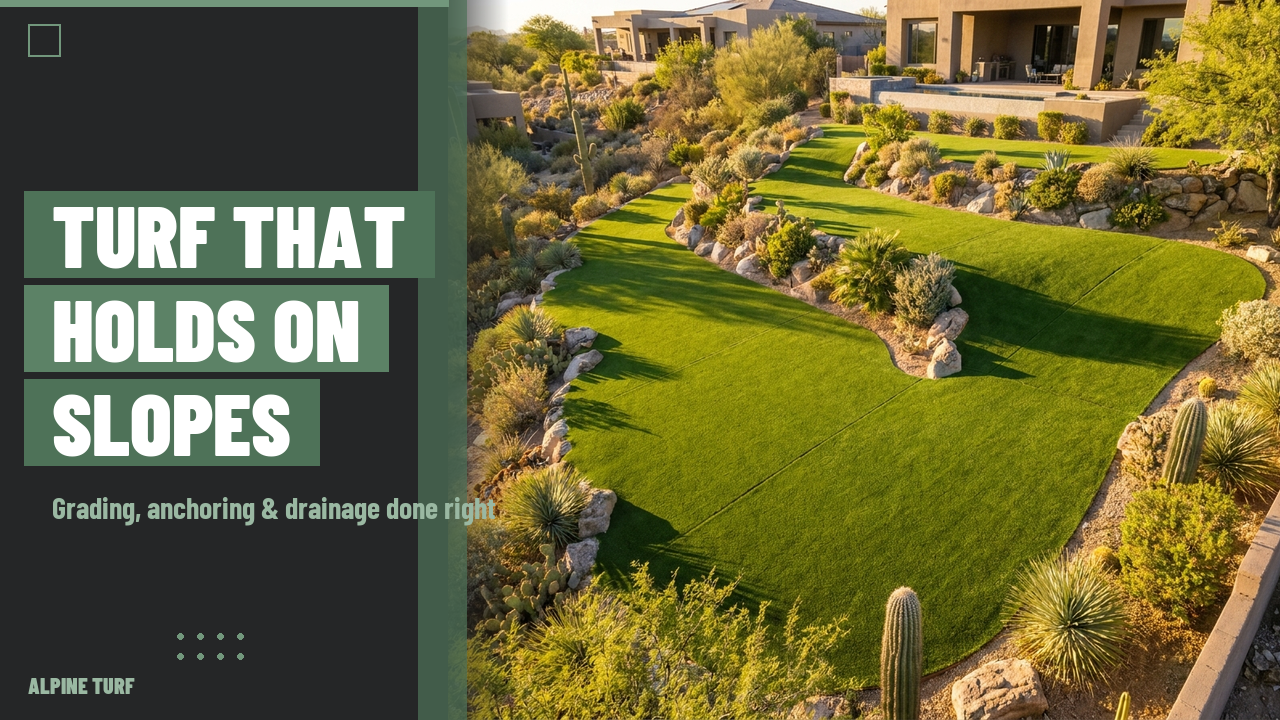
Every slope conversation starts the same way. A homeowner in Las Sendas or Encanterra walks us to the back corner of the yard where the grade drops toward a wash or a lower patio level and asks whether artificial turf on slopes arizona installers actually handle is real, or just a sales pitch to close a harder job. It's real, and East Valley yards make the question come up constantly. Graded pads step down from a covered patio. Side yards slope toward a block wall. Corner lots sit against wash easements, and acreage properties in Queen Creek and San Tan Valley often never had the natural grade flattened to begin with.
Turf on a slope is not the same install as turf on a flat pad, and treating it like one is where most DIY jobs, and a fair number of contractor jobs, fail within a year. The base moves, nails pull loose, infill migrates downhill with every monsoon storm, and a seam that looked fine in April is gapped open by August. None of that is inevitable. It just requires grading, anchoring, and seaming decisions a flat-yard install never has to make.
Artificial Turf on Slopes Arizona: How Steep Is Too Steep?
The question we actually answer on-site is simple: what's the grade, measured as a ratio or a percentage, not just "it's pretty steep." A 3:1 slope, meaning 1 foot of vertical drop for every 3 feet of horizontal run, works out to roughly 33%. That's the rough ceiling where standard turf installation methods, tightened up with extra anchoring and the right base work, hold reliably over time without a retaining structure.
Between flat and 3:1, the install gets progressively more deliberate but doesn't change in kind: more compaction passes, tighter nail spacing, careful seam orientation. Past 3:1, into 2:1 (50%) territory, we start talking about geogrid stabilization, terracing the slope into two or more level sections connected by a short retaining wall, or both. Past 2:1, turf alone isn't doing the structural work anymore; that's a hardscape and grading conversation before it's a turf conversation.
A few East Valley conditions push a slope into "measure it, don't guess it" territory faster than homeowners expect. Graded pads behind newer construction in Eastmark and Cadence at Gateway step down from the patio slab in increments that read as gentle from the house but measure steeper than they look once you're standing at the bottom. Wash-adjacent lots in Queen Creek and San Tan Valley often have engineered slopes tied to a drainage easement, which means the grade isn't yours to change even if you wanted a gentler pitch. And older Mesa and Chandler lots with sloped side yards toward a block wall sometimes carry decades of settled fill that isn't compacted the way a fresh grade would be, which changes what the base needs before turf goes down at all.
We measure every sloped section with a laser level or an inclinometer before quoting it, not for drama, but because "steep" and "3:1" are two different conversations, and only one of them tells you what the install actually needs.
Grading and Base Compaction on an Incline
Base work is where a sloped install lives or dies, and it's also where corners get cut because it's invisible once the turf is down. On flat ground you excavate to depth, lay and compact aggregate base in one or two passes, and move on. On a slope, that same shortcut leaves loose material sitting on an incline with nothing holding it there but friction, which monsoon rain and gravity both work against from day one.
The fix is compacting in horizontal lifts rather than trying to compact a sloped surface directly. Each lift, typically 2 to 3 inches of crushed aggregate base, gets spread level, compacted to the target density, then the next lift goes down on top of that. Stacking level lifts up a slope, rather than dumping and grading loose material at an angle, is what keeps the base from creeping before the turf is even installed.
Underneath that base, a woven geotextile fabric matters more on a slope than almost anywhere else on a property. It separates the base aggregate from the native soil so decomposed granite and fill material don't migrate downhill through the base over repeated monsoon cycles, which is exactly how a compacted base slowly turns into a soft, uneven one a year or two after install. On East Valley caliche soil, which sheds water fast once you're past the hardpan layer, that separation layer earns its keep every time a storm rolls through.
For grades past roughly 15 to 20%, we'll also add a lightweight geogrid or cellular confinement layer within the base itself, the same category of product used for erosion control on highway embankments, scaled down for a residential slope. It's not needed on a gentle 5 to 10% grade transitioning off a patio, but it earns its cost on anything approaching that 3:1 range, because it's the difference between a base that stays put and one that slowly slides toward the toe of the slope over a few summers.
Anchoring Turf on a Slope: Nail Patterns and Spacing
On flat ground, we run galvanized turf nails on roughly 6-inch centers around the perimeter and on a wider field grid, often 12 to 18 inches. That spacing assumes the turf isn't fighting gravity, just holding flat against a compacted base. A slope changes that math.
On an incline, perimeter spacing tightens to 4 to 5 inches, and it stays tight the entire way up the grade, not just at the top and bottom edges. The top edge of a slope carries the most tension, since that's where the turf is being pulled downhill by its own weight plus infill weight, so we'll often run a doubled row of anchors along the top transition line where turf meets a flat section or a hardscape border. The toe of the slope gets the same treatment, anchored into a header board, bender board, or paver edge restraint so the bottom edge has something more rigid than compacted base to nail into.
Field anchoring also tightens on a slope, typically down to an 8 to 10-inch grid instead of the wider spacing used on flat turf. It's more nails and more labor, and it's also the single biggest reason a sloped install that looks fine in the first month either holds for a decade or starts rippling and creeping by the following summer.
Nail length matters as much as spacing. Standard 6-inch galvanized nails work through compacted base on most East Valley soil. On looser fill or sandy sections, common in newer San Tan Valley and Queen Creek subdivisions, we step up to longer nails instead. We'll also add turf-specific ground anchors at stress points, like the outside corners of a seam or anywhere the slope changes angle. A nail that doesn't fully seat into compacted material is a nail that works itself loose within a season, and on a slope, a loose nail doesn't just sit there; it lets that section of turf start creeping downhill.
Seaming Technique on a Sloped Yard
Seam placement on a slope is a layout decision made before a single roll of turf gets cut, not an afterthought. Wherever the slope's shape allows it, we orient seams to run perpendicular to the fall line, meaning horizontal across the slope rather than straight down it. A horizontal seam sits under even tension along its length. A seam running down the slope has gravity actively working to peel it open at every point, and that's the difference between a seam that's invisible five years later and one you can spot from the patio by year two.
That's not always possible. Odd-shaped slopes, tight side yards, or a grade that changes direction partway down sometimes force a seam to run at an angle or even vertically for a short section. When that happens, we compensate with a wider seaming tape, adhesive applied in a continuous bead along the full seam rather than spot-gluing, and tighter nail spacing flanking the seam on both sides, typically dropping to 3 to 4 inches near a downhill-running seam specifically.
Backing quality plays into this too. A turf with a stable, non-stretch backing holds a seam far better on an incline than a cheaper backing with any give to it, which is one more reason product selection changes when the install site is sloped rather than flat. A seam on a slope gets tested by gravity every day the turf sits there, not just during a storm.
Drainage and Monsoon Erosion Control
Flat-yard turf drains through a perforated backing into a compacted base that absorbs and slowly releases water. A slope adds a second problem: water isn't just draining through the turf, it's also moving across the surface and down the grade every time a monsoon cell parks over the East Valley, and that lateral flow is what causes erosion at the edges and toe of a sloped install. The same drainage principles we cover in our guide to building a monsoon-proof backyard apply here, just under more pressure because gravity is already working against the install.
The single most important piece is a swale or French drain at the toe of the slope, positioned to intercept runoff before it can undercut the bottom edge of the turf or wash out the header board. On steeper grades we'll sometimes run a shallow interceptor drain partway up the slope too, especially on longer runs where a single toe drain can't handle the volume a real monsoon downpour generates in minutes.
Edge restraint matters just as much as drainage. An unedged or loosely edged bottom border is the first thing a hard monsoon storm finds; water undercuts the exposed base, and infill and aggregate start washing out from underneath the turf edge within one or two storm seasons. A buried, staked header board or a mortared paver border at the toe gives the drainage system something to work against instead of an open edge for water to exploit.
Infill choice plays a smaller but real role too. On a slope we lean toward infill with better particle-to-particle lock, since loose sand-based infill migrates downhill under wind and water far faster on a grade than on flat ground. Between July and September, a single storm cell can drop more rain in twenty minutes than a flat yard sees in a month, and a sloped install with no drainage plan shows it fast, usually as a washed-out toe edge or a section of infill visibly thinner than it was in June.
Retaining Walls, Terracing, and When You Actually Need One
Not every slope needs a retaining wall, and we'd rather say that upfront than sell a wall that isn't structurally necessary. The threshold we watch for is roughly that 3:1 to 2:1 range: past a 3:1 grade, terracing the yard into two flatter sections connected by a low wall usually outperforms anchoring turf down a continuous steep run, both for how it looks and for how long the install holds up.
Terracing has a practical upside beyond stability. It turns one unusable steep slope into two flat, usable areas, a lower turf pad and an upper one, connected by a short wall or a few steps, which is often the difference between a slope nobody uses and a backyard that gains real square footage. We see this most on graded new-construction lots in Eastmark and Cadence at Gateway, where the builder left a single steep grade behind the patio slab instead of stepping it, and terracing turns that dead zone into two usable turf areas.
Retaining wall height matters for permitting, not just structure. Most East Valley municipalities require an engineered permit for retaining walls above 4 feet, and some require one lower than that depending on surcharge loads (a patio, a pool, or a structure uphill of the wall adds load the wall has to resist). A wall under a few feet handling a straightforward slope is usually a standard segmental block or masonry build; anything taller, or anything near a pool, foundation, or property line, gets an engineer's stamp first, and that's not caution for its own sake, it's what the permit process requires.
The honest trade-off: a retaining wall costs more upfront than tightening up the anchoring and calling it done. But on a grade past that 3:1 range, skipping the wall to save the cost usually means paying for it anyway a few years later, in re-anchoring, re-seaming, or a full base rebuild after the slope has slowly migrated downhill under the turf.
Existing Sprinkler Slopes and Other Site Conditions
A lot of East Valley slopes we get called out to already have something on them: old spray-head sprinkler runs, a drainage channel a previous owner cut by hand after one too many washouts, or erosion channels from years of unmanaged runoff before turf was ever on the table. None of that gets ignored just because turf is going on top.
Old sprinkler lines on a slope almost always get capped or removed rather than routed around, since a spray head under turf on an incline is one more thing for water to pool against and undercut. If the irrigation still serves plant beds elsewhere on the property, we'll reroute the mainline around the turf footprint rather than leaving abandoned risers buried in the base, which avoids a soft spot forming later if a cap fails.
Erosion channels get graded and compacted flat before base work starts, never just filled loose and covered. A channel that's been actively carrying water for a season or two has already proven it's the path water wants to take, and skipping proper compaction there just buries the same problem under new turf instead of solving it. On lots with a visible erosion channel, we'll often add a subsurface drain along that same path as a belt-and-suspenders move, since the water has already told you exactly where it wants to go.
The bigger point: every sloped yard has its own history. A quote that skips walking the actual grade with a level, and relies on a photo estimate instead, is guessing at everything above. The Synthetic Turf Council's landscape installation and base system guidelines make the same point: base preparation should account for site-specific variables like grade and drainage, not a single generic spec. That's the whole case for treating every slope as its own assessment instead of a flat-yard quote with extra nails thrown in.
Frequently asked questions
How steep can a slope be before you can't install artificial turf?
Most East Valley slopes up to roughly a 3:1 grade (about 33%) install reliably with standard turf methods, tightened anchoring, and the right base work. Between 3:1 and 2:1 (50%), geogrid stabilization or terracing usually enters the conversation. Past 2:1, turf alone isn't doing the structural work anymore and a retaining wall or terraced grading plan makes more sense than fighting gravity with nails.
What nail spacing do professionals use for turf on a hill?
Flat-yard perimeter spacing runs roughly 6 inches on center. On a slope, that tightens to 4 to 5 inches around the entire perimeter, with a doubled row of anchors along the top transition edge where tension is highest. Field anchoring also tightens, typically to an 8 to 10-inch grid instead of the wider spacing used on flat turf.
Do I need a retaining wall for artificial turf on a slope?
Not always. Grades up to roughly 3:1 typically hold with tightened anchoring, compaction, and drainage alone. Past that, terracing the slope into flatter sections connected by a low wall usually outperforms continuous anchoring, both structurally and for usable yard space. Wall height above 4 feet, or walls carrying surcharge load from a patio or pool, generally require an engineered permit in most East Valley municipalities.
How do you keep turf infill from washing out during monsoon season?
A swale or French drain at the toe of the slope intercepts runoff before it can undercut the turf edge, paired with a buried, staked header board so water has something to work against instead of an open edge. On steeper or longer runs, a shallow interceptor drain partway up the slope handles volume a single toe drain can't manage during a hard monsoon downpour.
Can you install artificial turf over an existing sprinkler slope?
Yes, but old spray heads on a slope almost always get capped or removed rather than routed around, since a head buried under turf on an incline gives water somewhere to pool and undercut the base. If irrigation still serves plant beds elsewhere on the property, the mainline gets rerouted around the turf footprint instead of leaving abandoned risers in place.
Does a seam on an incline need anything different than a seam on flat ground?
Yes. Seams are oriented to run perpendicular to the fall line (horizontal across the slope) wherever the layout allows, since a seam running straight down a slope has gravity working to peel it open. Where a downhill-running seam is unavoidable, wider seaming tape, a continuous adhesive bead, and tighter flanking nail spacing compensate for the added tension.
Keep reading.
Ready to ditch the grass?
We install premium artificial turf across the East Valley: Gilbert, Chandler, Mesa, Queen Creek, San Tan Valley. Free on-site measure and quote, no obligation.
Book your free quote