
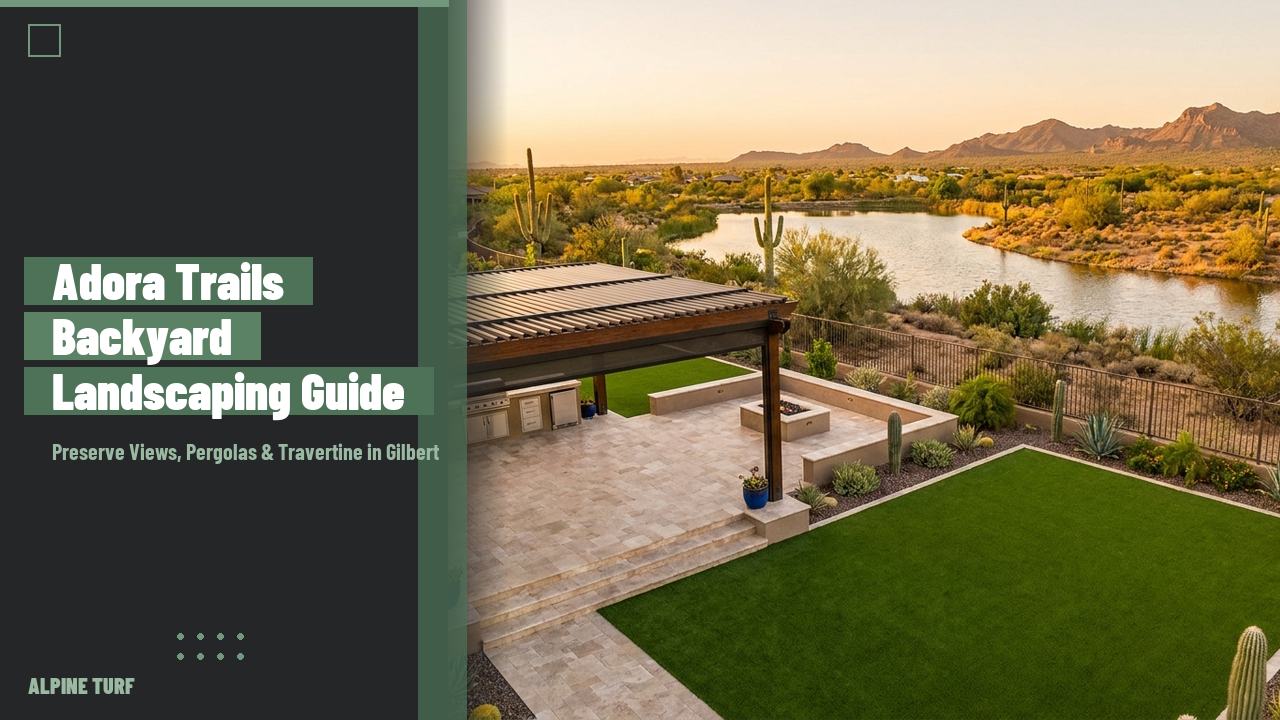
Most Adora Trails backyard landscaping Gilbert homeowners inherit from the builder starts the same way: a slab of turf or decomposed granite, a fence line, and a pool or preserve view sitting behind it that the homeowner paid a real lot premium for and barely gets to look at. The patio furniture faces the house. The pergola, if there is one, has a post planted dead center of the sightline to the lake. Nobody designed the yard around the reason they bought the lot.
Adora Trails is a Taylor Morrison community off East Riggs Road between South Higley Road and South Val Vista Drive in Gilbert, built out in phases since 2010 across five home collections (Discovery, Encore II, Passage, Summit, Odyssey). That range means lot depths, yard widths, and setback lines vary a lot within the same community, and the backyards that back to the scenic lake or the open desert preserve edge have a genuinely different design problem than an interior lot backing to a block wall. This is what we've learned building pergolas, travertine patios, and turf layouts across those lots, and how to get the ACC submission through without a redesign.
Adora Trails backyard landscaping Gilbert: designing around the view first
On a lake or preserve-view lot, the single biggest design mistake is treating the pergola, patio, and seating area like they'd go on any other Gilbert lot and figuring out the view later. By the time the concrete forms are set, it's too late to move a support post six feet to open up the sightline from the kitchen slider.
We start every view-lot design standing at the back door, at the pool's edge if there is one, and at the primary seating height (roughly 18 inches off the ground, where a lounge chair puts your eyes) to map exactly what's visible from each spot before anything gets drawn. Pergola posts get pulled to the corners or split into an asymmetric layout rather than centered, so the structure frames the water or preserve rather than bisecting it. Roof material matters here too: a solid insulated patio cover blocks more sky and more view than an open-beam pergola with a louvered or shade-cloth roof, which is why most of the view-lot pergolas we build in Adora Trails use adjustable louvers instead of a solid roof. You get shade control without permanently closing off the backyard's best asset.
Fencing and view walls need the same treatment. Many lake-facing lots have a wrought-iron view fence instead of block at the rear property line specifically to preserve sightlines. If your landscape design adds a raised planter, a fire feature, or anything else along that line, keep the sightline height in mind, low plantings and low-profile fire features work; a tall built-in bar or a row of full-size palms right at the fence line defeats the entire point of the lot premium.
The Adora Trails Community Association review process
Adora Trails is governed by the Adora Trails Community Association, and like every East Valley HOA we work in, the association requires architectural review before you install artificial turf, a pergola, a patio, or most other backyard hardscape. The association publishes Architectural and Landscape Design Guidelines through its Resource Center, alongside the community's CC&Rs. Those guidelines are the actual source of truth for what's allowed on your specific lot, not a blog post, so pull the current version before you finalize a design or order material. Guidelines get updated, and building to a stale copy is the single most common cause of a rejected submission.
What we can tell you in general, because it holds across nearly every planned community in the East Valley: expect to submit a plot plan showing the location and dimensions of any new hardscape or structure, product specs for turf (pile height, color, backing), and in most communities, confirmation that drainage isn't being redirected onto a neighboring lot or common area. Adora Trails' proximity to the community lake and its stormwater system makes that last point matter more here than in a typical interior-lot community; grading changes near the water get scrutinized more closely than the same change on a landlocked lot.
Arizona House Bill 2131, effective September 24, 2022 and codified at A.R.S. §33-1819, means the association cannot deny artificial turf outright if natural grass would otherwise be allowed on your lot. It can still regulate how the turf looks (blade height, color realism, seam visibility) and require the same design submission as any other hardscape change. We put together the plot plan, product spec sheet, and photos most ACC packages ask for as part of every Adora Trails project, which is worth asking about before you submit anything yourself. Related reading: our full breakdown of what Arizona's turf law actually requires covers the statute in more detail.
Pergolas and shade structures that hold up to Gilbert summers
Gilbert regularly sees 110°F+ afternoons from June through August, and an uncovered patio on a view lot gets used a fraction as often as one with real shade. The choice on most Adora Trails projects comes down to a wood or steel pergola with a louvered or shade-cloth roof versus a solid insulated patio cover.
Solid patio covers tied into the home's roofline block the most heat and give you full shade regardless of sun angle, but they also block the most sky, which works against a view-lot's whole purpose. Louvered pergolas (aluminum, motorized or manually adjustable) let you dial in shade through the day while keeping the structure visually open when you want it, and they cost less than a full insulated cover while still handling monsoon rain reasonably well when closed. Fixed lattice or shade-cloth pergolas are the budget option; they cut direct sun meaningfully but don't fully block a July afternoon the way louvers or a solid roof do, and shade cloth needs replacing every few years once Arizona UV breaks down the fabric.
Whichever structure you choose, footing depth matters more on Adora Trails lots near the lake than you'd expect. The soil profile close to the water table and stormwater basin can hold moisture longer after monsoon storms, and post footings poured too shallow or without proper compaction underneath can shift over a few seasons. We footing-depth every pergola post to the structure's engineered spec, not a standard depth pulled from a smaller inland lot.
Travertine patios: heat, sealing, and lake-adjacent humidity
Travertine is the material of choice for most of the premium patios we build in Adora Trails, and for good reason: honed travertine runs noticeably cooler underfoot than poured concrete or dark-colored pavers in direct summer sun, which matters on a patio you're actually barefoot on near a pool. It also reads as a step up in finish from standard concrete, which fits the community's overall look.
The trade-off is maintenance. Travertine is a porous limestone, and it needs a penetrating sealer reapplied roughly every 2-3 years to resist staining and efflorescence (the white mineral deposits that bloom on the surface as water evaporates through the stone). Lots backing to the lake or sitting closer to the community's irrigation and stormwater systems see slightly higher ambient humidity than interior Gilbert lots, which can shorten that resealing interval if the patio doesn't drain and dry properly between monsoon storms. Grade the patio surface for real fall (a minimum 1-2% slope away from the house and any structure footings) before you set the first paver, not after homeowners notice standing water.
Tumbled travertine (softer, more irregular edges) is a common choice around pool decks specifically because the texture stays slip-resistant when wet, which matters more on a lot where the patio, pool, and lawn all get used together. French-pattern travertine (a mix of four rectangular sizes) reads as more premium and works well on larger patios; a single uniform tile size is cheaper and faster to install but shows less visual interest on the bigger patios that view lots tend to have room for.
Turf as the low-maintenance base for a view-lot yard
On a lot where the whole point is the view and the outdoor living space, natural grass works against you. It's one more thing competing for attention and maintenance time on a yard that should let you sit down and look at the lake instead of mowing. Artificial turf as the lawn base, paired with the patio and pergola, keeps the yard looking finished year-round without the water use, without dead patches from Gilbert's summer heat, and without the weekly mowing that a real lawn near a lake and canal system tends to need even more of, given the extra humidity feeding weed growth at the turf's edges.
For a view lot specifically, keep turf runs simple and geometric near the sightline, an irregular or heavily bordered turf shape close to the fence line draws the eye down instead of out toward the water. Save the more detailed turf-and-paver combination work (borders, insets, a dog run) for areas closer to the house, where it doesn't compete with the view. Infill choice still matters the way it does anywhere in the East Valley: a zeolite or antimicrobial blend keeps pet areas from developing odor faster than plain silica sand, and it's worth specifying up front rather than retrofitting later.
Caliche soil and drainage near the lake
Most of Gilbert, Adora Trails included, sits on caliche, a hard, calcium-carbonate-cemented soil layer that can run anywhere from a few inches to a couple of feet below grade. Caliche doesn't drain well on its own, and it's tough enough that a standard tiller or shovel won't break through it, which is exactly why so many DIY turf and paver jobs fail within a year or two: the base looks fine on install day and then holds water and settles unevenly the first heavy monsoon season.
Proper prep means excavating through the caliche layer where it's shallow, not just skimming the topsoil, and building a compacted crushed-granite base with real drainage fall built in. On lots closer to the community lake or the stormwater basin, we pay extra attention to where that graded water actually goes; sending it toward a neighboring lot or a common-area drainage easement is both an ACC violation and a good way to end up in a dispute with a neighbor. A licensed installer will grade the yard to move water to an approved point, typically the street or an existing drainage swale, before any turf or hardscape goes down.
Sequencing a full Adora Trails backyard remodel
The projects that come out looking intentional, rather than like a patio here and a turf patch there, get sequenced in the right order: grading and drainage first, then utility sleeves for any future lighting, irrigation, or gas line, then the compacted base for hardscape and turf together, then the pergola footings, then the finish materials. Trying to add a pergola after the patio is already poured and sealed usually means cutting into finished travertine to set footings, which costs more and looks worse than planning the footing locations from day one.
If budget means phasing the project over a couple of seasons, which is common on Adora Trails' larger Summit and Odyssey-collection lots, plan the full footprint (patio, turf, pergola, any pool equipment pad) at the start and build only phase one now. That way the drainage grading and base compaction get done once for the whole yard instead of being redone every time a new feature gets added. It also means you submit one ACC package for the full design intent rather than multiple separate submissions as the project grows.
Frequently asked questions
Does the Adora Trails HOA allow artificial turf?
Yes. Arizona House Bill 2131 (A.R.S. §33-1819) prevents HOAs, including the Adora Trails Community Association, from banning artificial turf outright where natural grass is otherwise allowed. The association can still regulate appearance and requires an architectural submission with a plot plan and product specs before installation.
How do I design a backyard around a lake or preserve view in Adora Trails?
Start by mapping sightlines from your main seating areas before placing any structure. Push pergola posts to the corners or use an asymmetric layout instead of centering them, keep fencing and plantings along the view line low-profile, and choose an open or louvered pergola roof over a solid patio cover if preserving the view matters more than maximum shade.
How often does a travertine patio need to be resealed in Gilbert?
Roughly every 2-3 years for most Gilbert patios. Lots closer to the Adora Trails lake or stormwater basin can see slightly higher humidity, which may shorten that interval if the patio isn't graded and sealed properly to drain after monsoon storms.
Do I need special drainage planning near the Adora Trails lake?
Yes. Grading has to route water to an approved point, typically the street or an existing drainage swale, not toward a neighboring lot or the community's stormwater easement. This gets checked more closely on lots near the lake than on interior lots, and it's part of what the ACC reviews in your submission.
What's the ACC approval timeline for a backyard project in Adora Trails?
Timelines vary by association workload and how complete the submission is. A plot plan, product specs, and photos submitted together typically move faster than a partial package that gets sent back with questions. Check the current Design Guidelines on the association's Resource Center for the association's stated review timeline before you plan a start date.
Keep reading.
Ready to ditch the grass?
We install premium artificial turf across the East Valley: Gilbert, Chandler, Mesa, Queen Creek, San Tan Valley. Free on-site measure and quote, no obligation.
Book your free quote