
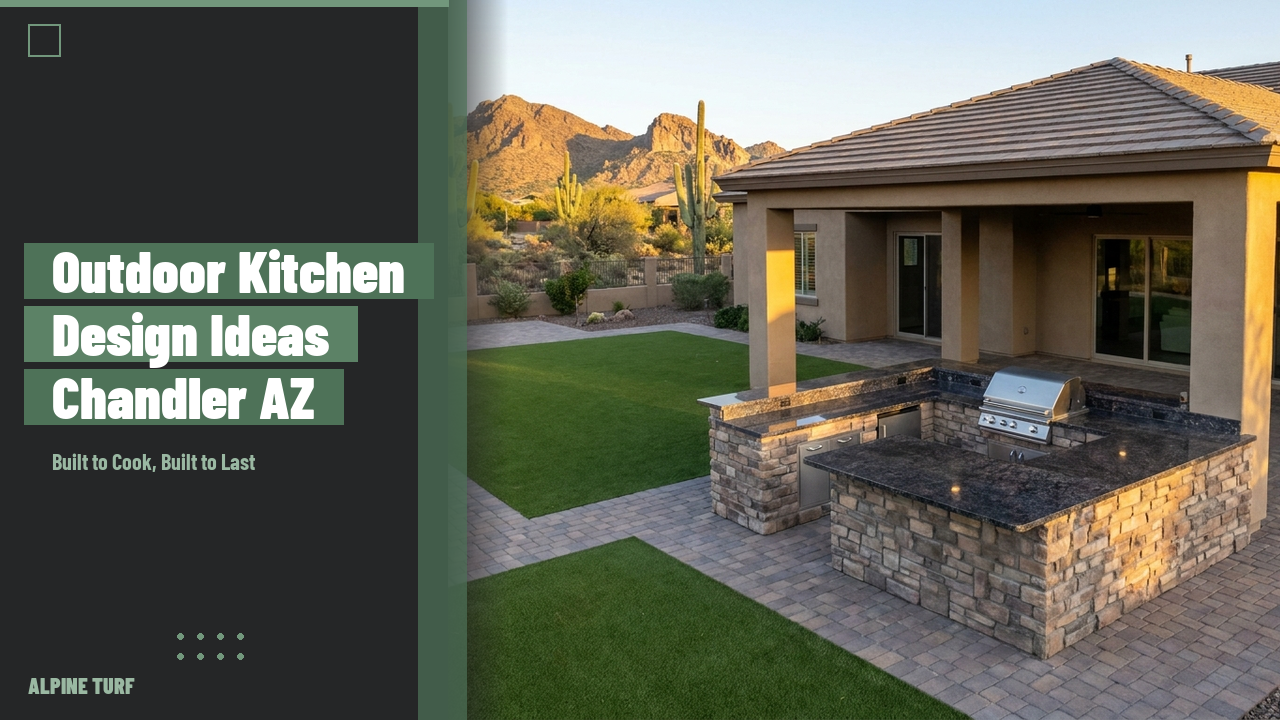
Most outdoor kitchen design ideas Chandler homeowners find online come from magazine spreads shot in Napa or Charleston: a wide-open counter, a single umbrella, string lights. None of that survives a Chandler summer. By July, an unshaded granite counter is too hot to set a plate on before 9am, and a stainless fridge facing west absorbs enough radiant heat off the block wall behind it to shorten its compressor life by years.
We've built outdoor kitchens across Chandler neighborhoods from Ocotillo to Clemente Ranch to Fulton Ranch, and the ones that actually get used every week share the same bones: a zone layout that keeps traffic out of the cook's way, materials chosen for 115°F surface temps rather than curb appeal alone, and real shade over the hot zone. This is the design process, not a Pinterest board.
Outdoor kitchen design ideas Chandler homeowners actually use: the four-zone layout
Every functional kitchen, indoor or out, breaks into four zones: cold (refrigeration, ice, cold storage), hot (grill, side burner, pizza oven), wet (sink, ice bin, bar), and dry (prep counter, serving space). Keep at least 4 feet of clearance between the hot zone and anything cold or wet. That's the gap that keeps a grease fire away from an ice maker and gives the cook room to pivot without backing into a guest.
In a typical Chandler backyard, we lay the hot zone downwind of the main seating area based on the lot's prevailing summer breeze, usually placing the grill island against the block wall farthest from the covered patio doors so smoke and heat don't roll back into the house. The cold zone (fridge, drawers) goes on the shaded end of the run. Direct west sun on a compact outdoor fridge in July will make the compressor run constantly and cut years off its life. Wet zone next to cold, dry zone closest to the dining table. That order isn't arbitrary; it's the sequence you actually move through when you're cooking for eight people on a Saturday night.
Don't forget utility access when zoning: the hot zone needs a gas or 220V electric drop, the wet zone needs a water line and drain, and the cold zone needs a standard 120V circuit on its own breaker, not daisy-chained off the string lights. Map utilities to zones before you finalize the footprint. Moving a gas stub after the paver base is down means jackhammering it back out.
Materials that survive a Chandler summer without cracking, fading, or burning bare feet
Countertops take the most abuse. Polished granite looks sharp in a showroom but runs hottest in direct sun. We've measured unshaded dark granite past 150°F on a June afternoon, hot enough to blister skin on contact. Honed (matte) granite or porcelain slab counters run noticeably cooler to the touch and don't reflect glare into your eyes at dinner. Stay away from natural travertine for counters specifically. It's fine underfoot on a patio, but the porous surface stains permanently from grill grease and wine.
For the kitchen's base and facing, stucco over CMU block matches the house and holds up to UV without fading for a decade-plus; stacked stone veneer looks great but costs more and needs the joints sealed every few years against monsoon-driven water intrusion. Stainless appliances rated for outdoor use (look for 304-grade stainless, not 430) resist the surface rust that shows up fast on budget units left exposed to sprinkler overspray and monsoon humidity.
Cabinetry underneath the counter should be marine-grade polymer or powder-coated stainless, never wood or MDF, since even "weatherproof" wood cabinets swell and warp within two or three Arizona monsoon seasons. If budget is tight, spend it on the counter and appliances first; a simple painted CMU base with a stone cap still looks finished and won't fail structurally.
Covered vs. open: the shade decision that determines whether you use the kitchen in July
An outdoor kitchen without shade in Chandler gets used in October through April and sits idle the other five months. That's the single biggest design mistake we see in DIY layouts and budget builds. The kitchen itself is beautiful, but there's nowhere shaded to stand while you cook, so nobody uses it after 9am from June to September.
A vented aluminum patio cover or a wood/steel pergola with a shade cloth or louvered roof over the hot and dry zones cuts direct solar load dramatically and lets the heat that does build up around the grill vent upward instead of pooling. Solid insulated patio covers tied into the home's existing roofline perform best for full-day use, but they cost more and usually need a permit and engineering review. A freestanding pergola is cheaper, doesn't touch the house, and can be added in a later phase without disrupting the kitchen build.
Whichever you choose, plan the header height and support post locations before you set the kitchen island. We've had to redesign counter layouts more than once because a support post landed exactly where a client wanted the sink.
Choosing appliances that hold up to a Chandler summer
Not every grill sold as "outdoor rated" is built for Arizona. Look for a stainless body rated 304-grade (not the cheaper 430-grade, which pits and rusts within a season or two once monsoon humidity and sprinkler overspray get at it), and check the BTU rating against the cooking surface size rather than chasing the biggest number on the box. A 40,000-50,000 BTU grill with a 500-600 square inch cooking surface covers most family cookouts; going bigger mostly means a higher gas bill and a hotter kitchen island to stand next to in July.
Side burners and pizza ovens both need dedicated venting clearance above them, typically 24-36 inches to any combustible overhang like a wood pergola beam. If you're building under a covered patio, plan the vent hood or open-air clearance into the structure's design before the roof goes up, not after. A warming drawer and a compact outdoor-rated fridge round out most builds; skip a full-size outdoor refrigerator unless you're entertaining large groups regularly; they draw significant power and the compressor works harder in ambient heat even when shaded.
For the sink, a single-basin stainless bowl with a hot/cold mixing valve is enough for rinsing produce and washing hands; full dishwashing usually still happens inside. Insulate any exposed supply line running along an exterior wall; a hard freeze is rare in Chandler but does happen most winters, and an uninsulated line can crack.
Utility planning: gas, water, electric, and drainage before anyone pours concrete
The City of Chandler requires a permit for gas line work serving an outdoor kitchen or built-in grill, and the city's Homeowner's Building Permit Manual specifies a minimum burial depth of 12 inches for buried gas pipe. Even a gas run of a few feet into a covered patio or kitchen island needs a permit and inspection. Skipping it isn't worth the risk to your homeowner's insurance if something goes wrong later.
Water and drain lines for the wet zone need a proper trap and tie into the home's existing plumbing, not a garden hose bib repurposed as a sink supply. Electrical for the cold zone and any lighting should run on GFCI-protected circuits rated for wet-location use, sized for the actual appliance draw. A compact fridge, ice maker, and warming drawer on one 15-amp circuit will trip constantly.
Sequence matters more than most homeowners expect: gas, water, and electrical sleeves and stub-outs go in before the compacted base and pavers, even if you're building the kitchen itself in a later phase. We rough in utilities for the full backyard plan on day one of any Chandler project specifically so a future outdoor kitchen, fire feature, or pool equipment pad doesn't mean tearing out finished hardscape.
Pairing the kitchen with turf, pavers, and lighting for one connected backyard
An outdoor kitchen built as an isolated island in the middle of a dirt or gravel yard never feels finished, no matter how good the appliances are. The Chandler backyards that get used the most treat the kitchen as one piece of a connected outdoor living space: paver flooring that extends from the kitchen through the dining and lounge areas without a material change underfoot, turf bordering the hardscape so kids and dogs have a cool, low-maintenance surface nearby, and low-voltage path and step lighting so the space is usable after dark without floodlighting the whole yard.
We design and install the full package (turf, pavers, kitchen, lighting, irrigation) as one sequenced project specifically so the utility rough-in, drainage grading, and base compaction happen once instead of being redone every time a homeowner adds the next feature a year later. Deciding whether pavers or turf goes in first depends on where the kitchen sits in the yard. If you're planning to phase the full Chandler backyard build over a couple of budget cycles, tell your installer up front; a good design plans the drainage and utility sleeves for the whole yard even if only the kitchen gets built this year.
Frequently asked questions
Do I need a permit for an outdoor kitchen in Chandler, AZ?
Yes, if it involves gas line work. Even a short run of a few feet requires a permit under the City of Chandler's building code, with gas pipe buried a minimum of 12 inches below grade. Electrical and plumbing work typically requires separate permits too. We pull and manage all required permits as part of the build.
What's the best layout for a small Chandler backyard?
A single-run galley layout against a wall works best on tight lots: grill, then a narrow prep section, then a compact fridge, all in one line under a pergola. It keeps the four zones close together without needing an L-shaped island, which eats more square footage than most small yards can spare.
Can I build the outdoor kitchen in phases?
Yes, but plan the utility sleeves (gas, water, electrical) for the full kitchen footprint during phase one, before the paver base goes down. Adding a gas line under finished hardscape later means cutting pavers and repouring base, which costs far more than running an extra conduit up front.
Does an outdoor kitchen need to be covered in Arizona?
It's not required by code, but in practice an uncovered kitchen in Chandler sits unused from roughly June through September. A vented patio cover or pergola over the hot and dry zones is what makes the difference between a kitchen used nightly and one that only gets used in the cooler months.
What countertop material handles Chandler heat best?
Honed granite or porcelain slab run noticeably cooler to the touch than polished granite, which can exceed 150°F in direct summer sun. Avoid natural travertine on counters specifically, since it stains permanently from grease and wine, even though it holds up fine as patio flooring.
Keep reading.
Ready to ditch the grass?
We install premium artificial turf across the East Valley: Gilbert, Chandler, Mesa, Queen Creek, San Tan Valley. Free on-site measure and quote, no obligation.
Book your free quote