
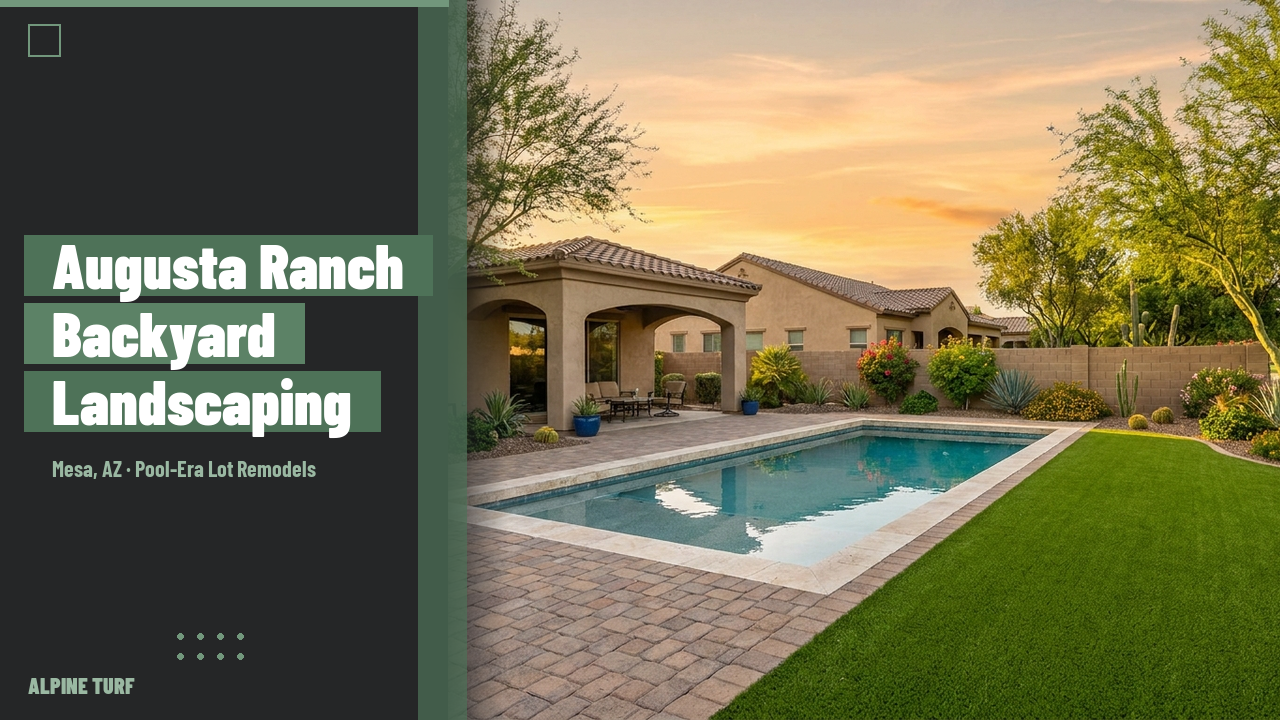
Most of Augusta Ranch was built out between the late 1990s and the mid-2000s, which means a lot of the community's backyards are now old enough to need real work, not just a refresh. The original Bermuda or rye sod has thinned out under 20-plus summers of East Valley heat, the pool deck coping is chalky and cracked, the patio cover has faded two shades lighter than the house, and the water bill keeps climbing to keep any of it green. We've run turf, paver, and pool-deck jobs across the community's named sections, from interior production lots to the golf-course-adjacent parcels that back up to the Augusta Ranch Golf Club fairways, and the guideline questions are nearly identical every time: what can actually go around the pool, what counts as a header the Architectural Review Committee will approve without pushback, and how a 1998-era backyard gets rebuilt without losing the bones that still work.
Augusta Ranch's Covenants, Conditions, and Restrictions were recorded with Maricopa County on June 5, 1998, and the community's Architectural Design Guidelines, adopted under Article IV of that Declaration, are the document that actually governs what happens in your yard today, more than 25 years later. This post walks through what those guidelines say about Augusta Ranch backyard landscaping, turf, groundcover, patio covers, and pool decks, what the ARC review process looks like in practice, and what it costs to rebuild a backyard that's earned its age.
What makes an Augusta Ranch backyard different to remodel
Augusta Ranch sits in east Mesa, bounded by Baseline Road to the north, Guadalupe Road to the south, Crismon Road to the east, and Ellsworth Road to the west, with more than 2,200 homes built around the Augusta Ranch Golf Club, an 18-hole, par-61 executive course with its own Scratch Pub & Grill. That's a meaningful number of households, and it's also a meaningful age range: a 1998-era production lot off the interior streets looks and remodels differently than a 2005-era golf-course-adjacent parcel with mature saguaros and a view fence instead of a solid block wall.
The age cuts both ways on a remodel. On the plus side, the trees are established, mesquite and palo verde canopies that took 15 years to fill in, so a good design works around them instead of starting from bare dirt. On the downside, a lot of the original infrastructure is aging out at the same time: pool pumps and filters from the early 2000s are well past their service life, irrigation controllers are usually the original builder-grade units, and the paver or stamped-concrete patio most lots started with has had two decades of monsoon runoff and summer UV working on it. A remodel here is rarely just "add turf." It's almost always turf plus a patio-cover repaint or rebuild, a pool-equipment relocation and screening fix, and an irrigation retrofit, all submitted as one ARC package rather than three separate ones.
The ARC review Augusta Ranch actually runs
Article IV, Section 4.3(A) of the CC&Rs is explicit: no improvement, alteration, excavation, grading, or landscaping that changes the exterior appearance of a Residential Parcel from its condition on the date the Tract Declaration was recorded can happen without prior written approval from the Residential Design Review Committee. That's a broad standard on paper, and in practice it covers essentially everything we touch on a backyard remodel, turf, hardscape, patio covers, accessory structures, and anything visible above the rear fence line.
The process itself runs on a monthly cycle. Submittals are due by 5:00 p.m. on the second Wednesday of the month, and the Architectural Committee meets the third Thursday at 9:00 a.m. to review that batch. Miss the Wednesday deadline and the application waits for the following month's cycle, not a quick follow-up review, so we build every Augusta Ranch submittal to be complete the first time: plat, material samples, and a clear plan drawing, not just a sketch.
A few CC&R specifics worth knowing before a design gets drawn: the guidelines require at least two off-street covered parking spaces per home, they explicitly prohibit artificially colored rock and boulders anywhere on the lot, and perimeter walls on lots bordering golf-course or common-area open space can't be removed to create rear-yard access without approval, doing so triggers a full cost assessment against the lot. That last rule matters more here than in most East Valley communities, because a meaningful share of Augusta Ranch backyards back directly onto the golf course or a common tract.
Turf, groundcover, and border rules under the current guidelines
Augusta Ranch's Landscape Guidelines don't carry a dedicated artificial-turf spec sheet the way some newer East Valley HOAs do, no required face weight, pile height, or infill type spelled out by name. Instead, turf falls under the general groundcover language: all bare earth has to be covered by an approved organic material for a "neat, dust-free appearance," and the guidelines list turf, decomposed granite, or other approved natural rock as acceptable groundcover. That means the actual approval hinges less on the turf product itself and more on how it's bordered and how it reads next to the home.
The border rule is the one that actually decides most submittals. A brick border in the brown or red family, installed no higher than 3 inches above grade, doesn't need Architectural Committee approval at all. Any other border type or material does. We default to a low brown-brick or color-matched concrete header on Augusta Ranch jobs specifically because it clears that exemption; metal edging or a raised paver border still works design-wise but adds a review step we can usually skip.
- Groundcover: turf, decomposed granite, or approved natural rock, all bare earth must be covered.
- Border exemption: brown or red brick, 3 inches or less above grade, no approval needed.
- All other borders: metal, raised paver, or stone edging requires Architectural Committee sign-off before installation.
- Rock and boulders: natural earth tones only, no artificially colored rock or boulders anywhere. River rock is capped at 3–6 inches in diameter and can't exceed 10% of the front-yard landscape.
- All hardscape: walls, driveways, walkways, lighting, fountains, and anything visible above the rear fence line needs prior approval, not just front-yard work.
Arizona's HB2131, signed in March 2022 and effective that September, backs this up at the state level: in any planned community that allows natural grass, the HOA can't flatly prohibit a homeowner from installing artificial turf instead. Augusta Ranch's guidelines don't fight that law, they just route turf through the same groundcover and border review as every other ground treatment, which is a more workable position than the newer, more prescriptive turf spec sheets some other East Valley HOAs have adopted.
Pebble-Tec pools, extended patios, and pool-deck remodels
A big share of Augusta Ranch pools were plastered with a Pebble-Tec or comparable pebble-aggregate finish, the product was already the standard choice for new Arizona pool construction by the late 1990s, and most of those finishes are rated for somewhere in the 15-to-20-year range before they need resurfacing. For a pool built in 2000 or 2003, that window has already closed or is closing now, which is exactly why so many of our Augusta Ranch calls start as "the pool deck looks rough" and turn into a full patio-and-turf remodel once we're out measuring.
Here's a detail that actually works in a homeowner's favor: pools and spas themselves do not require Architectural Committee approval under the current guidelines. What does require approval is everything built around the pool, the patio cover, the extended paver deck, the turf border, and the pool equipment itself, which the guidelines require to be screened from neighboring view. On a remodel, that screening requirement is often the easiest line item to miss, a relocated or newly exposed pump pad needs a planted or built enclosure before the ARC will sign off.
Patio covers carry their own material rules, and they're specific enough to plan around before a design goes to the committee:
- Materials: must match or complement the home's existing materials, not a generic off-the-shelf cover.
- Roof: either a parapet design or built from the same material as the home's roof, matching clay or concrete tile color.
- Columns: stuccoed and painted to match the home's body color.
- Roof fencing: if the patio roof has a rail, it has to be wrought iron. Wood or other railing materials aren't approved.
That's a different standard than a lot of non-HOA Arizona rebuilds, where a stock aluminum patio cover kit is the default. On an Augusta Ranch job we're pricing a stuccoed, tile-roofed cover against the home from the start, not retrofitting one after a rejected submittal.
Driveway extensions and hardscape approval
Driveway and walkway work comes up often enough on Augusta Ranch remodels, especially when a backyard project includes a side-yard gate or RV-access strip, that it's worth planning around the specific limits up front. The guidelines cap total driveway-extension concrete at 30 feet of contiguous area or 50% of the lot's width, whichever is smaller, and require the extension to meet the existing driveway at a 45-degree angle with at least two plants, a minimum of 3 feet tall, planted in the resulting angled bed.
If an extension lands within a foot of the side property line, the guidelines require written notice to the adjacent neighbor, who then has 15 days to respond before the Board acts on the submittal. Additional walkways are capped at 5 feet wide and only get approved where there's landscaping on both sides, and concrete access strips for double gates run a minimum 16-to-18-inch width at 2,500-to-3,000 PSI, with pavers specifically disallowed as a substitute material for that particular use.
What Augusta Ranch backyard landscaping actually costs
Scope drives cost more than anything else here, and because so many Augusta Ranch lots are now due for both a groundcover refresh and a pool-deck or patio-cover rebuild, the honest range for Augusta Ranch backyard landscaping spans further than a single number would suggest.
A turf-only refresh, pulling dead sod, grading, installing turf with a brick or approved header, and leaving the existing patio and pool deck as-is, typically runs $5,000 to $18,000 depending on square footage. A full backyard that adds a new paver patio, planting beds, and drip irrigation on a standard production lot lands between $18,000 and $40,000. Once a project includes resurfacing or extending the pool deck and rebuilding a stuccoed, tile-roofed patio cover to the guidelines' material standard, the realistic range runs $35,000 to $75,000 or more, with golf-course lots and larger custom parcels sometimes exceeding that on the high end. None of those figures include the ARC review timeline itself, which typically adds two to six weeks on top of a standard East Valley install schedule depending on how close a submittal lands to the monthly meeting cutoff.
We pull the current Architectural Design Guidelines and CC&R excerpts and handle the ARC submittal as part of every Augusta Ranch quote, because a rejected first package costs a homeowner a full month waiting on the next meeting cycle, and that's the single biggest schedule risk on a project like this, not the construction itself.
Frequently asked questions
Does Augusta Ranch allow artificial turf?
Yes. The guidelines list turf as an approved groundcover alongside decomposed granite and natural rock, and there's no separate artificial-turf spec sheet to clear. The part that actually gets reviewed is the border: a brown or red brick header 3 inches or less above grade needs no approval at all, while any other edging material requires Architectural Committee sign-off before installation. Arizona's HB2131 (2022) also prohibits the HOA from banning artificial turf outright anywhere natural grass is allowed.
Do I need ARC approval to remodel my pool deck?
The pool and spa itself doesn't need approval, but the deck, patio cover, and any turf or paver work around the pool do. Pool and spa equipment also has to be screened from neighboring view, which is easy to miss if a pump pad gets relocated or newly exposed during the remodel.
What turf border or edging is approved without extra review?
A brick border in the brown or red family, installed no more than 3 inches above grade, is exempt from Architectural Committee approval. Metal edging, raised pavers, stone, or any other border material still needs to go through the standard review process before installation.
How long does Augusta Ranch's ARC review take?
Submittals are due by 5:00 p.m. on the second Wednesday of the month, and the Architectural Committee meets the third Thursday at 9:00 a.m. to review that batch. Missing the Wednesday deadline pushes an application to the following month's cycle rather than getting a quick follow-up, so we build every submittal to be complete on the first pass.
Can I extend my driveway or add a paver walkway?
Yes, with limits. Driveway extensions are capped at 30 feet of contiguous concrete or 50% of the lot's width, whichever is smaller, must meet the existing driveway at a 45-degree angle, and need at least two plants 3 feet or taller in the angled bed. Additional walkways are capped at 5 feet wide and need landscaping on both sides to be approved.
What does a full Augusta Ranch backyard remodel cost?
A turf-and-border refresh that keeps the existing patio and pool deck typically runs $5,000 to $18,000. A full backyard with new pavers, planting, and irrigation lands between $18,000 and $40,000. A pool-deck remodel that includes rebuilding the patio cover to the guidelines' material standard commonly runs $35,000 to $75,000 or more, depending on lot size and scope.
Keep reading.
Ready to ditch the grass?
We install premium artificial turf across the East Valley: Gilbert, Chandler, Mesa, Queen Creek, San Tan Valley. Free on-site measure and quote, no obligation.
Book your free quote