
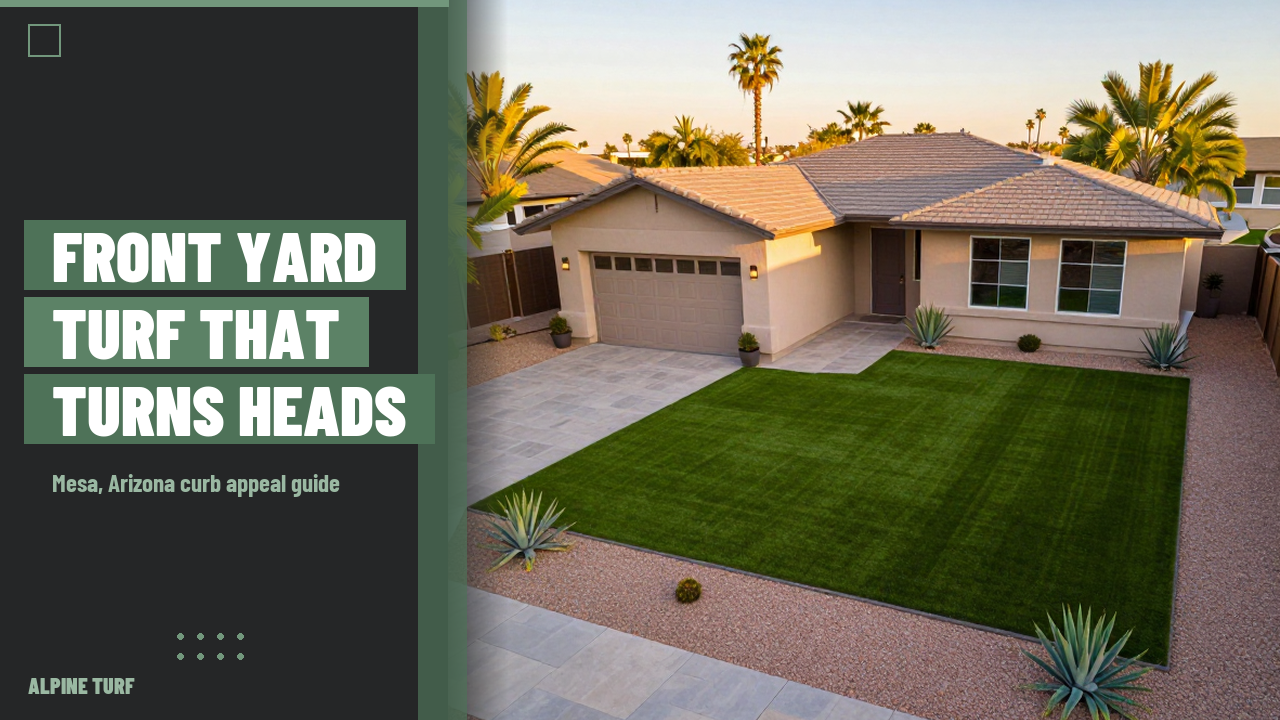
Front yard artificial grass curb appeal Mesa AZ homeowners actually want doesn't happen by accident. It's the one landscaping decision that every neighbor, every mail carrier, and every potential buyer sees before they see anything else about your house. A backyard refresh is for you. A front yard is for the street, and right now a lot of Mesa front yards are losing that argument: thinning Bermuda going dormant and brown for half the year, bare dirt patches blowing dust onto the driveway, and a water bill that keeps climbing to keep a lawn alive that still looks half-dead by August. We get the call most often right after an HOA courtesy notice shows up, or right before a house goes on the market and the listing photos need to not embarrass anyone.
Front yard artificial grass curb appeal in Mesa comes down to three decisions done right: knowing what your HOA will actually approve, picking a turf product and layout that reads as a real yard from the sidewalk instead of a green rectangle, and installing it correctly for Mesa's caliche soil and summer heat. Get those three right and a front yard refresh is one of the fastest, least disruptive projects we run, usually a single day of work. Get them wrong and you've got an HOA letter, a front yard that looks worse than the dead grass it replaced, or turf that's buckling at the edges within two summers.
Why Mesa front yards fail faster than backyards
A Mesa front yard usually faces full sun for more hours of the day than a backyard does, especially on the south- and west-facing lots common in subdivisions built along Baseline, Southern, and University. There's no block wall or patio cover throwing shade, no pool evaporating heat off a deck, just open exposure from sunrise past noon. That's exactly the condition natural grass handles worst in the Valley: cool-season rye needs overseeding every fall to survive, warm-season Bermuda goes dormant and brown from November through March, and either way the sprinkler system is running through a front yard that's visible from the street every single day it isn't green.
Front yards also take more foot and vehicle traffic than people account for: delivery drivers cutting corners, kids and dogs using it as the shortest path to the sidewalk, trash and recycling bins rolled across it twice a week. Natural grass thins out along those wear paths first, and it's always the most visible part of the yard that goes bald first. A properly installed turf system doesn't have that failure mode: the backing and infill are built to take foot traffic without compacting or wearing through, which matters more in a front yard than almost anywhere else on the property.
Will your Mesa HOA actually allow it?
Most established Mesa subdivisions, Dobson Ranch, Alta Mesa, Red Mountain Ranch, Las Sendas, and newer communities like Eastmark alike, run an HOA with some form of architectural review for front yard changes. The good news for homeowners: Arizona's HB2131, signed in March 2022 and codified at A.R.S. §33-1819, means an HOA in a planned community cannot flatly prohibit artificial turf anywhere it already allows natural grass. An HOA can still require a design submittal and set reasonable rules about appearance, border materials, and placement, it just can't say no to turf outright.
In practice, that means most Mesa front yard turf submittals get approved on the first pass as long as the design avoids a few common rejection triggers: wall-to-wall turf with no plant material at all (reads as "fake lawn," not landscaping, to most architectural committees), turf installed flush against the sidewalk or curb with no transition material, and bright, uniform "stadium green" product that doesn't match anything else on the block. We pull the specific CC&Rs and submittal form for the community before designing anything, because the paperwork itself is usually simpler than people expect, a plot plan, a material sample, and a plant list covering the non-turf area.
One program worth knowing about before you design around it: the City of Mesa's Grass-to-Xeriscape rebate does not pay for turf-only conversions. To qualify for the rebate, the converted area needs low-water-use plants covering at least 50% of what used to be irrigated grass. Most front yard turf projects we design end up skipping the rebate paperwork and just building the planting into the layout anyway, because a turf-only front yard is both a harder HOA sell and a less interesting one to look at.
Choosing turf that reads as a lawn, not a showroom sample
The single biggest mistake we see on front yard turf jobs, including ones installed by other companies, is picking a product built for a backyard putting green or a dog run and using it front and center where everyone can study it up close. A front yard gets looked at differently than a backyard: people walk past it on the sidewalk at eye level, not glance down at it from a patio chair. Two things separate turf that reads as real from turf that reads as carpet:
- Blade shape and color blend: a single, uniform S-shaped blade in one shade of green looks artificial the moment someone gets within ten feet. A blended product, mixing a thatch layer with two or three green tones and a slightly varied blade profile, mimics how a real lawn actually looks up close.
- Face weight: residential landscape turf in the 80–100 oz/sq yd range has enough density to hide the backing and stand back up after foot traffic. Lighter, cheaper product (under 60 oz) mats down fast in a high-traffic front yard and starts looking thin within a year or two.
Surface heat is the other front yard consideration people underestimate. A south- or west-facing front yard with no shade at all can see turf surface temperatures well over 150°F during a Mesa summer afternoon, noticeably hotter than the decomposed granite or concrete next to it. That matters less in a front yard you're not walking across barefoot, but it does affect product choice: a lighter-colored blend and a reflective or cooling infill (like a treated silica or specialty cooling product) keeps the surface meaningfully cooler than a dark, dense product chosen purely for backyard shade conditions.
Front yard artificial grass curb appeal Mesa AZ layouts that work
Wall-to-wall turf from the sidewalk to the house is the fastest way to make a front yard look like an afterthought, and it's also the layout most likely to get flagged by an HOA architectural committee as "not landscaping." The front yards that actually move curb appeal combine turf as the green anchor with a border or transition zone that gives the eye somewhere else to land:
- Decomposed granite borders: a 12–24 inch DG strip along the sidewalk and driveway edges breaks up the green field and gives a clean, intentional edge that reads as designed, not just laid down.
- Low-water plant accents: desert marigold, red yucca, and Texas sage hold color and structure year-round with minimal irrigation, and they're exactly the kind of planting most HOA guidelines are looking for alongside turf.
- A real walkway: flagstone or paver stepping pads from the driveway to the front door, set into or alongside the turf, does more for perceived value than almost any other single front yard feature.
- Boulder or accent rock: one or two larger natural-tone boulders, not a pile of small landscape rock, anchor a bed without looking busy.
A good rule of thumb on a standard Mesa production lot: turf covers roughly 50–65% of the usable front yard area, with the rest split between DG transition zones, a planting bed along the house foundation, and whatever walkway or driveway accent the design calls for. That ratio satisfies most HOA groundcover-variety expectations and also just looks better, an all-green front yard with zero texture variation photographs flat even when the turf itself is excellent.
Installing it right in Mesa's caliche and summer heat
Mesa sits on some of the shallowest caliche hardpan in the East Valley, and front yards are where it shows up most often, because builders typically did less soil prep on the street-facing strip than they did on the backyard pad. A standard backyard turf base runs about 3 inches of compacted aggregate. When we hit caliche within the first few inches of a front yard excavation, and in older Mesa subdivisions that's common, the base spec changes: breaking up the hardpan to 4–6 inches, adding a woven geotextile fabric to separate the base from the caliche layer below and keep weeds from pushing through, and compacting in lifts rather than all at once.
Drainage matters more in a front yard than people expect too, because the grade has to move water away from the foundation and toward the street or a municipal drain, not pool against the house during a monsoon downpour. We grade every front yard base with a slight fall away from the slab before turf ever goes down, and we check it against the existing sidewalk and driveway elevations so water has somewhere to go that isn't the garage.
Timing is the last piece. Turf adhesive and seam tape cure fastest and most reliably in the 60–95°F range, which in Mesa means spring and fall installs go smoother than a July install where surface temps on dark asphalt and concrete nearby can push past 140°F before 10 a.m. We still install turf year-round, summer installs just mean starting early, working the seams in shade when the sun angle allows it, and giving adhesive extra cure time before the first full afternoon of direct heat.
What a Mesa front yard turf project actually costs
Front yards are smaller and simpler than backyards, no pool equipment, no patio cover, usually no drainage retrofit around existing hardscape, so the cost range is tighter and the timeline is shorter. Most Mesa front yard lots run 400–900 square feet of actual yard area once you subtract driveway and walkway.
At $5–8 per square foot installed, which includes turf material, base prep, border material, and labor, a straightforward 500 sq ft front yard lands around $3,000–$4,500, and a larger corner lot with a full planting plan and a new walkway can run $6,000–$7,000 or more. Caliche-heavy lots add real cost: deeper excavation and extra base material for a lot with hardpan at 4 inches typically adds $500 to $1,500 over a standard-soil install of the same size. None of these figures include a backyard, an irrigation controller upgrade, or anything beyond the front yard footprint itself.
Keeping it looking good after install
Front yard turf needs less upkeep than natural grass, but "less" isn't "none," and a front yard that's neglected shows it faster than a backyard because more people see it. A monthly brush-and-rinse keeps the blades standing upright and clears dust that settles out of Mesa's dry air, especially after a windy spring or a monsoon dust storm. Pet areas need an enzyme rinse on a more regular schedule to prevent odor buildup in the infill, and if the front yard is the primary path dogs use to the sidewalk, that's worth planning the infill choice around at install time rather than retrofitting later.
If the community runs periodic landscape inspections, which a lot of Mesa HOAs with front yard turf approval do, keeping the border lines clean and the DG topped off matters almost as much as the turf itself for passing a drive-by review. We cover the specific maintenance routine, including which infill types resist odor and heat best, in our artificial turf maintenance guide for Arizona.
Frequently asked questions
Can my Mesa HOA stop me from installing front yard artificial turf?
Not outright. Arizona's HB2131 (A.R.S. §33-1819), effective September 2022, prohibits an HOA in a planned community from banning artificial turf anywhere it already allows natural grass. The HOA can still require a design submittal and set reasonable rules on border materials, color, and placement, so it's worth pulling your specific CC&Rs before designing, but a flat "no turf" rule isn't enforceable under current state law.
Does Mesa's Grass-to-Xeriscape rebate cover a front yard turf install?
Only partially. The rebate requires the converted area to include low-water-use plants covering at least 50% of the space that used to be irrigated grass, a turf-only conversion doesn't qualify on its own. Most front yard designs that mix turf with a planting bed and DG border can meet that requirement, but it changes the layout math from the start rather than being an afterthought.
How do I keep front yard turf from looking fake from the sidewalk?
Pick a blended product with a mixed blade shape and two or three shades of green rather than a single uniform color, and don't run turf wall-to-wall. Breaking the green field with a decomposed granite border, a planting bed, and a real walkway gives the eye texture to read instead of one flat rectangle, which is also usually what gets a design through HOA review faster.
Why does my front yard need a different turf base than my backyard?
A lot of Mesa front yards sit closer to shallow caliche hardpan than the backyard pad, because builders typically graded the street-facing strip less aggressively. Where caliche shows up a few inches down, the base needs 4–6 inches of breakup and compacted aggregate instead of the standard 3-inch backyard spec, plus a geotextile fabric layer to stop weeds and separate the base from the hardpan below.
How hot does front yard turf get in direct Mesa sun?
A south- or west-facing front yard with no shade can see turf surface temperatures well over 150°F on a summer afternoon. That's not a barefoot-comfort issue in most front yards, but it affects product choice: a lighter color blend and a cooling or reflective infill keeps surface temps noticeably lower than a dark, dense product chosen for backyard shade conditions.
What does a typical Mesa front yard turf project cost?
Most Mesa front yards run $3,000 to $7,000 fully installed, including turf, base prep, border material, and labor, for a typical 400–900 sq ft lot. Lots with shallow caliche requiring deeper base prep typically add $500 to $1,500 over a standard-soil install of the same size.
Keep reading.
Ready to ditch the grass?
We install premium artificial turf across the East Valley: Gilbert, Chandler, Mesa, Queen Creek, San Tan Valley. Free on-site measure and quote, no obligation.
Book your free quote