
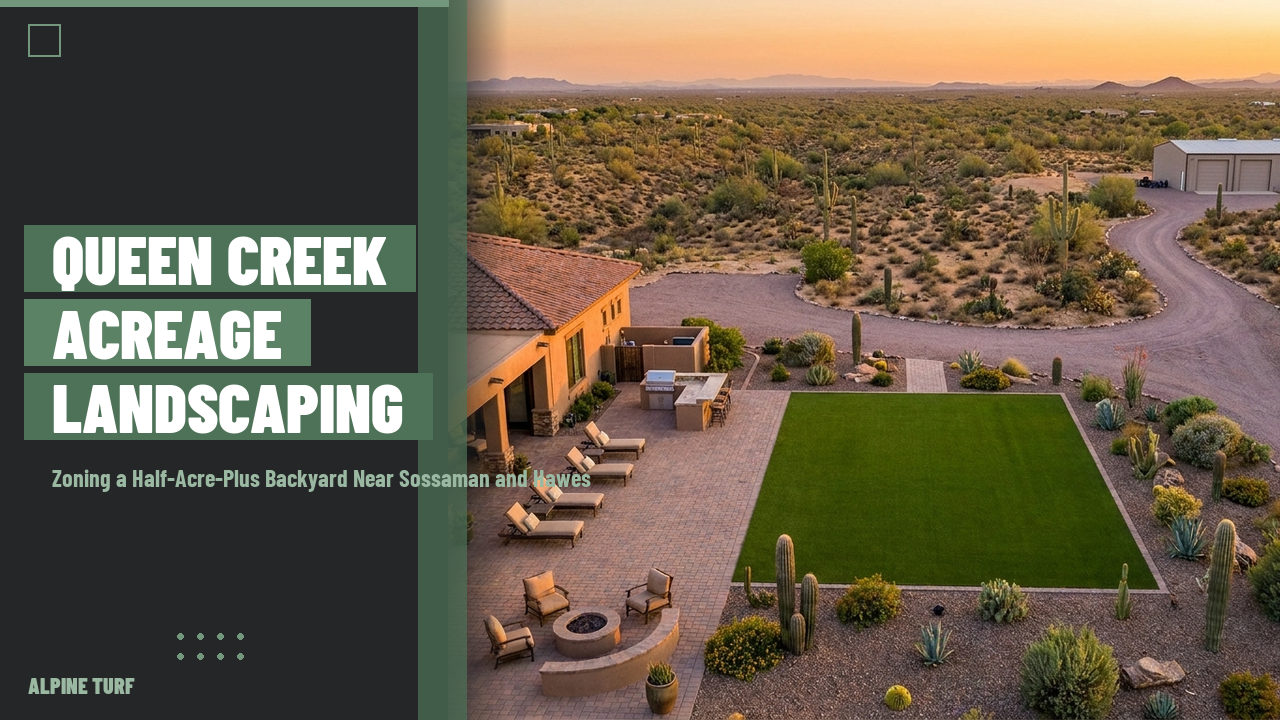
Most of our Queen Creek calls are for a quarter-acre production lot: block wall already up, HOA already dictating the border material, maybe 1,200 square feet of actual yard to work with. Out toward Sossaman Road and Hawes Road, that conversation changes entirely. These are half-acre, one-acre, sometimes two-acre-plus parcels, often with horse setups, workshop buildings, or just room to spread out that a standard subdivision never offers. The problem isn't how to fit a design into a small space anymore. It's that a half-acre of open desert dirt is a blank canvas with no obvious edges, and turfing the whole thing would cost more than most houses out there are worth.
We've designed and built acreage backyards across this stretch of Queen Creek for years now. The questions are consistent: how much of this should actually be turf, what does the well and septic system let us do, and how do we keep the place from feeling unfinished for three years while the budget catches up to the lot size. Good Queen Creek acreage landscaping answers all three before a shovel goes in the ground. This post walks through how we zone these properties, what the well and septic setbacks actually require, and what a realistic phased build costs.
What Makes a Queen Creek Acreage Lot Different to Landscape
A quarter-acre HOA lot and a 1.2-acre parcel near Hawes Road aren't the same design problem scaled up. They're different problems. The subdivision lot has a known boundary, a known soil profile from the builder's grading, city water and sewer already stubbed in, and an ARC that will tell you exactly what border material is acceptable. The acreage lot usually has none of that. Water often comes from a private well rather than a municipal line. Wastewater often runs to an onsite septic system rather than a sewer connection. The soil hasn't been uniformly graded by a production builder either. It's raw desert, and caliche hardpan shows up at different depths across the same lot, sometimes six inches down, sometimes three feet. You don't know until you dig test pits.
Most of these parcels also sit outside the tightly governed HOAs that dominate Queen Creek's newer subdivisions. Some are deed-restricted county islands with a loose set of CC&Rs, others have no architectural committee at all. That's freedom on one hand, there's no ARC submittal waiting period here, but it also means there's no builder-installed irrigation backbone, no pre-run sleeves under a driveway, no existing drainage plan to build around. Everything, including where the water goes in a monsoon downpour, gets designed from scratch.
The upside is real: more room for an actual entertaining layout, more flexibility on where structures go, and often mature desert vegetation, mesquite, palo verde, ironwood, that a thoughtful design can build around instead of clearing. The honest trade-off is that a half-acre-plus property costs more to finish than a standard backyard, not because the per-square-foot turf and paver pricing changes, but because the supporting infrastructure, wells, septic, long irrigation runs, perimeter fencing, has to be designed and paid for before the fun parts even start.
Zoning the Lot: Entertaining, Turf, and Open Desert
The single biggest mistake we see on acreage design requests is homeowners assuming the whole lot needs to look "finished" the same way a subdivision yard does. It doesn't, and trying to make it look that way is how a half-acre project turns into a $300,000 line item nobody budgeted for. Instead, we zone the property in four rings working outward from the house:
| Zone | What goes here | Typical footprint |
|---|---|---|
| Entertaining zone | Paver patio, outdoor kitchen or fire feature, covered ramada, directly off the back of the house | 800–2,500 sq ft |
| Turf zone | Artificial turf for play, pets, or a lounge lawn, bordered and bermed for drainage | 1,500–4,000 sq ft |
| Transition zone | Decomposed granite paths, boulders, low-water shrubs softening the edge of the turf | Variable, often the largest visual share |
| Perimeter zone | Native and drought-tolerant plantings, existing desert left largely undisturbed, fencing or view fence | The remainder of the acreage |
That perimeter zone is the part homeowners have the hardest time accepting at first: on a 1.2-acre lot, it might be 30,000-plus square feet of land that gets light grading, a handful of salvaged or new native plants, and nothing else. That's not an unfinished yard, it's the correct answer. Fighting the desert to make an entire acre look like a golf course backyard means an irrigation and water bill that doesn't make sense even on a well, and a maintenance burden that defeats the point of installing turf in the first place.
Where Turf Actually Earns Its Keep on a Big Lot
Turf on an acreage property does the same job it does anywhere else in the East Valley: it gives you a usable, cool-underfoot, no-mud, no-dust surface right where you actually spend time. The difference is scale discipline. We size turf zones on acreage jobs to the entertaining zone's footprint, not the lot's, which on most of these properties lands in the 2,000 to 6,000 square foot range even when the parcel itself is 20 times that size.
A few placement rules that come up constantly on these jobs: keep turf out of any area within the septic setback (more on that below), avoid laying turf directly against a block wall or view fence without a drainage gap since acreage lots see more sheet-flow water during monsoon season than a graded subdivision does, and don't skip the compacted decomposed-granite base just because "there's plenty of room to spread out." Base prep matters exactly as much on an acre as it does on a quarter-acre lot. Skipping it to save money on a bigger job just means a bigger area that settles unevenly two summers later.
If there are dogs or horses on the property, that changes the turf spec too, denser face weight, permeable backing, and zeolite or antimicrobial infill in the pet zone specifically, not necessarily across the whole turf footprint. We treat the dog run or pet zone as its own sub-zone with its own drainage and infill spec rather than extending one blanket product across every turfed area.
Low-Water Planting for the Acres You're Not Turfing
The transition and perimeter zones are where the water budget either works or doesn't. Native and desert-adapted species, mesquite, palo verde, ironwood, desert willow, agave, red yucca, brittlebush, establish on drip irrigation at a fraction of what a turfed or heavily planted area needs, and many acreage lots already have mature specimens worth designing around instead of clearing. A mesquite that's been growing on the property for 20 years provides more shade and more visual weight than anything we could plant and grow in five years, and salvaging it is almost always cheaper than removing it and replacing the canopy it provided.
Where the lot has been scraped bare by a previous owner or a builder, we replant in drifts rather than evenly spacing specimens across the whole perimeter, it reads more natural, and it concentrates the drip irrigation into zones instead of running emitter line across land that doesn't need consistent coverage. Decomposed granite ties the planted zones together visually and keeps dust down between establishment and full growth, which on a well-dependent property also matters for water use since DG needs no irrigation at all once it's compacted.
Septic, Wells, and the Setbacks That Shape Your Design
This is the section most subdivision-focused landscape guides skip entirely, and it's the one that actually constrains an acreage design before a single plant goes in the ground. If the property is on a private well, Arizona's exempt well rule, administered by the Arizona Department of Water Resources, limits withdrawal to 35 gallons per minute for domestic household use, and an exempt well can't be used to irrigate two acres or more of cropland. That cap doesn't usually bottleneck a residential turf-and-planting design, but it does mean we size irrigation zones and run times around the well's actual output rather than assuming municipal-grade flow, and we coordinate scheduling so the sprinkler system, the house, and any livestock water needs aren't all drawing from the same well simultaneously during peak demand.
Septic systems drive the harder constraint. Maricopa County's setback requirements require any well to stay at least 100 feet from all septic system components, and require the septic system itself to stay at least 50 feet from a shared property line in areas served by individual wells, reducible to as little as 5 feet only if the adjacent property owner agrees in a recorded document. In practice, that means the leach field and any septic tank are usually fixed, immovable features on the property, and everything else, the turf zone, the patio, the planting beds, gets designed around them rather than the other way around. We pull the as-built septic location and well registration before finalizing a layout on every acreage job, because redesigning a patio after discovering it overlaps a leach field costs far more than checking the county records up front.
One more practical note: turf and heavy irrigation directly over or immediately adjacent to a leach field is a bad idea even where the setback technically allows it, root intrusion and saturated soil both shorten a septic system's working life. We keep irrigated turf and dense planting clear of the field and use that margin as part of the transition zone instead, usually decomposed granite with light, deep-rooted native shrubs that won't send roots looking for moisture in the leach lines.
Wind, Dust, and Privacy Without a Full Perimeter Wall
Subdivision lots get a block wall on day one as part of the builder's standard package. Acreage lots frequently don't, view fencing, three-rail pipe fencing, or sometimes just open boundary on one or more sides is common, especially where the neighboring parcel is also acreage. That's a real trade-off: it preserves the open desert views that are a big part of why people buy out here, but it also means wind-blown dust and a lack of privacy near the house have to be solved with landscaping rather than masonry.
We handle this with a layered planting strategy close to the entertaining zone: a mix of taller shrubs and small trees, Texas ranger, desert spoon, a staggered row of mesquite or palo verde, planted to break wind without fully blocking the view, combined with turf and DG (rather than bare dirt) immediately around the house to cut down on the dust that open acreage kicks up during windy spring afternoons and monsoon outflow. A solid wall only goes up where real privacy is needed, usually just along the side facing the nearest neighbor or a pool area, not around the whole perimeter.
Driveways, RV and Shop Access, and Phasing the Build
Long gravel or paver driveways, dedicated RV pads, and detached shop buildings show up far more often on acreage jobs than on any subdivision lot we work in, and they change both the sequencing and the budget of a project. A paver or turf-and-gravel driveway that runs 150 to 300 feet from the road to the house is its own line item, often $15,000 to $40,000 depending on width, material, and grading, and it has to go in before heavy equipment needs repeated access to the backyard for the rest of the build, not after.
Because acreage projects run bigger and more expensive than a standard backyard, we almost always phase them rather than build everything in one pass. A typical sequence: Phase 1 gets the driveway, any required grading and drainage work, and the entertaining-zone hardscape done first since that infrastructure benefits every later phase. Phase 2 adds the turf zone and core irrigation. Phase 3 fills in the transition and perimeter planting over one or two seasons, which also lets establishing plants get watered in before full-summer heat rather than fighting both installation and 115-degree afternoons at once. Phasing this way means a homeowner isn't carrying a six-figure project cost all at once, and it lets us sequence irrigation trenching and any septic-adjacent work around each other instead of re-digging the same ground twice.
What Queen Creek Acreage Landscaping Costs
Scope and lot condition swing acreage pricing more than almost anything else we quote, because the starting point ranges from raw, ungraded desert to a partially developed lot with an existing well and septic already placed.
A focused first phase, paver patio, 2,000 to 3,000 square feet of turf, and basic drip irrigation to a handful of new planting beds, typically lands between $25,000 and $55,000 on a lot that already has usable driveway access and a known well and septic location. Add a driveway rebuild, a shop or RV pad, and a full irrigation backbone sized for future phases, and the realistic range moves to $55,000 to $100,000. A fully built-out half-acre-plus property, entertaining zone, turf zone, mature transition planting, and perimeter work across the whole parcel, commonly runs $100,000 to $150,000 or more when phased over multiple seasons. None of those numbers include well drilling or septic installation themselves; we design around whatever system is already on the property or already permitted, and we coordinate with the homeowner's well or septic contractor rather than bidding that work ourselves.
We pull well registration and septic setback records as part of every acreage quote before we draw a single line on the design, because moving a proposed patio or turf zone eight feet on paper costs nothing. Discovering a conflict with a leach field after excavation starts costs real money and real time.
Frequently asked questions
Do I need to turf my whole acreage lot?
No, and we'd talk you out of it if you asked. Most acreage jobs we build size the turf zone to 2,000–6,000 square feet right around the entertaining area, with the rest of the lot handled as low-water native planting, decomposed granite, and preserved open desert. That keeps both the irrigation demand and the install cost proportional to how the space actually gets used.
How does a private well affect my landscaping design?
Arizona's exempt well rule caps a domestic well at 35 gallons per minute, which is plenty for a well-zoned residential landscape but does mean irrigation run times and zone sizing have to be designed around the well's actual output rather than assumed municipal flow. We also coordinate irrigation scheduling so it doesn't compete with household or livestock water demand at peak times.
How close can turf or a patio go to my septic system?
Maricopa County requires septic system components to stay at least 100 feet from any well and at least 50 feet from an undeveloped shared property line. Beyond the legal setback, we keep irrigated turf and dense planting clear of the leach field specifically, since saturated soil and root intrusion both shorten a septic system's working life. We pull the as-built septic location before finalizing any design.
Do I need a full block wall around an acreage property?
Usually not, and most acreage lots near Sossaman and Hawes don't have one. View fencing or open boundaries preserve the desert sightlines that make these lots appealing in the first place. We typically solve privacy and wind with layered planting close to the house and reserve solid walls for specific areas, like a pool or the side facing the nearest neighbor, rather than the full perimeter.
Why phase an acreage landscaping project instead of building it all at once?
A half-acre-plus build commonly runs $100,000 or more when fully finished, which is rarely a number homeowners want to commit to in a single draw. Phasing, driveway and entertaining zone first, then turf and core irrigation, then transition and perimeter planting, spreads the cost across seasons, lets each phase's infrastructure serve the next, and avoids re-trenching the same ground twice.
Keep reading.
Ready to ditch the grass?
We install premium artificial turf across the East Valley: Gilbert, Chandler, Mesa, Queen Creek, San Tan Valley. Free on-site measure and quote, no obligation.
Book your free quote