
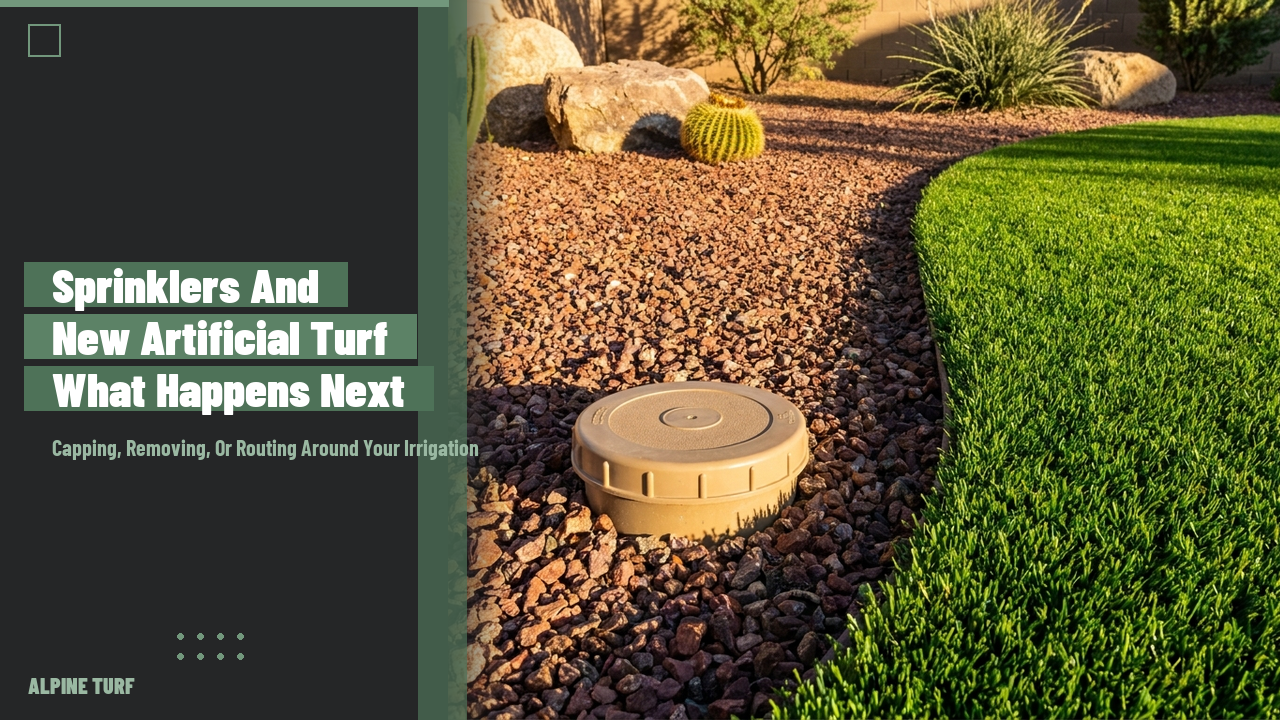
Every backyard turf conversion we quote in the East Valley has the same buried problem: a sprinkler system that's been watering grass for years and has no reason to exist once that grass is gone. Homeowners ask us some version of "what happens to sprinklers when you install turf" on almost every walkthrough, usually right after they picture a $40 bill for the water a dead lawn was already wasting.
The honest answer is that it depends on what's staying and what's going, and getting it wrong is one of the few mistakes that can actually sink a turf install months after we've left the jobsite. Here's exactly how a professional crew sorts out your irrigation before a single piece of base rock goes down.
What Happens to Sprinklers When You Install Turf (If You Just Bury Them)
Artificial turf backing has drainage holes engineered for monsoon rain falling from above, not for a cracked lateral line pushing water sideways underneath it. When a pressurized PVC line sits beneath compacted base rock and turf, any failure, a hairline crack from age, a nick from a trencher during demo, a fitting that finally gives out, has nowhere to go. The water spreads under the base, softens it, and shows up on the surface weeks or months later as a spongy low spot, a sour smell near a seam, or weeds pushing up through a perforation that was never meant to carry that much moisture.
It's also a warranty problem before it's anything else. Every reputable turf and base warranty, ours included, excludes damage caused by water intrusion from an irrigation system that was still live under the install. That's not a loophole, it's the installer protecting themselves from a failure they had no way to inspect after the fact. The only way to avoid that argument six months from now is documenting, at install time, that every line under the turf footprint was properly shut down.
There's a second, more immediate risk during the install itself. Plate compactors run multiple passes over the base rock to hit the density a turf warranty requires, and a line that's still pressurized when that compaction starts is far more likely to crack under the vibration than one that's been drained and capped ahead of time. Dealing with irrigation first isn't a courtesy step, it's sequencing that protects the rest of the job.
Cap, Remove, Or Reroute: The Three Ways We Handle It
Which path makes sense depends on how much of the yard is converting, what's staying planted, and how deep the lines run before they hit caliche. We walk every irrigation line in the footprint before we quote the prep work, and it usually lands on one of three approaches.
| Option | What it involves | Best for | Trade-off |
|---|---|---|---|
| Cap at the valve | Shut the zone off at the valve manifold, then cap each head flush at the lateral so nothing sits exposed under the base | Yards converting entirely to turf with no remaining planted zones on that circuit | Cheapest and fastest option, but the line from the valve to the caps still holds water, so every cap has to be done right the first time |
| Remove entirely | Trench out the lateral lines, pull the heads, patch the mainline, and retire the station on the controller | Full backyard remodels where new drainage, lighting, or hardscape trenches already cross the old irrigation path | Most labor-intensive option once caliche is involved, but it eliminates the risk entirely rather than managing it |
| Reroute to drip | Re-plumb the zone off the old lateral onto a dedicated drip line serving trees, shrubs, or planter beds that are staying in soil | Yards keeping perimeter planting beds, specimen trees, or pot circles around the new turf | Keeps the remaining plants alive without extra trenching, but it only works if the zone wasn't already mixed spray-and-drip on one valve |
Most East Valley backyards end up using two of these at once, cap or remove the zone that was running spray or rotor heads under the grass, and reroute or simply leave alone the drip zone already watering trees and shrubs along the fence line.
What Caliche Does To This Job
This is the part of the process that's genuinely different in the East Valley than almost anywhere else turf gets installed. Caliche, the cemented layer of calcium carbonate that forms in Arizona's alkaline, low-rainfall soil, typically starts somewhere between 8 and 24 inches down across Queen Creek, San Tan Valley, and large sections of Gilbert and Mesa. Where it's shallow and thick, it behaves less like dirt and more like poorly poured concrete. A shovel bounces off it. A hand auger stalls. Homeowners who start a DIY line-removal project on a Saturday morning frequently abandon it by lunch and just cap what they can reach.
That's actually fine, as long as the cap happens at a true shutoff point. The mistake we see most often in yards we're re-doing after a failed DIY attempt isn't that the old lines got left in the ground, it's that they got capped at the sprinkler head instead of back at the valve, which leaves several feet of pressurized line sitting under what will become your turf.
Our crews run a demo pass with a sod cutter first to expose the lateral path before deciding whether a section is shallow enough to pull or sitting on top of hardpan we're better off capping in place. On lots where caliche sits close to the surface, that decision can change every few feet along the same line, which is why this gets assessed on-site rather than quoted sight unseen.
What Happens To The Zones Watering Your Trees And Shrubs
Most East Valley irrigation systems already separate turf-area zones from planting-bed zones, one or two stations running spray or rotor heads across the lawn, and a separate drip zone or two feeding trees, shrubs, and foundation planting. When we convert the grass area to turf, it's only the lawn zone that gets capped, removed, or rerouted. The drip zone watering your palo verde or your foundation shrubs stays exactly as it is, we just make sure the valve isolation keeps water from the active zone away from the converted footprint.
If the whole backyard is going to turf and nothing stays planted, we retire that station on the irrigation controller rather than leaving a dead zone programmed into the schedule. If you're keeping a few accent trees or a planter border around the new turf, we reroute that zone onto drip tubing and, where the turf footprint cuts across the old path, run a sleeve under the turf edge so the drip line can keep reaching plants on the far side without ever sitting under the install itself.
Why Rebate Programs Care About This Step
If you're applying for a grass-to-xeriscape rebate, this isn't just a maintenance detail, it's part of the paperwork. Mesa's combined SRP and city rebate runs up to roughly $1,100 for qualifying conversions, and Gilbert's program pays $800 for residential conversions plus a $250 bonus for an upgraded controller. Both programs require documentation that the irrigation zone feeding the converted turf area was actually shut off or capped, not just that the grass is gone. An inspector or photo-verification reviewer who sees an active spray head sitting in a turf yard can deny the claim outright.
Because we're doing this work as part of the install anyway, we photograph the capped valves and lines as we go and include them in the documentation packet clients submit with their rebate application. It's a five-minute step for us and it's often the difference between a rebate that gets approved on the first pass and one that bounces back for more proof.
What This Actually Costs
This is a small piece of a larger install, not a standalone project, so it's almost always folded into base-prep labor rather than billed as its own line item. As a rough range: capping a zone at the valve typically adds $150 to $400 to a full install, depending on how many heads are on the circuit. Removing lines entirely in caliche-heavy lots runs closer to $3 to $6 per linear foot of trench, mostly labor given how slow that digging can be. Rerouting a zone to drip for retained plantings usually lands between $200 and $500 depending on how many heads convert and how much tubing the remaining beds need.
Frequently Asked Questions
Can I just leave my sprinkler system buried and turned off?
Only if it's capped at a true shutoff point, at the valve or a sealed lateral fitting, not just plugged at the sprinkler head. A line that's merely turned off at the controller is still pressurized at the valve, and any failure in that section will push water under your new turf exactly like an active line would.
What if I'm only converting part of my yard to turf?
We isolate at the valve so only the zone feeding the converted area gets capped, removed, or rerouted. Zones watering grass, planting beds, or trees you're keeping stay fully functional. This is the most common scenario we see in the East Valley, a turf backyard with a live drip zone still running along the perimeter.
Does Alpine Turf handle the irrigation work, or do I need a separate plumber?
We handle capping, removal, and rerouting as part of the install, it's priced into base prep rather than farmed out to a separate irrigation contractor. The one exception is a mainline repair or a backflow preventer issue unrelated to the turf footprint, which we'll flag separately if we find it.
Can my old sprinkler lines be reused for drip irrigation instead?
Sometimes. If a zone was running mixed spray-and-drip off one valve, we usually can't selectively keep part of it, the whole zone gets capped or rerouted together. But a dedicated lateral that's already isolated to a planting bed can often be converted to drip tubing off the same valve without new trenching.
What happens to my irrigation controller after conversion?
We retire the stations tied to zones that no longer exist so your controller's schedule matches reality. If you're applying for a city rebate with a controller upgrade bonus, like Gilbert's $250 smart-controller add-on, we can point you to qualifying models during the same visit.
Will capping sprinklers cause problems with my HOA?
No, HOA irrigation requirements apply to maintaining a green, watered landscape, not to the specific plumbing underneath it. Arizona SB 1016 also prevents HOAs from banning artificial turf outright, so an HOA that required sprinklers for a grass lawn can't use that same rule to block a turf conversion.
Keep reading.
Ready to ditch the grass?
We install premium artificial turf across the East Valley: Gilbert, Chandler, Mesa, Queen Creek, San Tan Valley. Free on-site measure and quote, no obligation.
Book your free quote