
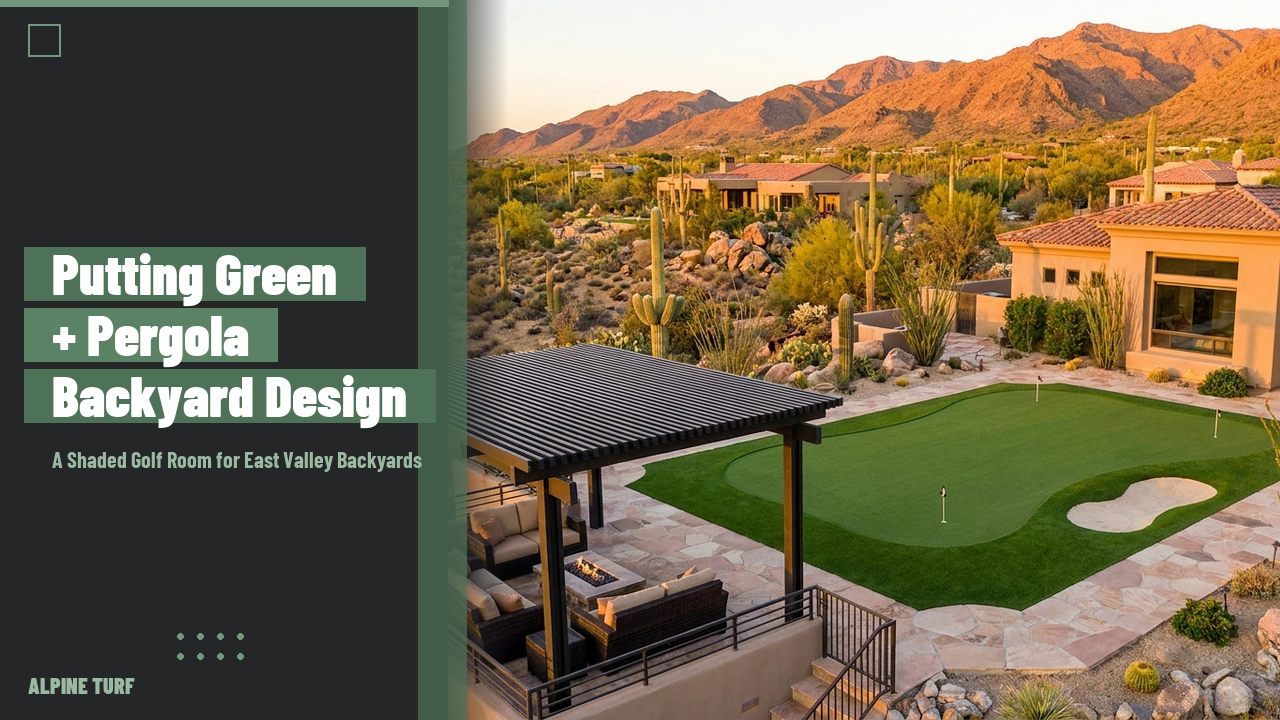
We get the same question on walkthroughs across Encanterra, Las Sendas, and Power Ranch: "Can we do a putting green and still have somewhere shaded to sit?" The answer is yes, and honestly, a backyard putting green and pergola design is one of the few upgrades we build where the finished space gets used nearly every week of the year instead of sitting empty from May through September like a lot of open-lawn backyards do.
The reason most DIY and some contractor-built greens end up unused by July is simple: nobody planned for shade. A green with no cover next to it looks great in a listing photo and then turns into a surface nobody wants to stand on by 11am in the summer. Pairing it with a properly placed pergola solves that, but only if the layout, the turf spec, and the structure itself are chosen for Arizona conditions specifically, not copied from a magazine photo shot in a cooler climate.
Why Pair a Putting Green With a Pergola in the East Valley
A backyard putting green by itself is a single-use feature. You practice, you leave. Add a shaded pergola with real seating along one edge and the same footprint becomes a place people actually hang out, not just a strip of turf with holes cut in it. We see this constantly in Queen Creek and Gilbert remodels: clients who originally asked for "just a putting green" come back during design and ask us to extend the pergola over part of the fringe so they can watch kids practice from the shade with a drink in hand.
There's a practical reason this matters more here than almost anywhere else putting greens get installed. Artificial turf surface temperatures in direct East Valley sun regularly exceed 150°F in July and August, hot enough to be uncomfortable barefoot and genuinely hard on a dog's paw pads in under a minute. A green with zero shade effectively becomes a six-month-a-year feature, usable October through April and avoided the rest of the time. Covering even a third to half of the green, plus the chipping or lounge area beside it, extends real usability into the shoulder months and early mornings or evenings all summer.
The pairing also solves a design problem we run into constantly: a backyard that needs both an active feature and a shaded gathering space, but doesn't have room for two separate structures. A pergola anchored at the edge of the green does double duty, it shades part of the putting surface and creates the seating zone in the same footprint, which matters on East Valley lots where usable backyard square footage is often tighter than homeowners expect once a pool, side yard access, and setback lines are accounted for.
Laying Out the Space: Where the Green and Pergola Go
Orientation decides whether this project works or disappoints. We walk the sun path on every site before finalizing a layout, not just at noon but specifically between 2pm and 6pm in June and July, since that's when shade actually matters most. The pergola almost always goes on the west or southwest edge of the green footprint, so its shadow falls across the putting surface during the worst heat of the afternoon rather than sliding off to one side.
Green shape and size depend on the yard, but a realistic residential green for a full backyard remodel runs 400 to 900 square feet, big enough for 2 to 4 cups and some real break and contour, without swallowing the whole usable yard. Smaller lots in newer Gilbert and Chandler communities, Cooley Station, Ocotillo, and similar tighter-lot neighborhoods, often land closer to 250 to 400 square feet, which is still enough for a legitimate short-game practice area if the contours are designed well rather than just flat turf with holes punched in.
We also plan sightlines from the house and from neighboring yards early, since HOA architectural committees pay close attention to how a pergola reads from the street or from an adjacent property, more on that below. A pergola set too close to a shared fence line, or one tall enough to sit above typical block wall height, is far more likely to get flagged in review than one scaled and positioned to read as part of the backyard rather than looming over it.
Picking a Pergola That Survives Arizona Summers
Wood pergolas look good for about two seasons here before Arizona's sun and low humidity start bleaching, checking, and warping the lumber. We still build them when a client specifically wants that look and understands the maintenance, refinishing every 2 to 3 years to keep it from graying out and cracking, but for a putting green pergola that's meant to provide real daily shade, we steer most East Valley clients toward powder-coated aluminum or steel.
A fixed aluminum pergola with a solid or slatted roof panel gives consistent shade and holds its color for a decade or more without warping. A motorized louvered aluminum pergola costs more upfront, typically adding $4,000 to $12,000 over a comparable fixed structure depending on size, but lets you rotate the louvers closed against a brutal 3pm sun angle in July and open them up for direct morning light in cooler months. For a structure that's meant to extend a putting green's usable season, that flexibility is usually worth the premium, especially on pergolas sized 16 by 20 feet or larger where a fixed roof either over-shades the green in winter or under-shades it in summer.
Whichever material you choose, footing depth matters more here than in most climates because of how shallow caliche sits under much of Queen Creek, San Tan Valley, and parts of Gilbert and Mesa. Post footings generally need to go 24 to 36 inches to clear expansive soil movement and hit stable bearing, and where caliche shows up at 12 to 18 inches, that often means coring or breaking through hardpan rather than simply augering a hole, which is a cost and scheduling detail worth confirming before you sign a pergola-only contract that didn't account for it.
Putting Green Turf: What Actually Makes It Putt True
The single biggest mistake we see in backyard putting greens built by handymen or general landscapers is using standard lawn-style turf and just mowing expectations down to match. Real putting surfaces use a dense, short-pile nylon or polypropylene turf, typically 3/8" to 5/8" in pile height, engineered specifically to hold a consistent, fast roll rather than the longer, more forgiving blade used for a backyard lawn.
Green speed on a well-built residential green lands around 8 to 10 on the Stimpmeter scale used by the United States Golf Association to measure putting surfaces, slower than a tournament green but fast enough to actually practice reads and distance control rather than just knocking a ball toward a hole. Nap direction matters too, the grain of the turf fibers affects how a ball breaks, and a professionally installed green accounts for that in how the turf rolls are oriented and seamed, not just in how the base is shaped.
Around the green itself, we typically run a fringe or "collar" zone in a slightly longer pile, usually 3/4" to 1", to simulate the transition from green to rough and give short chips and bump-and-run shots somewhere realistic to land. Skipping this and running the same low pile turf edge-to-edge is a shortcut that looks fine in photos but plays nothing like a real short-game area.
Base Prep, Grading, and Drainage Under a Putting Green
Contours and breaks on a backyard putting green live in the compacted aggregate base underneath the turf, not in extra padding layered on top. We shape and crown that base before a single strip of turf goes down, typically 4 to 6 inches of compacted road base or decomposed granite, hand-graded and compacted in lifts to hold the subtle slopes that give a green real character. Turf that's simply draped over flat, unshaped base will always putt flat, no matter how good the turf itself is.
Drainage gets more attention on a putting green than on a standard lawn conversion because standing water under a crowned surface shows up fast as a soft spot that throws a ball offline. We grade the base to shed water toward the surrounding hardscape or a perimeter drain rather than letting it pool in low sections of the green's own contours, which is exactly the kind of detail monsoon season in the East Valley punishes if it's skipped. On lots where caliche sits close to the surface, our guide on caliche soil backyard installs covers how that hardpan layer changes excavation and drainage planning for the whole yard, not just the green footprint.
Seaming also matters more here than on a standard lawn install. A visible seam on a backyard putting green isn't just cosmetic, it can create a ridge a rolling ball catches on. We glue and sand-lock seams flat and run them away from primary roll lines where possible, rather than cutting corners on a feature that's judged by how a ball actually behaves on it, not just how it looks from the patio.
HOA Approval for a Putting Green and Pergola Combo
Arizona's SB 1016 prevents homeowners associations from banning artificial turf outright, so the putting green portion of this project generally clears review without much friction once you submit a turf product spec and layout plan. The pergola is a different story. Structures still go through your community's standard architectural review process, setback requirements, height limits, and material or color guidelines that vary by HOA and aren't something we'll guess at for your specific community.
What we can tell you from building these across Gilbert, Chandler, and Queen Creek communities is what tends to go smoothly: pergolas kept below typical block wall sightline height, finished in neutral tones that match the home's existing exterior palette, and positioned with reasonable setback from shared property lines. What tends to get kicked back for revision: pergolas with bright or mismatched roofing, structures that crowd a side-yard setback, or designs submitted without a scaled site plan showing exact placement relative to the property lines.
Our advice on any backyard remodel involving a structure, not just a pergola, is to confirm current architectural guidelines directly with your specific HOA's management company before finalizing design, since requirements do change and vary community to community even within the same city. We handle the design drawings needed for a submission, but the HOA itself is always the final word on its own current rules.
What a Backyard Putting Green and Pergola Design Actually Costs
This is a premium backyard feature, not a budget add-on, and pricing it honestly matters more than making it sound cheap. A standalone backyard putting green, turf, base prep, cups, and basic contouring, typically runs $12 to $22 per square foot depending on size and how much contour and break you want built into the base, so a 500 square foot green generally lands in the $6,000 to $11,000 range before any surrounding hardscape.
A fixed aluminum pergola sized to meaningfully shade part of that green, roughly 14 by 16 feet to 16 by 20 feet, typically runs $8,000 to $16,000 installed, including footings. A motorized louvered version of the same footprint runs $14,000 to $28,000 or more. Add paver decking connecting the green to a seating area under the pergola, usually 200 to 500 square feet at $18 to $28 per square foot installed, and a full combo project with a mid-size green, a fixed pergola, and connecting hardscape generally totals $18,000 to $45,000, with louvered pergolas or larger greens pushing well past that on bigger East Valley lots.
Like the rest of our full backyard remodels, this kind of project can be phased, green and base prep first, pergola and hardscape added in a later budget cycle, as long as sleeves and conduit for lighting or irrigation that'll run under future hardscape get installed during the first phase so you're not re-trenching a finished patio later.
Frequently Asked Questions
How big does a backyard putting green need to be to feel real?
A minimum of around 250 to 300 square feet lets you build in a couple of cups and some meaningful break. Below that, a green tends to feel like a flat practice mat rather than something you can read putts on. Most of our full combo projects land between 400 and 900 square feet.
Can the pergola shade the whole green instead of just part of it?
For most residential lots, no, a pergola sized to fully cover a 500+ square foot green would be large enough to dominate the backyard and likely exceed typical HOA height and footprint guidelines. We usually design for partial coverage, shading the chipping area and one end of the green where play and lounging concentrate, rather than trying to roof the entire surface.
Does putting green turf need infill like lawn turf does?
Yes, but a different type. Putting greens typically use a fine sand infill to help the turf fibers stand upright and maintain consistent roll speed, rather than the rubber or zeolite infill used in pet or lawn-style turf. The amount and grooming frequency affects how the green plays over time.
Will a putting green and pergola combo need a building permit?
The turf itself generally doesn't require a permit, but an attached or freestanding pergola typically does in most East Valley municipalities once it exceeds a certain size or has a solid roof panel. We pull permits as part of the project and handle inspections, so you don't have to track city requirements separately from the HOA process.
How long does a green and pergola combo install take?
A standalone green typically takes 3 to 5 days from excavation to finished turf. Add a pergola and connecting pavers and a full combo project usually runs 2 to 3 weeks, with footing cure time and any permit inspections being the main schedule drivers rather than the turf work itself.
Can we add a putting green to an existing pergola instead of building both new?
Often, yes, as long as the existing structure's footprint and orientation actually provide useful afternoon shade for the green location you want. We'll walk the site and tell you honestly if an existing pergola's position works for this or if the shade falls in the wrong spot to be worth building around.
Keep reading.
Ready to ditch the grass?
We install premium artificial turf across the East Valley: Gilbert, Chandler, Mesa, Queen Creek, San Tan Valley. Free on-site measure and quote, no obligation.
Book your free quote