
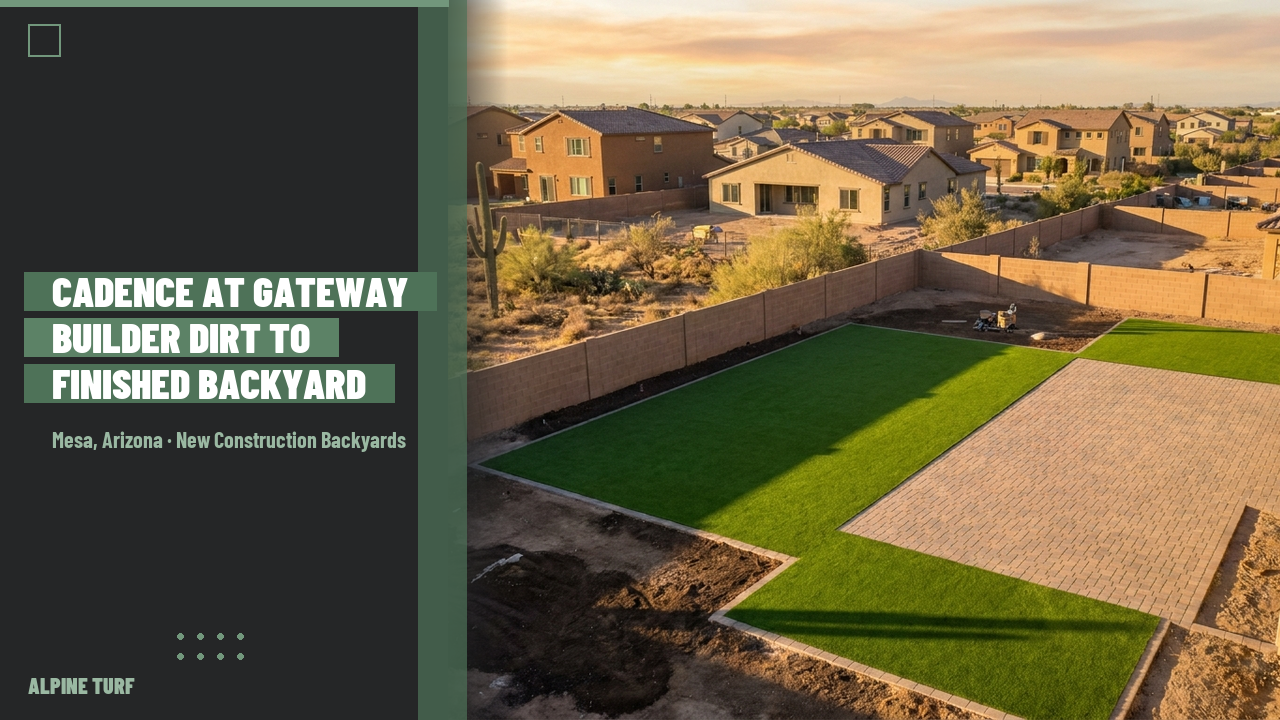
If you just closed on a new home at Cadence at Gateway in far east Mesa, you already know the feeling: a nice stucco elevation, a tile roof, a small slab patio, and dirt everywhere the builder's silt fence used to stand. Cadence at Gateway backyard landscaping is its own project, separate from the house you just bought, and most new owners here underestimate how much ground, and how much HOA paperwork, sits between that dirt lot and a backyard they'll actually use.
We've run turf, paver, and shade jobs across Cadence and the rest of far east Mesa near Phoenix-Mesa Gateway Airport long enough to know the pattern: an HOA that takes Architectural Review Committee (ARC) submittals seriously, caliche hiding under more lots than people expect, and homeowners who finish the front yard, run out of budget, and leave the backyard as dirt for a full year or more. This guide walks through it in the order we'd cover it on a first site visit: how the builder actually leaves your lot, what the HOA wants to see before you dig, what's really in the ground, what to build given a modest lot width, and how to sequence the work so you don't pay to tear anything out later.
Cadence at Gateway Backyard Landscaping Starts With a Dirt Lot
New construction in the East Valley almost always closes the same way: the builder grades the lot flat, pours a small covered or uncovered patio slab (often 10x10 or 10x12), stands the perimeter block wall, and stops. Everything inside that wall, turf, trees, a paver patio big enough to actually use, shade, irrigation, is on the homeowner. Cadence is no exception. Walk a few streets here on any weekend and you'll see the full range: lots still bare at the two-year mark next to lots with a finished turf-and-paver yard that went in within the first six months.
Two things make Cadence lots specific to plan around. First, Lennar's Discovery, Harmony, Horizon, Signature, and Inspiration collections in this community run from roughly 1,760 to 2,958 square feet of living space, and homes in that range sit on efficient, modest-width lots rather than the larger parcels you'd find in an older, more established part of Mesa. That usually leaves somewhere between a narrow side-yard strip and a backyard that's deep but not especially wide once you subtract the patio slab and setbacks. Second, bare dirt in a brand-new subdivision blows. Between haboobs and regular wind off the open desert near the airport, an unlandscaped Cadence lot kicks up dust against your own house and your neighbors' long before you're ready to deal with it, which is one more reason to not let the yard sit.
Before you design anything, walk your own lot and note three things: where the patio slab sits relative to the back wall (that gap is your real usable yard), where the sewer cleanout and water shutoff are (builders usually mark these, but confirm before you dig), and which direction the lot slopes. Builders grade for positive drainage away from the foundation, but that slope has to go somewhere, and on a lot with a shared side yard, it's often toward a swale that routes along the fence line to the street. Whatever you install can't block that path.
Clearing the ARC Before You Touch a Shovel
Cadence at Gateway, like most Lennar-built master-planned communities in the Valley, runs hardscape and landscape changes through an Architectural Review Committee application before any work starts. That includes turf, paver patios, pergolas, and anything that changes what's visible from the street or a neighboring yard. CC&Rs and the specific ARC submittal requirements vary by community and can change over time, so treat your actual HOA documents and your community's management company as the final word, not this post or anything a salesperson tells you verbally.
What we can speak to is pattern, built from running ARC submittals across dozens of East Valley HOAs: a complete package with a site plan, material and color samples, and a basic drainage note moves faster than a bare-bones request, and an incomplete submittal is the single biggest cause of schedule delay on a project like this, not the construction itself. In our experience, build in two to four weeks for a response on a well-documented application, not a same-week turnaround, and plan your install date around that review window rather than around the contractor's calendar.
One thing worth knowing if a neighbor or an older HOA document gives you pushback on artificial turf specifically: Arizona HB 2131, signed into law by Governor Ducey on March 30, 2022 and codified at A.R.S. § 33-1819, prohibits homeowners associations from banning artificial turf outright in communities that already allow grass. An HOA can still regulate appearance, blade color, height, and visible seams, but it cannot refuse turf as a category. That law doesn't replace the ARC process; you still submit and still wait for approval. It just means the conversation is about specification, not permission.
What's Actually Under Your Dirt in East Mesa
East Mesa, including the ground under Cadence at Gateway, sits on desert soil that commonly includes caliche: a cemented layer of calcium carbonate that can range from a soft, crumbly crust to a layer hard enough to dull a shovel and slow an excavator. It doesn't show up on every lot, and where it does, depth varies widely, from a few inches down to well over a foot. You won't know what you're dealing with until someone actually digs a few test holes, which is why we probe before quoting base depth or turf drainage on any new-construction lot rather than assuming standard soil.
Caliche matters for two practical reasons. It doesn't drain the way sandy desert soil does, so a turf or paver base built without accounting for it can trap water during a monsoon downpour instead of letting it percolate. And it's expensive to remove in bulk, so the better move on most residential lots is working with it: breaking and compacting a proper crushed-granite base over it rather than excavating it out entirely, and grading the finished surface so water still moves toward the yard's low point instead of pooling against the house or the block wall.
Grading itself follows the same basic rule everywhere in the Valley: positive slope away from the foundation, water directed to a street, drainage easement, or approved point, and nothing installed that blocks the weep holes at the base of your perimeter block wall. Those weep holes exist so water on your neighbor's side, or runoff moving along a shared swale, has somewhere to go. Burying them under a paver patio or a turf edge is one of the more common mistakes we see on first-time DIY installs, and it's also one of the faster ways to get an ARC complaint once water starts backing up against the wall during monsoon season. The City of Mesa's residential construction and permitting guidance is the reference point for what does and doesn't need a grading or drainage plan on file before you build.
Turf and Hardscape That Fit a Builder-Grade Lot
On a lot with a modest footprint, design decisions carry more weight than they would on an acre out in Queen Creek. We generally steer Cadence homeowners toward one continuous turf field rather than a patchwork of small planted beds and grass islands, because a single clean surface reads larger and holds up better against the reflected heat coming off two-story stucco walls, which is a real issue on narrower east- and west-facing side yards in this community. Artificial turf also solves a problem specific to new construction: there's no existing lawn to maintain or kill off first, so there's nothing to remove, no transition period, and no dead patches while new sod establishes in July heat.
If you've already got grass elsewhere in Mesa and you're deciding whether to convert it, our Mesa grass-to-xeriscape rebate guide covers the city and SRP incentive stack, but it doesn't apply here: there's no live lawn on a new Cadence lot to remove, so the rebate math simply doesn't come into play on this kind of project. What does carry over is the base-prep approach, since the same caliche soil conditions across the East Valley apply to new-construction dirt just as much as to an older yard being converted.
For hardscape, size the paver patio to the gap between the slab and the back wall rather than to a Pinterest photo of a half-acre yard. On a narrower lot, an L-shaped patio that wraps one corner usually reads bigger and functions better than a single rectangle centered on the yard, because it leaves a continuous turf run along the opposite side instead of carving the yard into disconnected strips. Keep sightlines in mind too: a pergola or shade sail placed to block the harshest west sun on the patio does more for how often you'll actually use the yard than almost any other single decision, and it's a lighter ARC submittal than a full patio cover if your community treats the two differently.
Sequencing the Install So You Don't Pay Twice
The single most expensive mistake we see on new-construction lots isn't a bad material choice, it's bad sequencing: homeowners install turf and pavers first, then add a pergola, outdoor kitchen, or putting green a year or two later and discover the electrical and irrigation lines they need now run directly under finished hardscape. Re-opening a paver patio to add a conduit run costs more than running it up front would have, even if phase two is still a maybe at move-in.
Sleeves, conduit, and drainage before anything else
Before any turf or pavers go down, run PVC sleeves under future hardscape for irrigation lines, low-voltage lighting wire, and any 110v or 220v conduit you might want for a future kitchen or spa. Sleeves cost very little compared to the cost of cutting into finished pavers later, and they cost nothing to leave capped and unused if phase two never happens. Set your drainage, confirm the grade moves water to its final point, and have the ARC-approved site plan on hand for the install crew so nothing shifts from what was submitted.
Base, turf, and paver installation
With sleeves and grading set, this is the core install: compacted crushed-granite base, turf with a drainage-backed system and the right infill for your climate and any pets, and paver patio set on its own compacted and screeded base, not just laid over native soil. This phase is also when planting beds, drip irrigation, and any low-voltage lighting actually go in, since all of it ties back to the sleeves placed in step one.
Shade and lifestyle additions when the budget allows
Pergolas, outdoor kitchens, fire features, and putting greens are the features that make a backyard feel finished, but they're also the easiest to delay without regret if step one left the infrastructure in place. A pergola footing can go into an existing paver patio with minimal disruption if conduit is already sleeved underneath. Without it, you're cutting pavers, trenching turf, and paying a second mobilization fee for work that could have been a line item on the original install.
Frequently asked questions
Does Cadence at Gateway require ARC approval before I install turf or pavers?
Yes. Like most Lennar-built master-planned communities, Cadence routes hardscape and landscape changes through an Architectural Review Committee application before work starts. Requirements can change over time, so check your current CC&Rs and submit through your community's management company rather than relying on secondhand information. We handle the submittal paperwork as part of every quote.
How long does a Cadence at Gateway backyard install take once the ARC approves it?
On a typical Cadence lot, a full turf-and-paver backyard with sleeves and drainage prep runs 3 to 5 working days once materials are on site. Larger jobs that add a pergola or outdoor kitchen footing in the same mobilization can run a week or more. We schedule around monsoon season and extreme heat days, which can shift timelines by a day or two.
Is there caliche under my Cadence at Gateway lot?
Possibly. Caliche shows up across east Mesa, but not on every lot, and depth varies widely where it does occur. We probe a few test spots before quoting base depth on any new-construction lot rather than assuming standard soil conditions, since guessing wrong affects both drainage and long-term turf performance.
Do I need a City of Mesa permit for backyard turf or pavers?
Most residential turf and paver-patio installs don't require a City of Mesa permit if drainage structures and the block wall aren't being altered. A pergola, patio cover, or anything attached to the house may trigger permit requirements depending on size and design. HOA approval is a separate process from a city permit, and you may need both depending on scope.
Can I install the backyard in phases and add a pergola or putting green later?
Yes, and on a Cadence budget it's often the smarter move. The key is running irrigation sleeves, lighting wire, and any electrical conduit under the hardscape during the first phase, even if you're not sure yet what phase two will include. That one decision is what keeps a future pergola or kitchen addition from requiring you to cut into finished pavers.
Can my HOA refuse to approve artificial turf at all?
No. Arizona HB 2131, signed into law in March 2022 and codified at A.R.S. § 33-1819, prohibits homeowners associations from banning artificial turf outright in communities that already allow grass. An HOA can still regulate appearance, blade color, height, and visible seams through its normal ARC process, but it cannot refuse turf as a category. You still need to submit and get approval on specification, not permission.
Keep reading.
Ready to ditch the grass?
We install premium artificial turf across the East Valley: Gilbert, Chandler, Mesa, Queen Creek, San Tan Valley. Free on-site measure and quote, no obligation.
Book your free quote