
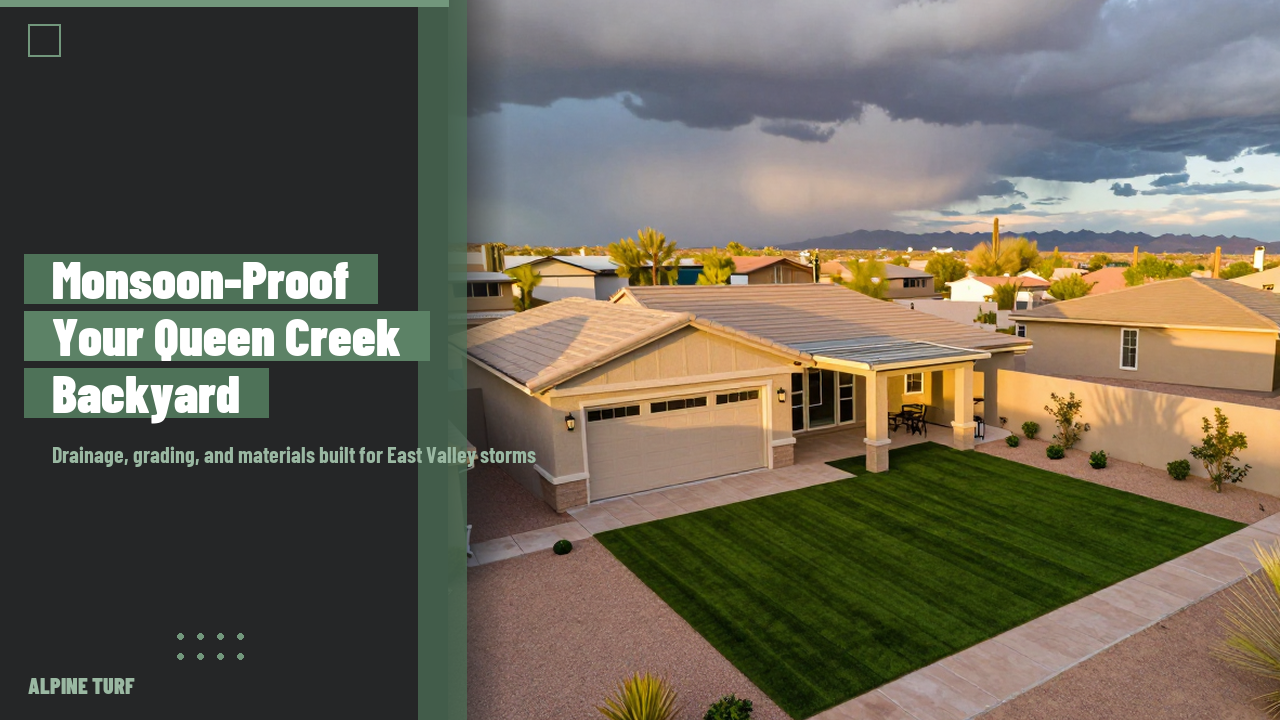
Every monsoon season, a handful of Queen Creek backyards end up standing in water, a ramada roof peels back in the wind, or a paver patio heaves where water pooled against it for three days straight. A monsoon proof backyard Queen Creek homeowners can actually count on through July, August, and September isn't luck. It's grading, drainage, and material choices locked in before the first storm cell rolls up off the San Tan Mountains, not patched together after the yard has already failed once.
We've designed and built backyards across Queen Creek long enough to know exactly where a storm finds the weak point: a lot graded just flat enough to pass final inspection, a turf base that traps water instead of shedding it, or a shade structure anchored like patio furniture instead of a structure engineered for wind. This guide walks through the full build in order, from grading and drainage, through turf and hardscape, to the plants and shade structures that take the hardest hit when outflow winds move through ahead of the rain.
Why Queen Creek Backyards Take the Worst of Monsoon Season
Queen Creek sits at the bottom of a watershed, not the top of one. The Queen Creek Wash and the Sonoqui Wash both run through town, and the San Tan Mountains to the south funnel a large volume of surface runoff straight into residential neighborhoods during a heavy cell, even when the storm itself never passes directly overhead. That geography is part of why the Town of Queen Creek runs a full Stormwater Management Plan through Public Works as required by the EPA and the Arizona Department of Environmental Quality, and why the Town and the Flood Control District of Maricopa County are jointly funding a detention basin and buried storm drain upgrade along the Sonoqui Wash corridor near Cloud Road.
That town-level infrastructure handles the wash. It does nothing for what falls directly on your lot. Most Queen Creek backyards sit on a thin cap of builder topsoil over dense clay and caliche subsoil that barely percolates, which we cover in detail in our clay soil yard problems guide. Add a backyard that was rough-graded flat enough to pass a final city inspection and nothing more, and a half-inch-an-hour monsoon cell has nowhere to go but sideways, toward whatever's lowest: your patio slab, your turf, or the block wall.
Wind complicates the picture before a single drop falls. Outflow boundaries, the gusty leading edge of a collapsing thunderstorm, routinely push 40 to 60 mph ahead of the rain across the open desert terrain around Queen Creek, kicking up a wall of dust that can reduce visibility to near zero in minutes. A monsoon proof backyard has to survive both halves of that event: the wind that hits first, and the water that follows.
Monsoon Proof Backyard Queen Creek Design Starts With Grading and Drainage
Grading is the cheapest, most important decision in the entire project, and it's the one most new builds get wrong first. The standard we build to is roughly a 2% slope, about a quarter inch of drop per foot, moving water away from the foundation for the first 10 feet of yard before it's allowed to level out toward an approved exit point: a street, a drainage easement, or a retention area your HOA or the Town has on file. Anything flatter than that and water sits long enough during a real monsoon downpour to soak into clay subsoil that was never going to absorb it anyway.
Two details trip up more Queen Creek yards than anything else. First, the weep holes at the base of your perimeter block wall exist so water moving along a neighbor's yard or a shared swale has somewhere to exit. Burying them under a paver patio or a turf edge, which we see constantly on DIY and rushed installs, turns your own wall into a dam during the next storm. Second, a lot that drains toward the back of the property, common across newer Queen Creek subdivisions that were rough-graded to shed water away from the street, needs a real plan for where that water goes once it reaches the back fence line: a French drain, a swale lined in rock rather than bare dirt, or a dry well, not a hope that it soaks in before the next cell arrives.
If your lot already floods and you're trying to fix an existing problem rather than build a new yard from scratch, our flash flood drainage guide walks through diagnosing and correcting an existing grading failure, the East Valley caliche conditions in that post apply here too.
Turf That Drains Instead of Pools
Artificial turf is one of the better monsoon materials available, but only when the base underneath it is built for Queen Creek clay, not generic desert sand. A proper turf base starts with a geotextile fabric layer that keeps the clay subsoil from migrating up into the compacted granite base over time, a 3 to 4 inch layer of crushed granite compacted in lifts, and turf with a perforated, drainage-backed system rather than a solid-backed product meant for indoor or athletic use. Skip the fabric layer on clay and the base slowly contaminates itself within a few seasons, which is exactly when yards start holding puddles after storms that didn't used to cause problems.
The turf itself still needs a direction to drain. A dead-flat panel on a dead-flat base just moves the pooling problem up one layer, from bare dirt to the surface of the lawn. We grade the base under the turf with the same positive slope as the rest of the yard, so water that does work its way through the blades keeps moving toward the yard's low point instead of sitting against a paver edge or a planting bed border. Infill choice matters too: a zeolite or antimicrobial blend sheds water faster than straight silica sand and resists the smell that standing moisture creates after a storm, especially relevant if you've got dogs using the same turf.
Paver Patios and Hardscape Built to Shed Water, Not Trap It
A paver patio that heaves, settles unevenly, or ponds water after a storm almost always traces back to the base, not the pavers themselves. Travertine, concrete pavers, and natural stone all hold up fine against Queen Creek's sun and monsoon rain when they're set on their own compacted and screeded base rather than laid directly over native clay. We pitch every patio surface at roughly a quarter inch per foot away from the house, matching the yard's overall grade, and we route that water to the same drainage path the turf and planting areas use rather than creating a second, competing low point.
Joint material matters more in monsoon country than most homeowners expect. Polymeric sand locks pavers in place and resists washout better than standard joint sand during a heavy downpour, but it has to be installed and activated correctly or it can actually seal the joints shut and turn the patio surface into a sheet that sheds water somewhere you didn't plan for. Step risers, raised planters, and any transition between patio and turf need a drainage gap or a channel drain underneath; without one, water backs up at that seam every time, which is one of the most common callback issues we see on patios that weren't built with monsoon volume in mind.
Ramadas, Pergolas, and Shade Structures Built for Wind, Not Just Shade
Most shade-structure failures we get called out for after a monsoon storm aren't roof failures, they're footing failures. A pergola or ramada post set in a shallow surface-mounted base, or one anchored with nothing more than a few concrete deck blocks, can rack or lift entirely once a 50 mph outflow gust catches a solid or semi-solid roof panel. We set posts in engineered footings, concrete poured below grade and sized to the structure's wind load, not just deep enough to hold the post upright on a calm day.
Roof material changes the wind math significantly. A lattice or open-beam pergola top lets wind pass through and loses far less to uplift than a solid Alumawood or steel panel roof, which catches wind like a sail if it isn't properly fastened and braced. If you want full shade and rain coverage, which most Queen Creek homeowners do for a usable outdoor kitchen or lounge area, a solid roof is the right call, but it has to be engineered for the load, not just purchased off a catalog page and bolted to whatever's underneath. Shade sails are the one structure we steer people away from using as a permanent, unattended monsoon-season fixture; they need to come down or release before a storm, and most homeowners forget until it's too late.
Plant Selection and Erosion Control Along Walls and Slopes
Bare dirt is the single biggest contributor to both erosion and wind-blown dust in a Queen Creek yard, and it's also one of the easiest things to fix permanently. Deep-rooted natives like Thompson's yucca, desert ironwood, and red bird of paradise form a dense root network that holds soil in place on berms, slopes, and the strip along a block wall where runoff concentrates during a storm. We plant those zones first, before turf or hardscape goes in, so the roots have a season to establish before they're asked to hold a slope through an actual monsoon event.
Decomposed granite ground cover does double duty in planting beds that aren't turf or paver: it cuts wind-blown dust compared to bare dirt and it slows surface runoff enough to let water infiltrate rather than sheet straight toward the lowest point in the yard. Any swale or channel carrying concentrated runoff should be rock-lined rather than left as bare dirt; an unlined channel erodes wider and deeper with every storm, eventually undermining whatever hardscape or turf edge sits next to it.
Sequencing the Build So the First Storm Doesn't Undo It
The order matters as much as the materials. Grading and drainage establish the yard's entire water story and have to be right before anything else goes in, because turf, pavers, and shade structures all get built on top of that grade, not independent of it. Getting this sequence backward is the single most common reason a brand-new Queen Creek backyard floods during its first monsoon season despite everyone involved thinking they did it right.
Grading, drainage, and sleeves before anything else
Set final grade across the whole lot first, confirm the slope away from the foundation and toward an approved exit point, and install any French drains, swales, or dry wells the site needs. This is also when PVC sleeves go in under future hardscape for irrigation, lighting, and any conduit you might want for a future kitchen or spa, since re-opening finished pavers to add one later costs far more than running it now.
Turf base, paver base, and planting zones
With grading set, build the turf base with geotextile fabric and compacted granite, set paver bases independently with their own compaction and pitch, and get deep-rooted plants into any slope or berm zone early enough to establish roots before the next monsoon season. All three should still be moving water toward the same drainage path established in step one.
Engineered shade structures and finishing details
Ramadas, pergolas, and patio covers go in last, with footings sized to the structure's actual wind load rather than a generic post-hole depth. By this point the sleeves from step one make running power and lighting to the structure straightforward, and the yard's drainage is already proven rather than theoretical.
Frequently asked questions
When is monsoon season in Queen Creek, and when should backyard prep be finished?
Arizona's monsoon season runs June 15 through September 30, fixed dates the National Weather Service adopted in 2008. We aim to have grading, drainage, and base work finished before mid-May so turf, pavers, and shade structures have time to fully cure and settle before the first real storm cell arrives.
How much slope does my yard actually need to drain properly?
We build to roughly a 2% slope, about a quarter inch of drop per foot, moving water away from the foundation for at least the first 10 feet before it's allowed to level toward an approved exit point. Flatter than that, and clay-heavy Queen Creek soil holds water long enough to cause problems during a heavy cell.
Will artificial turf trap water during a monsoon downpour?
Not if the base is built correctly. A perforated, drainage-backed turf system over a properly graded, compacted granite base with a geotextile fabric layer sheds water the way it's designed to. Turf laid over an unprepped or dead-flat base is what actually traps water, and that's a base problem, not a turf problem.
Can my paver patio survive monsoon runoff without heaving or shifting?
Yes, when it's set on its own compacted and screeded base with correct pitch and properly installed polymeric joint sand, not laid directly over native clay. Most heaving and shifting we get called to repair traces back to a base that skipped one of those steps, not a flaw in the pavers themselves.
How do I make sure a ramada or pergola survives monsoon wind?
Set posts in engineered footings sized to the structure's wind load, below grade, not shallow surface-mounted bases. Open lattice roofs handle outflow gusts better than solid panel roofs; if you want a solid roof for full shade and rain coverage, it needs to be engineered and properly braced, not just bolted on.
Does the Town of Queen Creek's stormwater work affect my own backyard drainage?
Town infrastructure like the Sonoqui Wash detention basin and the storm drain network handles neighborhood and wash-level flooding, but it does nothing for water that falls directly on your lot. Your own grading, drainage, and base prep are what determine whether your specific backyard floods during a storm, regardless of what the Town has built nearby.
Keep reading.
Ready to ditch the grass?
We install premium artificial turf across the East Valley: Gilbert, Chandler, Mesa, Queen Creek, San Tan Valley. Free on-site measure and quote, no obligation.
Book your free quote