
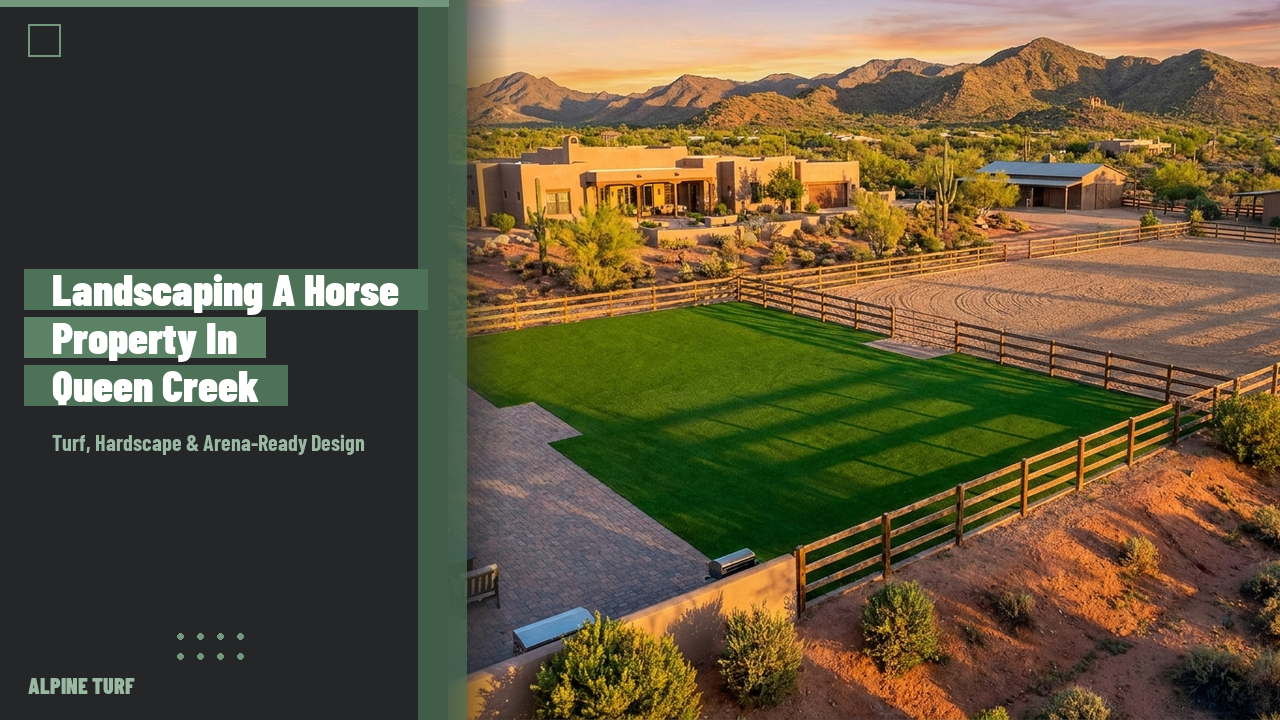
Queen Creek still has real acreage. Out along Rittenhouse, Hawes, Combs, Ocotillo, and the Signal Butte corridor, lots run an acre and up, and a lot of them come with a barn, a round pen, or a full arena already on the property. Horse property landscaping Queen Creek owners take on is a different job than a standard backyard install, because half the site has to hold up to hooves, manure, and a truck-and-trailer combo, and the other half is where the family actually lives.
We've designed and installed on enough of these lots to know where homeowners get it wrong: they hire a standard residential landscaper who treats the whole property like one big yard, and six months later the turf is stained from arena runoff, the trailer can't clear the new gate, or the HOA (or the county) flags something that should have been checked before the first shovel went in. This guide covers where turf actually belongs, how to fence and gate the property so it works for horses and vehicles, how to grade so drainage doesn't destroy your landscaping, which common East Valley plants are dangerous to keep near horses, and realistic budget ranges for the landscaped, non-arena portion of the property.
Horse Property Landscaping Queen Creek: The Non-Negotiables
Before any design conversation, a horse property needs to be split into two functional zones, and they should almost never overlap: the equine zone (arena, round pen, paddocks, turnouts, wash rack, manure storage) and the human zone (house, patio, pool, entertaining space, kids' play area). Everything in this guide flows from keeping that line clear.
The equine zone needs footing that drains, doesn't compact into concrete, and doesn't get slick, which usually means sand, decomposed granite, or a purpose-built arena mix, not turf and not decorative rock. The human zone is where turf, pavers, shade structures, and plantings actually go. The failure mode we see most often is a homeowner who wants "more green" and asks for turf to be extended toward the barn or along a paddock fence line. It looks good in a rendering and fails within a season: manure and urine runoff stains and eventually kills synthetic turf infill, and horses reaching over a fence line to graze on turf will pull up seams that cost real money to repair.
Dust control is the other non-negotiable most first-time horse property owners underestimate. Arena and turnout footing kicks up fine dust in Queen Creek's dry months, and if the human zone sits downwind without a buffer, it settles on the patio, the pool, and the house siding daily. Where the lot allows it, we orient hardscape and turf areas upwind or add a planting buffer (mesquite, palo verde, or a dense shrub row) between the arena and the entertaining space specifically to cut dust migration, not just for looks.
Zoning, Setbacks, and What You're Actually Allowed to Build
Horse-keeping in Queen Creek is tied to zoning, not just acreage. Some districts allow horses outright on qualifying lots (generally larger, low-density residential parcels), while standard suburban zoning and many HOA-governed communities do not, regardless of how much yard you have. Setback distances for corrals, stalls, and manure storage from property lines and neighboring residences also vary by parcel and subdivision, and they matter for where you can legally put an arena, a run-in shed, or even a fence line.
We do not guess at these numbers for a specific address, and you shouldn't either. Before finalizing a design, confirm your parcel's zoning designation, permitted animal units, and setback requirements directly with Queen Creek's Planning & Development Services and, if applicable, your HOA's architectural committee. Some Queen Creek horse properties sit inside HOA-governed subdivisions with their own CC&Rs covering fence style, arena visibility from the street, and manure management, layered on top of the town's zoning rules. Others are on county-adjacent parcels with fewer restrictions but still subject to the town's building and drainage requirements for any structure or grading work.
What we submit for design review on nearly every horse property job: a site plan showing the equine zone boundary, fence type and height, arena or turnout footprint, drainage routing, and any structures (run-in sheds, wash racks, tack rooms) that require a building permit. Getting this confirmed before you order material saves you from re-fencing or re-grading something that didn't meet a setback you didn't know applied.
Where Turf Ends and Horse Footing Begins
Artificial turf on a horse property earns its place around the house: a patio lawn for entertaining, a kids' play area, a dog run, a pool surround. It should never be the footing horses stand, walk, or are ridden on. Real arena and turnout footing needs to do things turf physically can't: drain fast after a monsoon downpour, cushion joints without excessive give, and hold up to repeated hoof impact without compacting into a hard, slick pan.
For turnouts and paddocks, a compacted decomposed granite base with a sand or screenings topcoat is the standard East Valley approach, sloped to shed water rather than pond it. Arena footing is a step up in engineering: a compacted sub-base, a geotextile separation layer in some cases, and a sand or sand-fiber blend topcoat sized to the riding discipline, typically 3 to 5 inches deep. This is a specialty install separate from turf and landscape work, and any installer who quotes turf as a substitute for arena footing either doesn't understand the use case or isn't being straight with you.
Where turf and the equine zone meet, the transition needs a hard edge, not a gradual fade. We detail this with a paver or steel edge restraint set below grade, backed by a compacted decomposed granite buffer strip 3 to 6 feet wide between the fence line and the turf edge. That buffer strip does two jobs: it keeps a curious horse's mouth away from turf fibers and infill, and it gives runoff somewhere to sheet across and drain before it ever reaches the turf base.
Inside the human zone itself, turf selection follows the same rules as any East Valley backyard: a shorter, denser blade pattern for a manicured look near the patio, a more resilient pet-grade product with antimicrobial infill if dogs share the space, and proper crushed-granite base compaction so the turf doesn't develop low spots that pond after monsoon storms.
Fencing, Gates, and Trailer Access That Actually Works
Powder-coated steel pipe fencing is the standard for East Valley horse properties for good reason: it holds up to Arizona sun without the maintenance cycle of wood rail, it doesn't splinter, and horses generally respect it better than wire. No-climb woven wire backed by pipe or wood posts works for smaller paddocks and is more budget-friendly, but it needs more frequent tension and repair checks than pipe. Whichever system you choose, fence height for general horse containment runs 5 feet minimum, with taller fencing (5.5 to 6 feet) recommended for breeds or individual horses known to test a fence line.
Gates are where we see the most expensive mistakes from owners who fenced the property themselves or hired a standard fence contractor. A gate sized for a single horse or a garden cart does not work for a truck and a two- or three-horse trailer. Plan for at least 12 feet of clear opening width for any gate a trailer needs to pass through, and 14 feet if the approach angle isn't dead straight. The apron on both sides of that gate needs to be compacted and graded flat, not loose dirt or gravel that ruts under trailer tire weight after rain; a paver or compacted decomposed granite apron extending 15 to 20 feet back from the gate keeps the approach usable in wet conditions.
Turning radius matters as much as gate width. A truck-and-trailer combo needs a wide, unobstructed arc to line up with a gate, so fence lines, landscape boulders, and mailbox posts near a trailer gate should sit well clear of that swing path, not tight against it because it looked cleaner in a landscape plan. We walk the actual approach with the owner's truck and trailer, if they have one on site, before finalizing gate placement, not after the fence is already in the ground.
Drainage and Grading Around Paddocks and Arenas
Monsoon season is the real test of a horse property's grading plan, and it's also where turf and hardscape near the equine zone most often go wrong. Water and runoff have to move away from the house, away from the turf and patio areas, and away from the arena and paddocks toward a drainage path that doesn't dump onto a neighboring property or pond against a fence line. On acreage lots this usually means more total grading and drainage work than a standard subdivision backyard, simply because there's more ground to move water across.
The specific failure we get called to fix most often on existing horse properties: a paddock or turnout graded so that its runoff, carrying manure and urine, sheets directly toward a turf lawn or patio instead of away from it. Beyond the smell and staining, that runoff accelerates infill breakdown and can void a turf product's warranty. The fix is almost always a combination of re-grading the equine zone to slope away from the human zone, and a French drain or swale cut along the boundary buffer strip to intercept and redirect anything that does make it that far.
Manure management ties directly into drainage. A manure storage or composting area needs its own pad, ideally with some cover or a bermed edge, set back from both the arena's drainage path and any wash toward the turf zone. Wash racks need a dedicated drain, not a slope toward decorative gravel or turf, since wash water carries the same contamination risk as paddock runoff.
Shade, Hardscape, and Horse-Safe Plant Choices
The human zone on a horse property gets the same hardscape and shade treatment as any premium East Valley backyard: paver patios, a pergola or ramada for shaded seating, string lighting or low-voltage landscape lighting, and a plant palette that earns its water. The one added layer is making sure nothing planted near the fence line, the arena, or hay storage is dangerous if a horse gets to it.
Oleander is the plant we flag most often. It's everywhere in East Valley landscaping because it's tough, drought-tolerant, and blooms most of the year, but it's seriously toxic to horses; the University of Arizona Cooperative Extension's guide to poisonous rangeland plants lists it among the plants that pose a real risk to livestock, and a small amount of ingested leaf material can be lethal. Horses generally won't choose to eat green oleander, but dried clippings blown into a paddock or accidentally mixed into hay change that risk fast. If oleander is already established anywhere near a fence line, turnout, or hay storage area on a property you're taking over, remove it before anything else goes in the ground.
Beyond oleander, keep the plant palette near paddocks and arenas limited to what's actually needed for dust control and shade, using desert-adapted, non-toxic species like mesquite, palo verde, and desert willow for shade trees, and skip ornamental shrubs with any question mark next to them near a fence line a horse can reach over. Inside the human zone, away from the equine areas, the full East Valley plant palette is open: bougainvillea, lantana, red yucca, and the usual mix of low-water color and structure plants that work anywhere else in Queen Creek.
Realistic Budget Ranges and Timeline
Arena footing, fencing, and structures like barns or run-in sheds are their own specialty scopes with their own pricing, and we're not going to pretend a single number covers all of it here. For the landscaped, non-arena portion of a Queen Creek horse property, the human zone, buffer strip, and any dust-control planting, three tiers cover most of what we build:
Larger lots and longer buffer strips push toward the top of each range simply because there's more grading, more fence-line frontage, and more irrigation run to cover. Timeline from signed design to finished human-zone landscaping typically runs 5 to 10 weeks, longer if drainage work requires permitting or if the project is sequenced around an active arena build happening at the same time.
Frequently asked questions
Can I put artificial turf in a horse paddock or turnout?
No. Turf isn't engineered to handle sustained hoof traffic, and horses that graze on turf fibers can pull up seams. Paddocks and turnouts need sand, decomposed granite, or a proper arena footing mix that actually drains and cushions. Turf belongs in the human zone: the patio, the play area, the pool surround.
Do I need a permit to fence a horse property in Queen Creek?
It depends on the fence type, height, and your specific zoning district, and whether the parcel sits inside an HOA with its own architectural review. Confirm setback and permit requirements with Queen Creek Planning & Development Services before installing, since requirements vary by parcel and subdivision rather than following one town-wide rule.
How wide does a gate need to be for a horse trailer?
Plan on at least 12 feet of clear opening for a truck-and-trailer combo, and 14 feet if the approach isn't a straight shot. The apron on both sides should be compacted and graded flat so it doesn't rut under trailer weight after rain.
What plants should I avoid on a horse property?
Oleander is the most common and most dangerous offender in East Valley landscaping; it's seriously toxic to horses even in small amounts. Keep any plant with unclear toxicity away from fence lines, turnouts, and hay storage, and stick to known desert-adapted, non-toxic species like mesquite, palo verde, and desert willow near the equine zone.
How do I stop paddock runoff from ruining my turf or patio?
Grade the equine zone to slope away from turf and hardscape, not toward it, and build in a compacted buffer strip and, where needed, a French drain or swale along the boundary. This is the single most common fix we make on existing horse properties where the two zones weren't separated correctly from the start.
How long does landscaping a horse property take?
The human-zone landscaping (turf, hardscape, shade, planting) typically runs 5 to 10 weeks from finalized design to walk-through. Arena footing, barns, and structural fencing are separate specialty scopes with their own timelines, and we sequence around them when both are happening on the same property.
Keep reading.
Ready to ditch the grass?
We install premium artificial turf across the East Valley: Gilbert, Chandler, Mesa, Queen Creek, San Tan Valley. Free on-site measure and quote, no obligation.
Book your free quote