
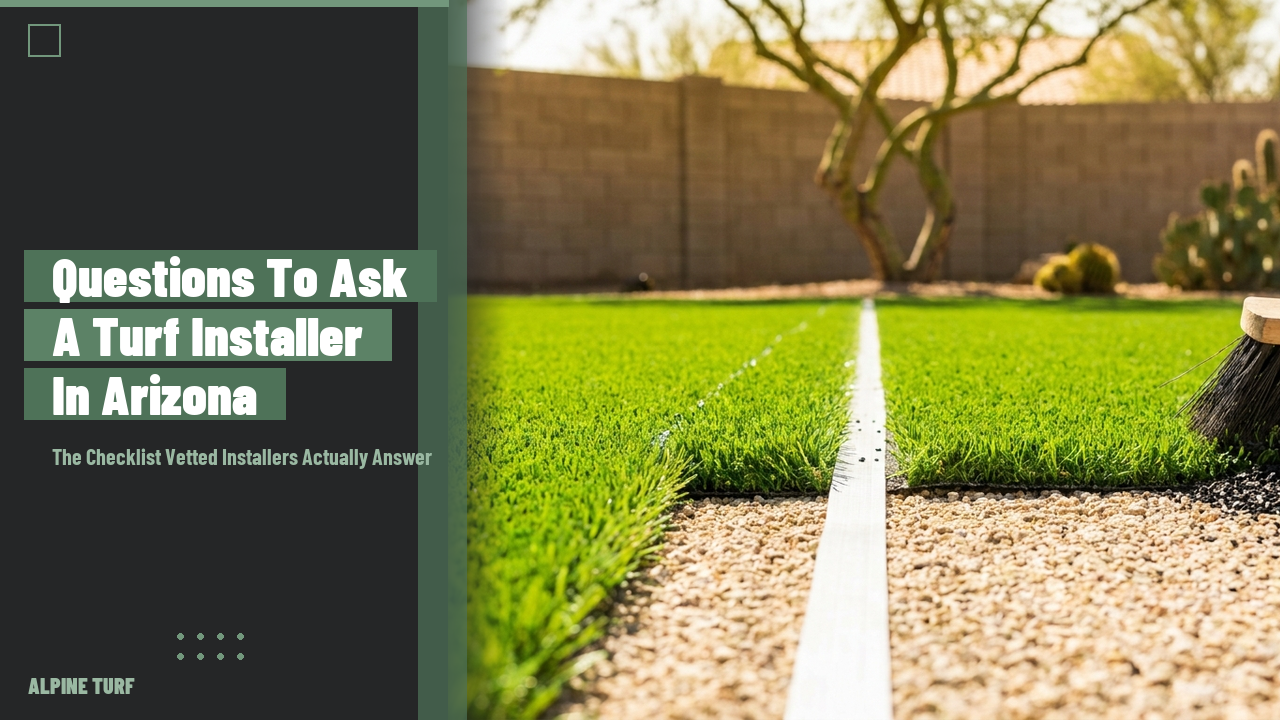
We get called out to fix more turf jobs than we'd like — not because the artificial grass itself failed, but because whoever installed it skipped a step nobody sees until the lawn stops draining, the seams start lifting, or the whole thing looks flat and matted after eighteen months. Arizona is not a forgiving climate for a shortcut. Summer surface temperatures on turf routinely exceed 150°F, monsoon storms can drop an inch of rain in twenty minutes, and a lot of East Valley lots sit on caliche, a cemented layer of calcium carbonate that doesn't drain and doesn't compact like normal soil.
None of that shows up on a sample swatch. It shows up eighteen months later, after the crew is gone and the invoice is paid. The fix is asking the right questions before you sign a contract, not after the lawn fails. This guide walks through exactly what to ask, in the order that actually protects you, and what a real answer sounds like versus a stall.
Start with the license and who's actually on your property
Before a single question about product specs, confirm who you're hiring. In Arizona, turf installation on a residential job falls under the CR-21 Landscaping & Irrigation contractor classification issued by the Arizona Registrar of Contractors, the same license category that covers pavers, planting, and retaining walls under three feet. It requires four years of documented field experience and passing the state's trade and statutes exams. A business card with a license number printed on it proves nothing on its own — look the number up yourself at roc.az.gov, where you can confirm the classification is active and check for any complaint history.
Ask directly: "Are the installers on my property your own W-2 employees, or is this job subcontracted?" Either arrangement can produce good work, but subcontracted turf crews are frequently paid a flat rate per square foot, which creates a direct incentive to move fast through the base prep and seaming steps that take the most time and are the hardest to inspect after the fact. If the answer is subcontracted, ask who supervises the crew on-site and whether that supervisor is also licensed. A company that can't answer who is physically doing the work on your lawn is not a company that's going to stand behind it when something goes wrong.
Ask about base material and compaction depth
The base is the part of a turf install nobody sees again after the first week, which is exactly why it's the step most likely to get shorted. Ask specifically: "What base material are you using, how deep will it be compacted, and what will you compact it with?"
For a residential East Valley lawn, the standard is 3 to 4 inches of a crushed, angular base material — commonly class II road base or a similar decomposed granite product — compacted in lifts with a plate compactor, not just driven over with a truck tire or hand-tamped. A base that's too shallow won't hold its shape under foot traffic and will develop low spots. A base compacted with the wrong equipment looks fine on install day and starts shifting within a season. If an installer's answer is vague on depth or equipment, or if they tell you the existing dirt is "good enough" without excavating it first, that's a shortcut that costs you later, not now.
Also ask what happens to the existing lawn or dirt before base goes down. Organic material, old grass, and root systems need to be fully removed, typically 3 to 4 inches below finish grade, because anything organic left underneath will decompose over time and create a sunken spot in your new lawn a year or two down the road.
Ask how they'll handle drainage and caliche
This is the question that separates an installer who's worked East Valley soil from one who hasn't. A meaningful percentage of lots across Queen Creek, San Tan Valley, Gilbert, and parts of Mesa and Chandler sit on caliche — a hardpan layer of cemented calcium carbonate that can start just a few inches below grade and effectively acts like concrete. Ask directly: "If you hit caliche during excavation, what's your process?"
A real answer involves breaking through the caliche layer with a jackhammer attachment or a trencher, not just excavating down to it and building the base on top. Building turf base directly on top of unbroken caliche traps water underneath the lawn with nowhere to go, and the first heavy monsoon storm will tell you about it. Ask what grade or slope they'll build into the base for surface runoff, and whether the turf backing itself is perforated for drainage — most quality synthetic turf backing is rated for well over 30 inches of water per hour, but that number is meaningless if the compacted base beneath it can't move water at all.
If your lot has a low spot, a pool deck tie-in, or ties into an existing drainage swale, ask how the new turf grade will interact with it. A crew that's done real work in your specific neighborhood should be able to describe this without hesitating; if drainage on a monsoon-heavy lot is a bigger concern than a routine install, our turf on slopes grading and anchoring guide and our caliche landscaping playbook go deeper on both problems specifically.
Ask about denier, face weight, and backing
"Premium" is not a specification. Ask for the actual numbers: denier (fiber thickness, higher is more durable), face weight (ounces of fiber per square yard, more material means more durability and a fuller look), and backing type (usually a polyurethane or latex coating bonding the fibers to a primary and secondary backing layer).
| Spec | What to look for in Arizona | Why it matters here |
|---|---|---|
| Denier | 8,000–10,000+ | Thicker fiber resists UV degradation and matting under our sun load |
| Face weight | 60–90 oz/sq yd | More material per square yard means it stays upright longer instead of flattening |
| UV stabilizers | Built into the fiber, not just a coating | Arizona gets far more annual UV exposure than the climates most cheap turf is spec'd for |
| Backing | Polyurethane preferred over latex | Holds up better long-term to our heat cycling without cracking or delaminating |
Ask where the turf is manufactured and whether it's a name you can independently look up, not a private-label product with no traceable manufacturer. This isn't about buying only U.S.-made turf on principle — it's that a traceable product line means the material spec sheet actually matches what's installed in your yard, and that the manufacturer's warranty is real and enforceable rather than backed by a distributor that may not exist in two years.
Ask about seam method and seam placement
Seams are where turf installs fail visibly. Ask: "How do you seam the rolls together, and where will the seams fall in my yard?" The standard method is a seaming tape, typically 12 inches wide, glued underneath the joint with a urethane-based seaming adhesive, with the fibers on each roll running in the same direction so the seam disappears visually once brushed. Stitched seams exist but are less common on residential lawns.
The placement question matters as much as the method. A competent installer plans roll layout so seams fall away from the highest-traffic path across the yard, like the direct line from a back door to a play structure or pool gate, since that's where a seam is most likely to see repeated flex and eventually show. Ask if they'll walk you through the roll layout before cutting, especially on an irregular lot shape. If a crew can't explain how they're minimizing seams in high-traffic zones, that's usually because they haven't thought about it.
Ask about infill type, especially for pets
Infill is the material brushed down into the turf fibers that keeps blades upright, adds weight so the turf doesn't shift, and in some products, helps with odor control and surface cooling. Ask specifically what infill is included in the quote, because this is a common place where a lowball bid quietly downgrades the product.
- Silica sand — the baseline infill for weight and blade support. Fine for yards without pets, but it doesn't do anything for odor.
- Zeolite — a mineral infill that absorbs ammonia from pet urine, reducing odor buildup. A reasonable upgrade for dog owners on a budget.
- Antimicrobial / enzyme-treated infill — built specifically for heavy pet use, actively breaks down odor-causing bacteria rather than just absorbing it. Costs more per square foot but is the right call for a primary dog run or a yard with multiple dogs.
- Cooling infill (acrylic-coated sand) — reflects more heat than standard silica sand, dropping surface temperature by a measurable amount on peak summer days. Worth asking about if kids or pets will be on the turf barefoot or paw-first during the day.
Ask the application rate too — infill installed too thin won't hold blades upright and the lawn will look matted within months; installed correctly, it's typically applied in multiple passes with a power broom between each pass rather than dumped and brushed once.
Ask about warranty, in writing
Get two separate answers here, because they're not the same thing: the material warranty from the turf manufacturer, and the labor or workmanship warranty from the installer. Quality residential turf products typically carry an 8 to 15 year material warranty against UV degradation, fading, and fiber breakdown. That warranty is worthless to you if the installer who sold it isn't around in year three to help you file a claim, so ask how long the company has been in business and whether they've handled a warranty claim before.
Ask what specifically voids the warranty. The most common answer is improper drainage or base prep performed by someone other than a certified installer — which is exactly why the base and drainage questions above matter for more than just performance. A DIY base or a bargain crew that skipped compaction can void a manufacturer's material warranty even though the turf itself was never the problem. Get the warranty terms in the written contract, not a verbal promise, including what "labor" covers if a seam lifts or a section settles in year two.
Questions to Ask a Turf Installer Arizona: The Short List
If you only have time for a short list, these are the six questions to ask a turf installer in Arizona that surface the most about how a crew actually operates:
- What's the compacted base depth, and what equipment compacts it? Listen for a specific number (3–4") and "plate compactor," not "we'll pack it down good."
- What's your process if you hit caliche? Listen for breaking through it, not building on top of it.
- What's the denier and face weight of the turf you're quoting? Listen for actual numbers, not "premium" or "top of the line."
- Where will the seams fall, and how many will there be? Listen for a layout plan, not "we'll figure it out on-site."
- What infill is included, and is it different if I have dogs? Listen for a real product name (zeolite, antimicrobial), not just "sand."
- What's the material warranty length, and what voids it? Listen for a specific number of years and a clear answer about improper installation, in writing.
A crew with real experience across the East Valley answers all six without hesitating, because they've been asked before and they've had to fix someone else's shortcuts. If a salesperson gets vague, changes the subject to price, or promises to "send that info later," treat it the same way you'd treat a landscape contractor who won't put a deposit amount in writing — our broader landscape contractor vetting checklist covers the licensing and contract red flags that apply just as much to a turf-only job as a full backyard remodel.
What working with Alpine Turf looks like
We answer these questions the same way every time, because they're the questions we'd ask if we were hiring someone else to touch our own yard. That means a CR-21-licensed crew, our own W-2 installers on your property rather than day-labor subcontractors, a written base and drainage plan before excavation starts, and named turf products with real denier and face weight numbers in the contract, not "premium" as a placeholder.
- A free on-site consult where we walk your lot before quoting, not a phone estimate based on a satellite photo
- Base depth, compaction method, and caliche handling spelled out in writing before we start digging
- Named turf products and infill type, with pet-specific infill options priced separately so you know exactly what you're paying for
- A written material and labor warranty before we ask for a deposit — and we've been here since 2018 to actually honor it
If you're still comparing what a full turf install runs across different East Valley cities, our backyard install timeline guide walks through how long a project like this actually takes start to finish, and our turf maintenance guide covers what upkeep looks like once it's in the ground.
Frequently asked questions
Does a turf installer in Arizona need to be licensed?
For most residential jobs, yes. Turf installation falls under the CR-21 Landscaping & Irrigation classification issued by the Arizona Registrar of Contractors, which also covers pavers, planting, and low retaining walls. You can verify any contractor's license directly at roc.az.gov by searching their license number or company name, which shows whether the license is active and whether there's a complaint history on file.
What denier and face weight should I look for in Arizona turf?
For a residential lawn that holds up to Arizona sun, look for a denier of 8,000 to 10,000 or higher and a face weight between 60 and 90 ounces per square yard. Lower numbers can still look fine on install day but tend to flatten and fade faster under our UV exposure, especially on south- and west-facing yards with no shade structure.
How deep should the base be under artificial turf?
A residential East Valley lawn should have 3 to 4 inches of compacted base material, typically a crushed, angular product like class II road base, compacted in lifts with a plate compactor. A shallower or poorly compacted base is the most common cause of turf that shifts, develops low spots, or fails to drain within the first year or two after installation.
What happens if a turf installer hits caliche during excavation?
A qualified installer should break through the caliche layer with a jackhammer attachment or trencher rather than building the base directly on top of it. Caliche is a cemented, largely impermeable layer common across parts of Queen Creek, San Tan Valley, and Gilbert, and building on top of it without breaking through traps water underneath the finished lawn, which shows up as pooling or soft spots during monsoon season.
What infill is best for a backyard with dogs?
Standard silica sand provides weight and blade support but does nothing for odor. Zeolite infill absorbs ammonia from urine and is a reasonable mid-tier upgrade, while an antimicrobial or enzyme-treated infill actively breaks down odor-causing bacteria and is the better choice for a primary dog run or multi-dog household, even though it costs more per square foot.
How long should a turf warranty last?
Quality residential turf typically carries an 8 to 15 year manufacturer's material warranty against UV degradation and fading, separate from any labor or workmanship warranty the installer offers directly. Ask specifically what voids the material warranty, since improper base prep or drainage installed by someone other than a certified installer is the most common reason a manufacturer denies a claim.
Keep reading.
Ready to ditch the grass?
We install premium artificial turf across the East Valley: Gilbert, Chandler, Mesa, Queen Creek, San Tan Valley. Free on-site measure and quote, no obligation.
Book your free quote