
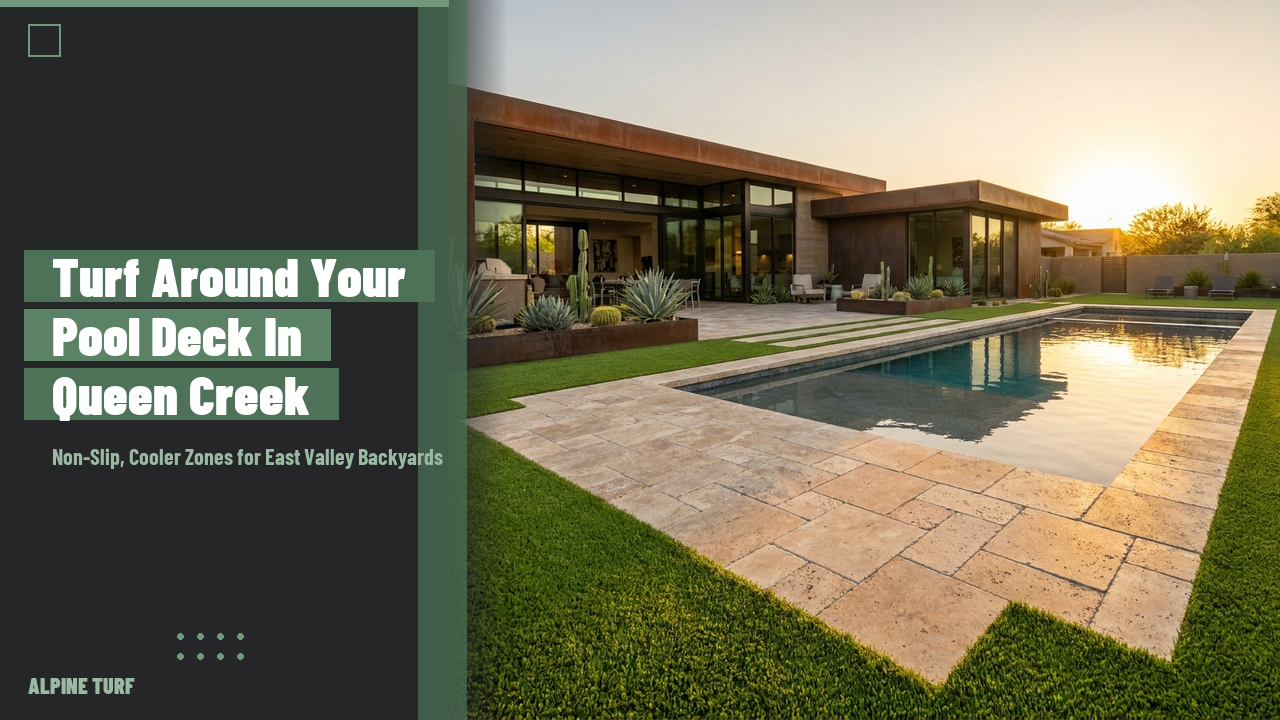
Every Queen Creek homeowner with a pool has stood on their own deck barefoot in July and regretted it. Travertine and concrete both store heat, and by mid-afternoon a full paver deck can be too hot to cross without sandals on. Turf around pool deck Queen Creek yards actually need solves a real problem: a cooler, softer, non-slip surface for the parts of the deck that don't need to be hard. The mistake most homeowners make is treating it as an either-or decision — rip out all the pavers and turf the whole deck, or keep it all hard because "turf and pools don't mix." Neither is right. The two materials solve different problems, and a deck that actually works uses both, in the right places, for the reasons below.
We've built pool decks across Hastings Farms, Meridian, Encanterra, and Harvest, and the layout question comes up on almost every one. This guide covers where pavers have to stay, how to pick turf that can handle chlorine and saltwater splash without breaking down, the base and drainage work that keeps it from becoming a swamp, and the HOA and code details specific to Queen Creek.
The problem with an all-paver pool deck in Queen Creek heat
A pool deck's job is simple on paper: give people a dry, walkable surface around the water. In practice, an all-hardscape deck in the East Valley creates three problems that don't show up until the deck's been in the ground a summer or two. First, heat. Dense materials like concrete and darker travertine tones absorb and hold radiant heat through the afternoon, and Queen Creek's ambient summer temperatures push deck surfaces well past comfortable barefoot range by early afternoon. Second, glare. A large expanse of light-colored hardscape next to a pool bounces a lot of reflected sun, which is a real comfort issue for anyone lounging poolside without shade. Third, cost and drainage complexity — extending pavers across the entire deck footprint, including areas that only see foot traffic a few times a week, is paying for a hard, expensive surface where a softer one would do the job better and cheaper.
The instinct to solve this by going the other direction — turf everywhere, right up to the coping — creates a different problem. Pool splash and backwash keep the material saturated near the water's edge, and turf that stays damp against a hard coping edge doesn't drain and dry the way it does out in the open yard. That's where algae and mildew show up first on a poorly planned deck, right along the seam between the coping and the turf.
Where pavers still belong around the water
The pool coping itself — the cap material right at the water's edge that people grip and stand on getting in and out — has to be a rigid, non-absorbent material. That's not a design preference, it's how coping is built and anchored, and it's the one part of the deck where turf was never a real option. Past the coping, we recommend keeping the first 3 to 5 feet of deck in hard material as well. That's the splash zone: the strip that takes direct wet-foot traffic and pool spray every time someone gets in or out, and it needs a surface that sheds water fast and doesn't hold moisture against a seam.
Travertine is the material we install most in this zone across Queen Creek — it stays noticeably cooler underfoot than concrete or darker pavers, which is the actual point of a good pool deck material choice, not turf. If you're weighing paver options for that hard perimeter, our travertine pavers cost and heat guide breaks down why it outperforms concrete and darker stone specifically around water.
Past that 3 to 5 foot hard perimeter, that's where turf takes over — the lounge zone, the transition to the rest of the yard, and any area where people are sitting in chairs or standing dry rather than walking wet out of the pool.
Turf around pool deck Queen Creek layouts that actually work
The most common layout we install is a simple hard perimeter with a turf field beyond it — travertine coping and splash zone, then a clean line where turf picks up and runs to the property's side yard or existing landscape beds. It's the lowest-maintenance option and reads as intentional rather than patched together, especially with a border row of pavers set flush at the transition to hide the edge.
A second layout we see a lot in newer Queen Creek communities is a checkerboard or ribbon pattern — alternating turf and paver squares or strips running perpendicular to the pool, usually in a secondary lounge area off to the side of the main deck rather than directly against the water. It reads as more custom and works well when there's a covered patio or ramada nearby, since the pattern gives the eye something to follow between the two structures. It's a more labor-intensive install — more edge restraint, more cut pavers — so expect it to run a meaningful premium over the straight perimeter-and-field layout.
A third layout, common on larger Queen Creek lots in communities like Harvest and Encanterra, uses turf to connect the pool deck to a separate function — a putting green, a dog run set back from the water, or a fire pit seating area — so the pool deck doesn't read as an isolated hardscape island in the middle of the yard. This is where the "full landscape install" conversation matters more than the pool deck conversation alone: the turf around the deck should tie visually and functionally into whatever else is happening in the backyard, not stop dead at an arbitrary line.
Whichever layout you're leaning toward, avoid two mistakes we see on DIY and lowball jobs. The first is a turf edge that dead-ends directly at the coping with no paver buffer at all — it looks fine for a season and then shows algae staining at the seam. The second is turf that's graded flat instead of sloped away from the pool — every inch of turf within 10 feet of the water needs a grade that pushes splash and rinse water away from the pool, not toward it, which matters even more given how much backwash and rinse water a Queen Creek pool sees during a normal summer.
Choosing turf that can actually handle a pool environment
Not every turf product sold in the East Valley is built for pool-adjacent installation, and this is the spec sheet detail most homeowners never think to ask about. Three things matter more here than they do on a standard backyard lawn.
Backing. Specify polyurethane-backed turf, not latex. Latex backing and the adhesives used to seam it break down faster under repeated chlorine or saltwater exposure than polyurethane does — most AZ backyard pools run a saltwater chlorination system rather than tablet chlorine, and that salt splash is just as hard on a cheap backing over time. This is one spec worth paying up for specifically in the pool zone, even if you're using a lower grade elsewhere in the yard.
Infill. Stick to silica sand or a cooling acrylic-coated sand in any turf area within regular splash range of the pool. Skip zeolite and antimicrobial pet infill here — they're built to absorb and break down organic waste, not pool chemistry, and they don't add anything in a zone that isn't a pet area. If the same lawn continues past the pool zone into a dog run or general yard, it's fine to switch infill types at that point.
Heat management. Be honest with yourself about the temperature trade-off. Turf infilled with standard silica sand can run as hot as, or hotter than, a light travertine deck in direct summer sun — the comfort win of turf near a pool is mainly about the non-slip, cushioned surface and the visual break from hardscape, not a guaranteed drop in surface temperature. If keeping the lounge area cooler underfoot is the priority, spec a cooling infill or plan for shade — a pergola or shade sail over the turf lounge zone does more for comfort than the turf choice alone.
Base prep and drainage for a pool-adjacent lawn
Base and drainage work the same way here as on any East Valley turf install, with one addition: grade. A standard residential lawn needs 3 to 4 inches of compacted crushed base — commonly class II road base — tamped in lifts with a plate compactor, and a lot of Queen Creek lots sit on caliche, the cemented calcium-carbonate hardpan layer that has to be broken through rather than built on top of. Our caliche landscaping playbook covers that excavation problem in detail if you haven't dealt with it before.
The addition for a pool deck is intentional grading away from the water. Every section of turf within roughly 10 feet of the pool should be graded with a slight fall away from the coping, not toward it, so splash and backwash run off into the yard's normal drainage path instead of pooling against the hard-to-turf transition seam. On a sloped lot, this sometimes means the pool-zone turf needs its own small grading plan independent of the rest of the yard's drainage, which is a detail worth confirming with whoever's doing the install rather than assuming it'll be handled automatically. If your whole lot has a grading or slope challenge beyond the pool zone, our turf on slopes grading and anchoring guide goes deeper on anchoring turf on grade generally.
HOA and code considerations for Queen Creek pool decks
Most of Queen Creek's newer master-planned communities — Hastings Farms, Meridian, Encanterra, Harvest — have design review committees that approve exterior changes including pool deck remodels, and turf specifications are almost always part of that review: blade height, color, and whether seams are visible from a neighboring yard or the street. Arizona state law (SB 1016, 2023) prevents an HOA from banning artificial turf outright, but committees can and do regulate its appearance, so submit your turf and paver layout for approval before the deck comes out, not after materials are on-site.
Separately from HOA design review, if a pool deck remodel touches your existing fence line, gate, or barrier in any way, confirm it still meets the town's pool barrier requirements. Queen Creek requires a continuous barrier at least five feet high around the pool, with a self-closing, self-latching gate, per the Town of Queen Creek's pool barrier ordinance. A remodel that shifts a gate location or adds a new deck section adjacent to the fence line is a reasonable time to have that barrier re-inspected, since it's the one code item that actually gets enforced at resale.
What a full pool deck remodel looks like with Alpine Turf
We're a full landscape installer, not a turf-only crew, which matters specifically for pool deck work because the paver perimeter, the turf field, the grading, and often the surrounding plant beds or shade structure all need to be planned as one project rather than three separate vendors guessing at each other's edges. A deck where the paver contractor and the turf installer never talked to each other is how you end up with a seam that doesn't drain right.
- A free on-site design consult that plans the paver perimeter and turf field together, not as separate bids
- Polyurethane-backed, pool-appropriate turf specified by name, with infill matched to the zone (pool-safe near the water, pet or standard infill past it)
- A written grading plan for the pool-adjacent turf before excavation starts
- HOA-ready design documentation for Queen Creek communities that require design review approval before work begins
If you're still working out the rest of the backyard around the pool, our Queen Creek backyard guide covers how a full remodel comes together beyond just the pool deck, and if the deck is part of a brand-new build, our Meridian design-review guide walks through what a builder-grade Queen Creek lot needs before the pool even goes in.
Frequently asked questions
Can turf go right up to the pool coping?
We don't recommend it. Keep the first 3 to 5 feet off the water in a hard material like travertine or concrete. That splash zone takes direct wet-foot traffic and pool spray every time someone gets in or out, and turf that stays damp against the coping edge doesn't dry fast enough, which is where algae and staining show up first on a poorly planned deck.
Is turf actually cooler than pavers around a pool?
Not automatically. Turf with standard silica infill can run as hot as, or hotter than, a light-colored travertine deck in direct summer sun. The real benefit of turf near a pool is the non-slip, cushioned surface and softer look, not a guaranteed temperature drop. If cooler surface temperature is the priority, spec a cooling acrylic-coated infill or add shade over the turf lounge area.
Does pool chlorine or saltwater damage artificial turf?
Standard splash exposure is fine with the right product, but backing quality matters. Polyurethane-backed turf holds up to chlorine and saltwater-system splash noticeably better than latex-backed turf, where the backing and seam adhesive break down faster under repeated chemical exposure. If turf is going anywhere near regular pool splash, specify polyurethane backing rather than accepting whatever's cheapest.
What infill should be used for turf near a pool?
Silica sand or a cooling acrylic-coated sand, kept to any zone within regular splash range of the water. Skip zeolite and antimicrobial pet infill in the pool zone specifically — they're formulated to absorb and break down pet waste, not pool chemistry, and don't add any benefit there. If the same lawn continues into a separate dog run away from the pool, switching infill types at that transition is fine.
Will my Queen Creek HOA approve turf around a pool deck?
Most likely yes, but plan to submit it for design review first. Arizona state law prevents an HOA from banning artificial turf outright, but Queen Creek's master-planned community design review committees still regulate appearance details like blade height, color, and seam visibility. Submit your turf and paver layout for approval before materials arrive on-site rather than after.
Does a pool deck remodel affect my pool barrier requirements?
It can, if the remodel touches your fence line or gate location. Queen Creek requires a continuous barrier at least five feet high around a pool with a self-closing, self-latching gate. A deck remodel that shifts hardscape near the fence line is a reasonable time to confirm the barrier still meets town code, since it's commonly checked at resale.
Keep reading.
Ready to ditch the grass?
We install premium artificial turf across the East Valley: Gilbert, Chandler, Mesa, Queen Creek, San Tan Valley. Free on-site measure and quote, no obligation.
Book your free quote