
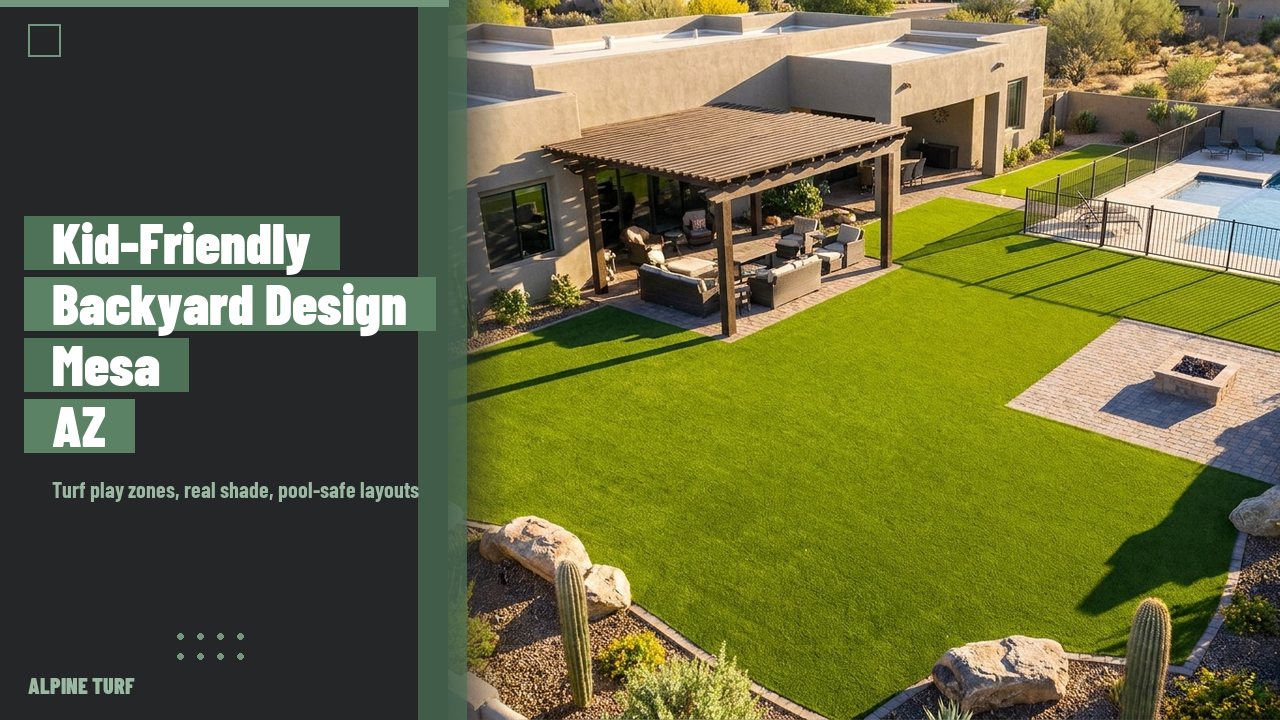
Most Mesa backyards aren't built for kids. They're built for a builder's photo, or for whoever owned the house before you cared about a play structure, a pool gate, or where a five-year-old is going to be running full speed at 4pm in July. We see the same pattern on new-construction lots in Eastmark and Cadence at Gateway and on established lots in Las Sendas and Augusta Ranch: a patio, a pool if there is one, and dirt or gravel filling in everything else. The dirt part is what parents actually complain about, because it's the part where nobody wants to sit and nobody wants their kid playing.
A kid-friendly backyard in Mesa isn't a product you buy, it's a layout. Turf, shade, and pool safety have to work together as a system, or you end up with an expensive yard that still doesn't get used between May and September, which in Mesa is most of the year. This is the zone-by-zone version of how we actually plan these installs, including the parts homeowners usually don't think about until the yard is already poured.
Kid friendly backyard design Mesa families can build: start with the zones
The most common mistake we see is homeowners shopping for individual pieces before they've decided how the yard is organized. A swing set gets ordered, a shade sail gets picked out at a home store, turf gets quoted for whatever square footage is left over. None of it talks to the other pieces, and you end up with a play structure baking in full sun twelve feet from the only shade in the yard.
We plan three zones before we talk about materials at all: an active play zone (turf, cushioned, away from hard edges), a shaded gathering zone (where the adults actually sit and can see the whole yard), and a pool perimeter that reads as physically separate from the other two. On a standard 6,000 to 8,000 square foot Mesa lot, that's usually a 40/30/30 split depending on whether there's a pool. The active play zone goes wherever it gets the most afternoon shade naturally, not wherever there happens to be leftover space after the patio and pool are accounted for.
Sightlines matter as much as square footage. Parents want to watch the play zone and the pool at the same time from the kitchen window or the patio, without a pergola post or a block wall blocking the view. We walk the lot from where an adult will actually be standing, not from the plan sheet, before we finalize where anything goes.
Turf as the play surface: heat, cushion, and what it isn't rated for
Turf is the right surface for a kid's play zone in Mesa because it drains fast, doesn't grow goathead stickers, and doesn't turn to mud during monsoon. But two things get misunderstood constantly: surface temperature and fall protection.
On temperature, direct-sun turf in Mesa routinely reaches 150°F to 170°F on a 105°F July afternoon, hot enough to burn bare feet in seconds. The single biggest lever on that number isn't the blade itself, it's the infill. Crumb rubber infill runs hotter than the turf around it and can carry an odor in heat, so we don't recommend it for kid zones at all. A silica or zeolite-based infill, sometimes sold under names like T°Cool, can knock 30°F to 40°F off peak surface temperature compared to a standard sand infill. Combined with shade over at least part of the play zone, that's the difference between a yard kids use at 5pm and one that just looks good in photos.
For cushioning underfoot during normal running and falling, a higher face weight (we spec 70 to 90 ounces for kid zones versus 50 to 60 for a standard lawn) and a pile height around 1.5 to 1.75 inches gives a noticeably softer feel than a thin, low-pile lawn turf, while still draining at the rate Mesa's monsoon storms need. What turf at that spec is not, is a certified fall-protection surface. The Consumer Product Safety Commission's playground surfacing guidance calls for impact-attenuating material, typically engineered wood fiber, rubber tile, or poured rubber, under any structure with a fall height over roughly 2 feet, sized to the fall zone around the equipment. If a swing set or climbing structure is going into the play zone, that footprint needs its own certified surfacing under and around it, with turf running up to the edge of that zone rather than under the equipment itself.
Shade is not optional in Mesa
Mesa runs 105°F to 115°F for most of June through August, and turf or not, an unshaded yard doesn't get used during daylight hours in summer. Three structures come up in almost every family backyard consult, and they perform differently enough that the choice matters:
Ramadas give full, permanent coverage and hold up best to Mesa's occasional monsoon outflow winds, which can hit 50 to 60 mph gusts several times a season. They're the most substantial structure and the most involved to build, since footings have to go through caliche.
Steel pergolas give partial, dappled shade and handle wind better than wood, which tends to check and loosen at the joints after a few Arizona summers. A steel frame with a louvered or shade-cloth top over the seating area, extended to cover the near edge of the play zone, is the setup we install most often for families because it shades two zones with one structure.
Shade sails are the least expensive option and the least durable for full-time use here. A sail rated for shade only, not wind load, has to come down before monsoon season or it becomes a liability in a 50 mph gust. If you want a sail, it needs to be engineered and anchored for Arizona wind loads, not the standard hardware-store version, or plan on taking it down and putting it back up twice a year.
Positioning matters more than the structure type. We put the primary shade structure over the seam between the patio and the play zone whenever the lot allows it, so it covers seating and the edge of where kids actually play, instead of shading an empty stretch of lawn that nobody's standing on.
Pool safety comes first, not last
If the yard has a pool, or will have one, the layout gets built around Arizona's pool barrier law before anything else gets placed. Arizona Revised Statutes §36-1681 requires an enclosure around the pool at least 5 feet tall, with a self-closing, self-latching gate positioned so the release mechanism is out of reach of small children. Mesa enforces this at final inspection when a pool permit is pulled, and it's not something an HOA can waive or a homeowner can skip by claiming the whole yard is fenced.
What that means for a kid-friendly layout: the play zone should sit on the opposite side of the yard from the pool gate whenever possible, or separated from the pool by a hard material transition (a paver walkway, a raised planter line) that reads as a boundary a toddler has to consciously cross, not drift across chasing a ball. Swing sets, climbing structures, and anything a kid could climb to gain extra height should never be placed within reach of the pool fence line, since a determined 6-year-old treats a play structure as a ladder over a barrier just as easily as over a wall.
We also see this get missed on retrofits: a family adds a play structure years after the pool went in, without re-checking the barrier clearance, and ends up with a trampoline or slide positioned close enough to the fence that it undermines the barrier's whole purpose. If you're adding play features to a yard that already has a pool, treat it as a barrier-compliance question first, not just a placement question. Arizona's pool barrier statute is public on azleg.gov and worth reading in full before you finalize a layout, especially the gate and door-alarm provisions that apply if the house has direct pool access.
If you're combining a turf play zone with a paver pool deck, the transition details (grading, edge material, how close turf can safely run to the coping) are their own set of decisions. Our turf around the pool deck guide covers that layout in more depth if a pool is already part of the plan.
Materials and edges: what to avoid within reach of running kids
A yard can have all the right zones and still hurt someone on the details. The edges are where that happens. Exposed paver or travertine edges bordering the turf play zone should be bullnosed or rounded, not left with a sharp factory cut, since a kid running full speed and catching a toe on turf-to-paver transition is a real and common way these injuries happen. We avoid raised decorative gravel borders around play zones entirely; a loose rock border at ankle height is a tripping hazard that a flush, buried steel or aluminum edge solves without giving anything up visually.
Wood posts on pergolas and ramadas near a play zone should be wrapped or finished so there's no exposed splintering surface at kid height, particularly at the base where irrigation overspray keeps the wood damp and accelerates splitting. Metal furniture, fire pit surrounds, and any dark hardscape near the play zone will be too hot to touch bare-handed for a meaningful part of the day in summer; keep those materials in the shaded gathering zone rather than the sun-exposed play zone.
None of this is exotic. It's mostly about not treating the play zone as an afterthought once the "real" hardscape decisions are made. Our installer vetting checklist has a section specifically on backing, edging, and base material questions worth asking before you sign with anyone, kid-focused yard or not.
What Mesa neighborhoods and lots actually need
The right plan changes depending on whether you're working with a blank dirt lot or an established yard with mature landscaping already in place. New-construction communities like Eastmark and Cadence at Gateway hand over a builder-grade dirt pad, which means you're zoning from scratch with no existing trees, structures, or drainage patterns to work around. That's actually the easier version of this project, since nothing has to be demolished or rerouted first.
Established communities like Las Sendas, Augusta Ranch, and Red Mountain Ranch more often have a Pebble-Tec pool and mature shade trees already in the yard, which means the play zone and shade structure have to be fit around what's already there rather than planned from a blank sheet. Existing trees are worth keeping for shade if they're healthy, but their root systems change how turf base gets excavated near them.
Across almost all of these, caliche shows up 8 to 18 inches below grade. It's a cemented calcium-carbonate hardpan layer that standard hand tools don't get through; it needs a breaker attachment or jackhammer, not just a shovel. This matters for two things in a kid-friendly build: the turf base needs to be excavated to full depth through the caliche for proper drainage during monsoon (a shallow base that sits on top of caliche will pond water after a summer storm, right where kids are playing), and any ramada or pergola footing needs to be drilled or broken through it too, not just poured on top. Skipping this step is the single most common reason a shade structure works loose or a play zone floods within a year or two of install.
Phasing the project without leaving hazards mid-build
Few families do the whole yard at once, and that's fine as long as the phasing order doesn't create a hazard partway through. If a pool is part of the plan, the barrier and gate go in with the pool, full stop, before any other feature, even if the rest of the yard is still dirt. After that, we sequence turf base and play zone next, since an unfinished dirt yard around a finished pool is its own safety problem (loose rock and uneven ground right next to open water). Shade structures come after the play zone is graded and based, since footing locations sometimes shift once the actual play zone boundary is staked out on the ground rather than on paper. Decorative elements, borders, and anything purely cosmetic go last.
What we tell families who are phasing this over a year or two: don't leave a play zone half-graded with exposed base rock over a summer, and don't leave a pool without its permanent barrier "temporarily" while you save up for the rest. Those are the two phasing shortcuts that turn into the actual incidents.
Frequently asked questions
What's the safest artificial turf for kids to play on in Mesa heat?
Look for a 70 to 90 ounce face weight with a 1.5 to 1.75 inch pile height, paired with a zeolite or silica-based cooling infill rather than crumb rubber. That combination gives a cushioned feel underfoot and can bring peak surface temperature down 30°F to 40°F compared to standard sand-infilled turf in direct sun.
Do I still need a pool fence if the whole yard is turf?
Yes. Arizona's pool barrier law (ARS §36-1681) requires a dedicated barrier at least 5 feet tall with a self-closing, self-latching gate around the pool itself, regardless of what surface covers the rest of the yard. Turf doesn't satisfy the barrier requirement, and Mesa inspects this separately at final on any permitted pool.
How close can a turf play area be to a pool in Mesa?
There's no fixed distance in code beyond the barrier itself, but we design the play zone on the opposite side of the yard from the pool gate whenever the lot allows it, with a hard material transition (paver path, planter line) between the two zones so it reads as a clear boundary rather than open turf running straight into the pool area.
What shade structure works best over a kids' play zone in Mesa?
A steel pergola positioned over the seam between the patio and the play zone is what we install most often for families, since it shades both the seating area and part of the play zone with one structure and holds up to Mesa's monsoon wind gusts better than wood. A full ramada gives more total coverage if the budget and lot size support it. Shade sails need to be engineered for Arizona wind loads or taken down seasonally.
Will a swing set or play structure damage the turf underneath it?
Turf isn't rated as fall-protection surfacing for structures over about 2 feet of fall height, so we don't recommend placing a swing set or climbing structure directly on turf. Instead we carve out a dedicated footprint with CPSC-compliant surfacing (engineered wood fiber or rubber) for the equipment, with turf running up to the edge of that zone.
Does HOA approval cover play structures and shade sails, not just turf?
Most East Valley HOAs review turf separately from structures, and a shade sail, pergola, or play structure typically needs its own architectural review submission with height, setback, and sometimes color specs. Submit the full layout together rather than piecemeal so the review board sees how the zones relate to each other, not just the turf square footage.
Keep reading.
Ready to ditch the grass?
We install premium artificial turf across the East Valley: Gilbert, Chandler, Mesa, Queen Creek, San Tan Valley. Free on-site measure and quote, no obligation.
Book your free quote